How Do Mortgages Work? Payments, Interest & Payoff Math

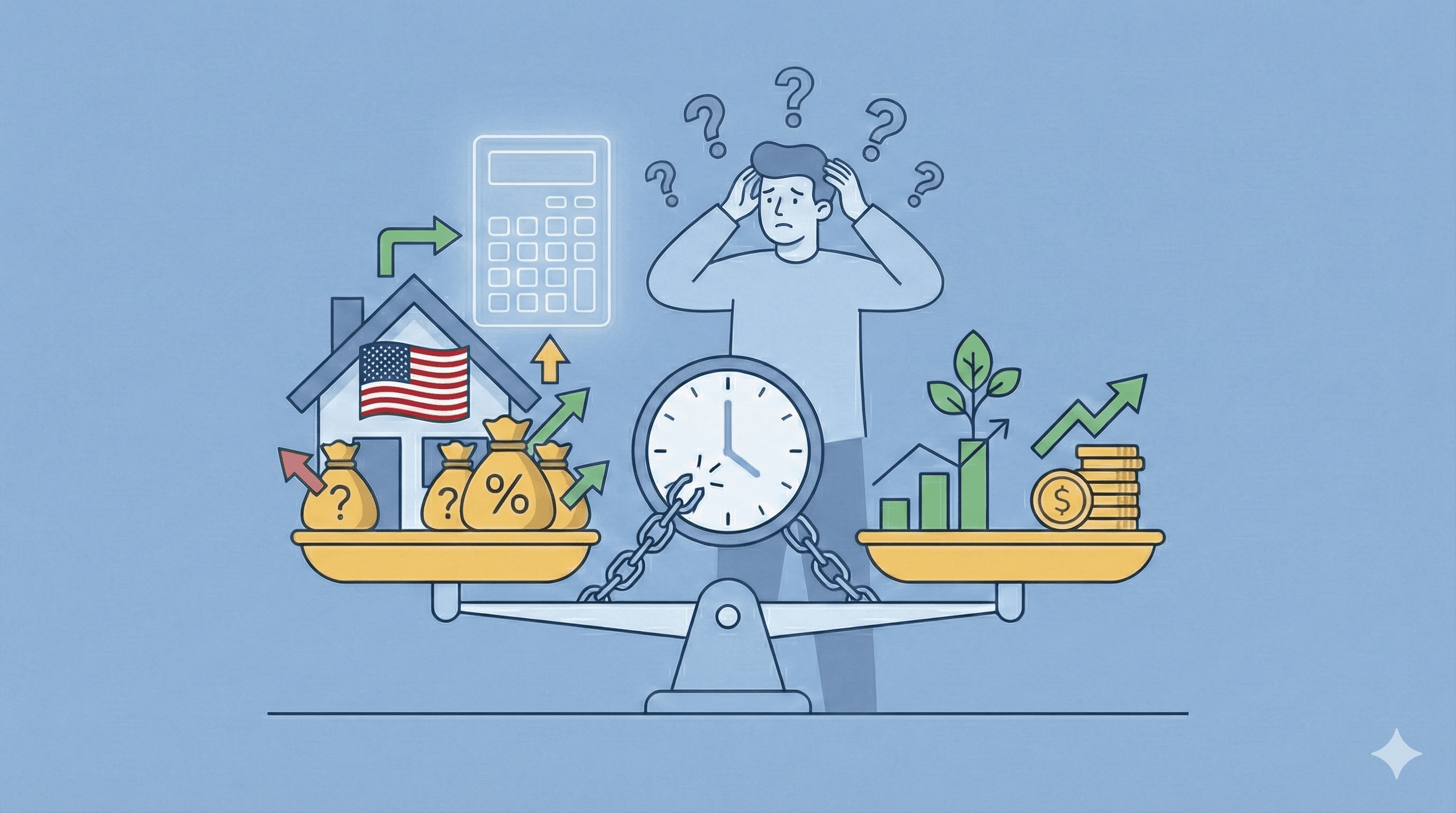
A mortgage is the biggest financial commitment most of us will ever make. How much do you actually know about yours?
Did you make your mortgage payment this month?
Good. Now — do you know how much of it actually went toward paying off your home?
No, seriously. Take a guess. Fifty percent? Seventy? All of it?
...
My story — and maybe yours too
I went through this myself a few years back and ran into a lot of surprises.
Maybe you've wondered the same things:
- How does this actually work?
- Should I go with 15 years or 30?
- What are extra payments and do they help?
- What's APR and why should I care?
- Can I refinance, and when does it make sense?
If you're in a similar spot — or just getting started with homeownership — this article is for you. It does assume you've already settled the question that comes before it; if you haven't, the rent vs buy calculator answers whether a mortgage is even the cheaper way to house yourself in your market.
Where Does Your Money Actually Go?
Let me ask you something.
When you pay $2,400 this month — how much of that reduces your debt?
Most people think: "Well, $2,400. That's the whole payment."
Unfortunately, wrong.
Every mortgage payment has two parts:
- Interest — what the bank charges you for borrowing their money
- Principal — what actually reduces your loan balance
And here's the gut punch:
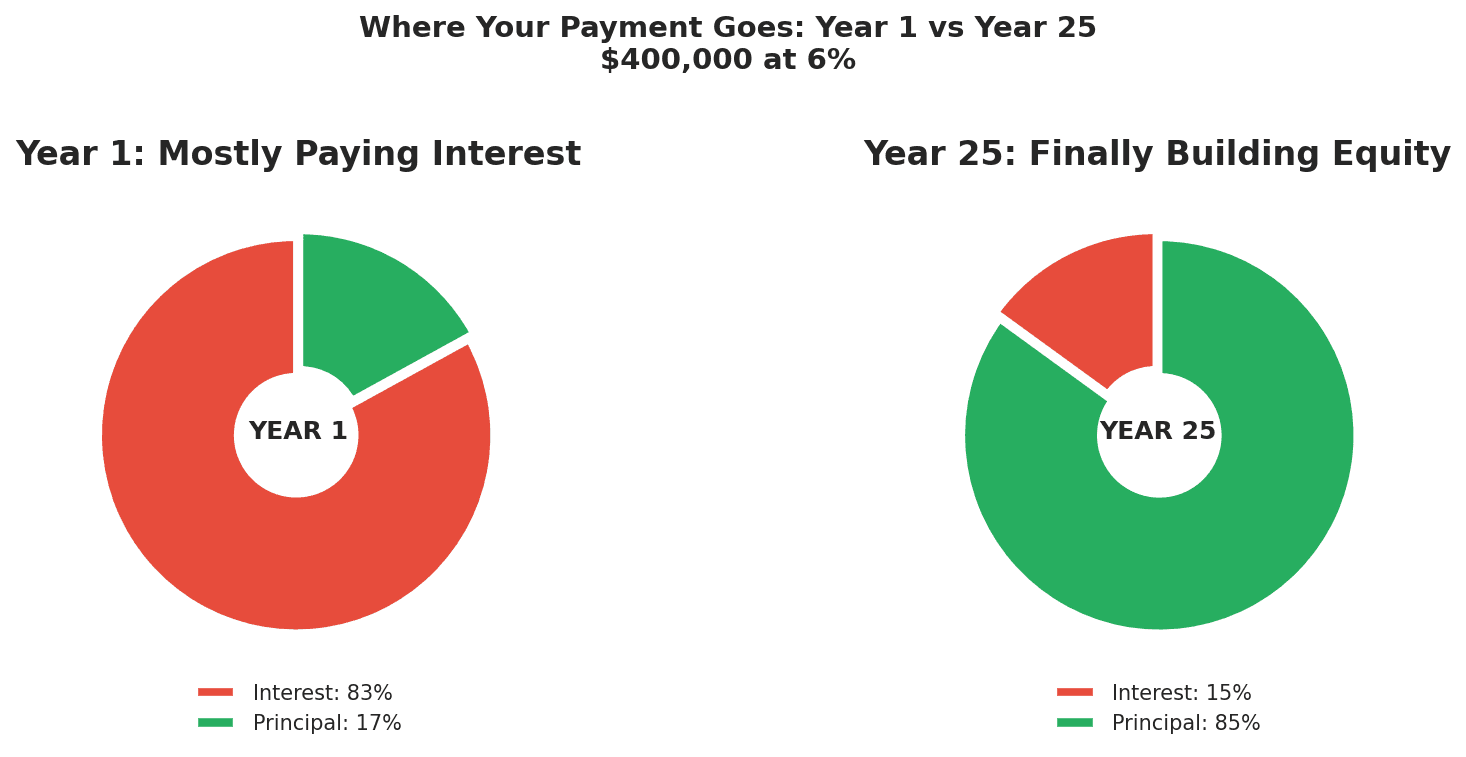
| Year of Mortgage | Goes to the Bank | Goes to Your Home |
|---|---|---|
| Year 1 | ~83% | ~17% |
| Year 10 | ~60% | ~40% |
| Year 25 | ~15% | ~85% |
Wait. What?
For the first decade, you're mostly paying for the privilege of having borrowed money.
It's only toward the end of your mortgage that payments actually go toward owning your home.
Did you know this? I didn't when I got my first mortgage. And I'd bet 90% of people signing mortgage papers don't either.
"30 Years = Half the Payment" — The Biggest Myth
You've heard this advice, right?
"Go with 30 years. The payment will be half, and you'll have breathing room."
Sounds reasonable, doesn't it?
Let's look at the actual numbers. $400,000 mortgage at current rates (~6.16% for 30-year, ~5.46% for 15-year).
| Term | Monthly Payment | Total Interest Paid |
|---|---|---|
| 15 years | $3,268 | $188,000 |
| 30 years | $2,441 | $479,000 |
The payment only dropped by $827. That's nowhere close to "half"...
But the total interest? Jumped by $291,000.
So here's the real question: Is that $827 monthly "savings"? Or just delayed pain that'll cost you an extra quarter million?
Tons of Strategies — But Which One Actually Works?
On Reddit, from your banker, from your mother-in-law. Everyone has a "guaranteed tip":
"Take the shortest term! Get it over with!"
"Take the longest term and invest the difference!"
"Extra payments! Every single month!"
So who's right?
Let's crunch the numbers and compare. We'll assume:
- Same mortgage — $400,000 at 6% interest
- No fees, no rate changes
Three Paths — Which One Is Yours?
Let's do the math. Same mortgage — $400,000, 6% interest rate.
Path 1: "I Want This Over With" (15 Years)
The logic is simple:
- Take a 15-year mortgage and maximize payments
- Pay it off ASAP, but carry the highest monthly burden
Path 2: "Keep Payments Low" (30 Years)
Here you take the full 30 years.
Lowest monthly payments, but you'll pay the most in total interest.
Path 3: "The 13th Payment" (30 Years + 1 Extra Payment Per Year)
This is where it gets interesting.
Take a 30-year mortgage — low payment, bank's happy.
But once a year, send one extra payment. Like you're paying 13 months instead of 12.
Heads up: this takes discipline!
What does one extra payment per year get you?
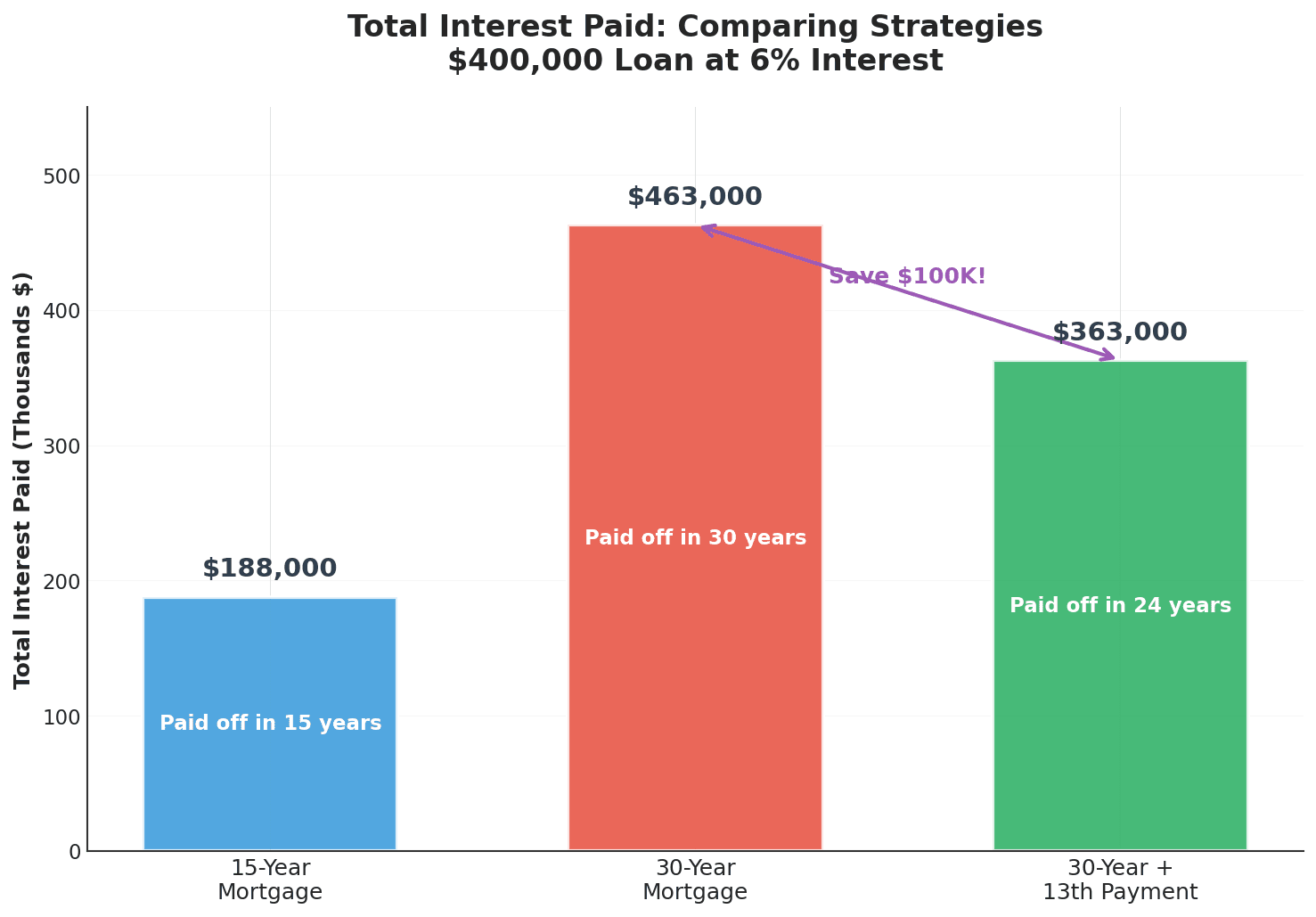
✅ Save ~$100,000+ in interest
✅ Pay off 5-6 years early
✅ Job loss or emergency? Skip the extra payment that year. No one's chasing you.
✅ One extra payment — totally achievable (tax refund, bonus, side gig income)
Comparison: What Does Each Path Cost?
| Strategy | Monthly Payment | + Yearly Extra | Paid Off In | Total Interest |
|---|---|---|---|---|
| 15 years | $3,375 | — | 15 years | $207K |
| 30 years | $2,398 | — | 30 years | $463K |
| 30 + 13th payment | $2,398 | $2,398 | ~24 years | ~$363K |
What Did I Choose?
I'm a fan of the third strategy — I love the flexibility, and so does my wife.
With the option to make extra payments, we stay flexible. Some years we might throw 5-10% extra at it, other years nothing extra at all.
How Extra Payments Work in America
We've been talking about different payoff strategies, and I've found that a lot of people don't even know this option exists! Let's break it down.
Here's the great news: In the US, prepayment penalties have largely disappeared from standard mortgages.
When Can You Make Extra Payments Without Penalty?
1. Almost Always — Thanks to Dodd-Frank
The 2010 Dodd-Frank Act changed everything. For Qualified Mortgages (which covers most conventional home loans), prepayment penalties are either banned or severely limited.
If there's a penalty at all, it can only be charged in the first 3 years — and it maxes out at 2% in year one, 1% in year three, then nothing.
2. Government Loans = Always Penalty-Free
FHA, VA, and USDA loans never have prepayment penalties. Period.
3. Most Major Lenders Don't Charge Anyway
Banks like Chase, Wells Fargo, Bank of America, and most credit unions allow extra payments anytime without fees. It's become the industry standard.
How to Do It: Log into your mortgage servicer's portal, make a payment, and specify "apply to principal." Or call and ask. That's literally it.
Pro tip: When making extra payments, always confirm they're being applied to principal, not just prepaying future payments.
"What If I Want to Refinance?"
You got your mortgage at 7%. Now you're seeing offers at 6%.
Can you do something about it?
Yes. But timing matters.
The Math Has to Work
Refinancing isn't free. Closing costs typically run 2-6% of the loan amount — that's $8,000 to $24,000 on a $400,000 mortgage.
Here's the formula:
Break-Even (months) = Closing Costs ÷ Monthly Savings
Example: $12,000 in costs, $300/month savings = 40 months to break even.
If you're selling or refinancing again before that? You lose money.
The Golden Rule: Don't Just Accept the First Offer.
- Lenders know it's cheaper to keep you than lose you
- Shopping around can save thousands
- Always get at least 3 quotes
When Refinancing Makes Sense
Old wisdom said wait for a 1 percentage point drop. Modern analysis says 0.5% to 0.75% can work on larger loans — IF you'll stay past break-even.
APR: The Number Lenders Don't Want You to Focus On
"Mortgages from 5.99%!" screams the ad.
But hold on. What does that number actually mean?
Lenders compete on advertised rates, then hit you with fees at closing.
That number in the ad? It's "just" the interest rate — the cost of borrowing. And that's under ideal conditions...
Thank god someone decided to make lenders also disclose APR, which represents the true cost of your loan.
APR = Interest + fees + points + mortgage insurance. Everything.
Always compare APR.
Real example:
| Lender | Interest Rate | APR |
|---|---|---|
| Lender A | 5.99% | 6.25% |
| Lender B | 6.09% | 6.15% ⭐ |
See that?
Lender A has the lower rate. But the higher true cost.
The Truth in Lending Act (TILA) requires this disclosure. You'll see it on your Loan Estimate (within 3 days of applying) and Closing Disclosure (at least 3 days before closing). Page 3 of the Loan Estimate, under "Comparisons."
Conclusion: Key Things About Your Mortgage
We've covered a lot of scenarios, tips, and terms. Let's recap.
1. The first decade, you're mostly paying air. That's why every percentage point matters.
2. "30 years = half the payment" is a myth. Take a few minutes and run the numbers yourself.
3. Refinancing works. Just make sure you'll stay past break-even.
4. Compare APR, not the rate from the advertisement.
Got a mortgage question? Email me at dennis.vymer@myfinancialfreedomtracker.com.
Stay Updated
Get notified about new articles and MFFT build-in-public updates.
Ready to Apply This?
Start tracking your finances today and put these tips into practice.
- Import bank statements in seconds
- AI-powered categorization
- Beautiful visualizations
- Set and track financial goals
Related posts
 Master Your Money
How to Stop Arguing About Money With Your Partner: Our Money Date Is Twenty Boring Minutes Because Nothing Is Left to Decide
Our monthly money date takes twenty minutes and it's deeply boring, and for years I thought that was because we're good at talking about money. It isn't. Half of couples avoid the conversation on purpose to keep the peace, and every article tells them to talk more. Here's the opposite case.
 Master Your Money
One Spouse Manages All the Finances in Our House. It's Me, and That's a Design Flaw.
In our house, one spouse manages all the finances, and it's me. I built the tool, I buy the ETF, I read the numbers out loud while my wife listens. That's a bus factor of one. Here's the 30-minute quarterly drill we run instead of a password folder, and why documents rot.
 Master Your Money
How to Calculate Net Worth (Formula + Worked Example)
Net worth is assets minus liabilities. What counts on each side, how to handle the house, pension and car, a worked example, and why monthly beats once.
 Master Your Money
How to Calculate Your FIRE Number (Formula + Examples)
Your FIRE number is annual retirement spending × 25, from the 4% rule. Three steps, a spending-to-target table, a worked example, and when 25× is wrong.
 Master Your Money
Job Hopping vs Staying in 2026: Both Camps Time the Market
Job hopping vs staying is market timing with a résumé: the switching premium hit a record low in January, then widened by July. I've made that mistake before.