Unexpected Inheritance? First 30 Days, Taxes & Next Steps

You get the call. A parent, grandparent, or relative has passed away. And somewhere in the paperwork, your name appears next to a dollar amount.
Maybe it's $25,000. Maybe it's $250,000. Either way, you're about to experience one of life's strangest moments: grief mixed with opportunity, and often deep confusion about what to do next.
Here's what most heirs don't realize: the next 30 days determine whether this inheritance accelerates your life or disrupts it. And 1 in 3 people spend down their entire inheritance within two years—not from necessity, but from emotional decisions made without a framework.
I'm going to walk you through every critical step from probate to taxes to family dynamics, so you make decisions from clarity instead of panic.
The Inheritance Reality Check: You Are Probably Unprepared (And That's Normal)
The Great Wealth Transfer is happening right now. Between 2025 and 2048, $124 trillion will transfer from older generations to heirs—with Gen X and millennials receiving $45.6 trillion combined. That's the largest wealth transfer in American history.
Here's the problem: 73% of millennials expect to inherit money, but 97% feel unprepared for the complexity.
You're not broken or irresponsible. You're experiencing a perfectly normal first-time situation. Most people have zero framework for navigating inheritance because it's not taught in schools and happens only a few times in a lifetime.
The stakes are real though. The financial decisions you make in the next few weeks will echo for decades through compound growth, tax consequences, and family relationships.

The First 30 Days: What to Actually Do Right Now
When someone dies, you're grieving. You're exhausted. You're making decisions at 30% cognitive capacity while dealing with real logistics.
This is not the time for complicated financial planning. This is the time for triage.
Immediate Actions (First 48 Hours)
Get death certificates. Order 10+ copies from the funeral director. You'll need these for every bank, broker, insurance company, and executor task.
Secure the property. If there's a home, ensure it's locked, utilities are on, and nothing is vandalized. If it's vacant for months during probate, that becomes expensive fast.
Locate the will or trust. This document—more than anything else—determines what happens next. It's usually with an attorney, the executor, or in a safe deposit box.
Notify key institutions. Call banks, brokers, employers, and insurance companies. Tell them the person has passed. Ask: "What happens next? What documents do you need?"
Within the First 30 Days
Meet with a probate attorney. Not optional. A good probate lawyer costs $2,000-$5,000 upfront but saves $10,000-$50,000 in mistakes and court costs. They'll clarify whether probate is necessary, how long it takes in your state, and what the executor's duties actually are.
Hire a CPA or tax specialist. An inheritance creates immediate tax questions: Is stepped-up basis available? Do I owe income tax on inherited IRAs? What about state inheritance taxes? A few hours with a tax pro costs $500-$1,500 and prevents thousands in missed deductions or surprise bills.
Don't move money. This is critical. Don't transfer inherited funds to your account, don't invest anything yet, don't pay debts or give it away. Let it sit while your team figures out the tax and legal implications. Time is your friend here.
Create a simple spreadsheet. Document every account: bank accounts, brokerage accounts, retirement accounts, real estate, vehicles, etc. Note the institution name, account number, approximate value, and whether it's probate or non-probate status. This becomes your roadmap.
Probate vs. Non-Probate Assets: Understanding What You Actually Inherit
This distinction changes everything about timing and taxes.
Probate assets go through court. A will controls them. The executor files with the court, creditors are notified, and the court oversees distribution. In Florida, this takes 6-12 months. In California, 12-24 months. In Texas, often 6-9 months with less court involvement.
Non-probate assets bypass court entirely. These include:
- Bank and brokerage accounts with "payable-on-death" (POD) or "transfer-on-death" (TOD) designations
- Life insurance proceeds
- Retirement accounts (401(k)s, IRAs, Roth IRAs)
- Property in a revocable living trust
- Jointly owned accounts
Non-probate assets transfer directly to beneficiaries, usually within weeks. Probate assets take months or years.
Why this matters for you: Non-probate assets are yours faster, but they come with specific tax rules (especially inherited retirement accounts). Probate assets take longer, but the process is structured and clear. Many people inherit a mix of both. Your attorney will sort which is which.
The Stepped-Up Basis Opportunity: A $50,000+ Tax-Planning Edge Most Heirs Miss
This is the most powerful feature of inheriting money, and 90% of heirs never optimize it.
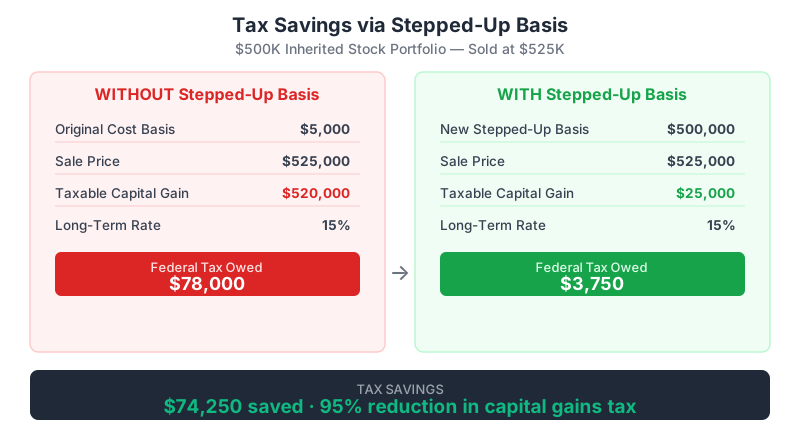
When you inherit appreciated assets, the IRS "steps up" the cost basis to the fair market value at the date of death. This eliminates all capital gains tax on appreciation that happened before you inherited.
Example: Your aunt bought Apple stock in 1995 for $5,000. At her death in 2026, it's worth $500,000. Without stepped-up basis, selling triggers $74,000+ in capital gains tax (at 15% long-term rate). With stepped-up basis, your cost basis becomes $500,000. If you sell immediately for $500,000, your capital gain is $0. The $74,000 in tax disappears.
How to Maximize Stepped-Up Basis
-
Don't sell inherited appreciated assets for at least 6-12 months. Let the step-up lock in tax-free. Only then decide whether to keep or sell.
-
For real estate: Selling within the first year means ZERO capital gains tax on appreciation before death. That's powerful compared to keeping it as a rental, where you'd pay tax on appreciation and deal with landlord obligations.
-
For stocks and funds: Use the step-up to rebalance your inherited portfolio. Sell positions you don't want without tax consequences. Reinvest in alignment with your investing strategy.
-
Watch for state taxes. Five states (Kentucky, Maryland, Nebraska, New Jersey, Pennsylvania) have state-level inheritance taxes. Spouses are exempt in all five. If you're inheriting in one of these states, plan accordingly. But for most Americans, stepped-up basis is a federal gift with minimal state complication.
Inherited Real Estate: The Decision Framework for Keeping, Selling, or Renting
Real estate is the most emotionally charged inheritance for most people. It's where money meets memory.
62% of heirs inherit or expect to inherit property. And the decision "what do I do with this house?" often gets made emotionally instead of strategically.
Option 1: Sell Immediately
Best for: You don't live near the property, it needs expensive repairs, you don't want landlord responsibility, or you want liquidity.
The math: Stepped-up basis eliminates capital gains tax on appreciation before death. You sell, pay no tax (or minimal), and have cash for investing or paying down debt. On a $400K home, expect about $370,000 net after 5-6% realtor commission.
The timeline: 30-90 days in normal market conditions.
Option 2: Rent It Out
Best for: You want passive income, property values are appreciating, local rental market is strong.
The math: $400K property renting for $2,500/month = $30,000 annual revenue. Subtract: property management (8-12% of rent), taxes ($3,000-$5,000), insurance ($1,200), maintenance (1-2% of value = $4,000-$8,000). Your net income: $10,000-$15,000/year. That's 2.5-3.75% yield. Compare to 7% stock market returns on the same $400K. Stocks win on pure math—but real estate provides tax deductions and tangible value.
The complexity: Being a landlord means tenant disputes, repair emergencies, and managing a small business. Many heirs underestimate this emotional cost.
How to Decide
-
Calculate your own housing need. Do you need to live somewhere? If yes, living in an inherited home with no mortgage is powerful. If no, keeping it for emotional reasons is an expensive choice.
-
Compare to investing inherited wealth strategically. Would you be better served taking the proceeds and investing in a diversified portfolio?
-
Assess the property's condition. Get a professional inspection. Factor in deferred maintenance costs.
-
Think about mortgage vs. investing returns. If it has a mortgage, would paying it off with inherited funds beat your investment opportunity cost? Usually no—a 3% mortgage is cheaper than your investment returns.
-
Consider liquidity. Real estate is illiquid. If you might need that money in 5 years, selling is smarter.
Inherited Retirement Accounts: The 2026 Rules That Changed Everything
When you inherit a 401(k) or IRA, the rules are dramatically different. SECURE Act 2.0 (fully in effect 2024-2026) made things more complex.
The 10-Year Rule
If the deceased wasn't yet taking required minimum distributions (RMDs), you have 10 years from death to withdraw all funds.
Why this matters: You can't leave $300K in an inherited IRA untouched. By year 10, it must be gone—either withdrawn or transferred.
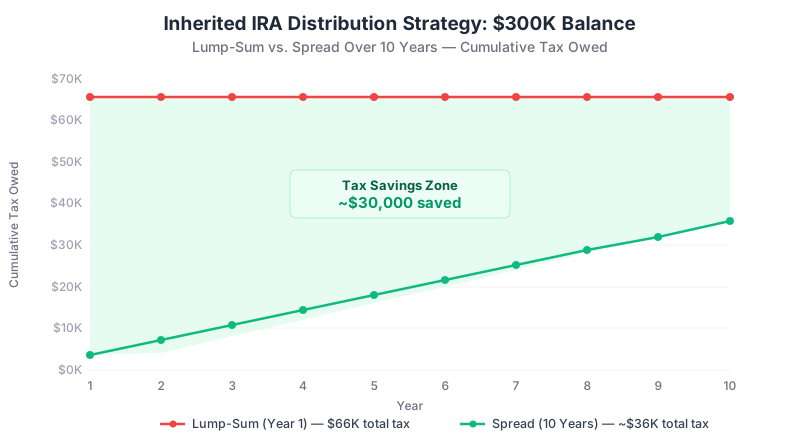
The tax consequence: All withdrawals from traditional IRAs are taxed as ordinary income. If you inherit $300K and withdraw it all in year 10, that's a $300K taxable event—potentially $66K+ in federal tax in one year.
Strategy: Spread Withdrawals Across 10 Years
Work with a CPA to optimize the distribution. Example: $300K inherited traditional IRA over 10 years:
- Years 1-5: Withdraw $18K/year
- Years 6-10: Withdraw remaining balance
This spreads the tax hit across multiple years, keeping you in lower brackets. In some years, you might Roth-convert inherited IRA funds if your income is low—locking in permanently low tax rates.
The 5-Year Rule for Roth Conversions
If you inherit traditional IRA funds, you might consider strategic Roth conversions in low-income years. This locks in tax rates permanently. Example: You inherit $300K, but your income year 3 drops to $50K (sabbatical, job transition). Convert $50K of inherited traditional IRA to Roth that year at your 12% effective tax rate. In year 10, when you withdraw everything, that $50K is permanently tax-free, saving you $7,500 in federal tax.
Roth IRAs: The Dream Inheritance
If you inherit a Roth IRA opened 5+ years ago, withdrawals are completely tax-free. A $200K Roth IRA = $200K tax-free money over 10 years.
Critical mistakes to avoid:
- Don't cash out the entire inherited IRA immediately (creates $66K+ tax in one year)
- Don't treat it like your own IRA (you can't roll inherited IRAs into your IRA)
- Don't miss the 10-year deadline
Investing Inherited Wealth Without Emotional Mistakes
Money you didn't work for feels like "play money" in a way that salary doesn't.
This is the psychological phenomenon called the "windfall fallacy." It's real, it's measurable, and it's why 1 in 3 heirs spend down their entire inheritance within 2 years.
Your brain categorizes inherited money as "found money" rather than "earned money." The psychological friction that prevents you from spending your salary is absent. So spending feels consequence-free.
Add grief, shock, and emotional overwhelm, and you get a recipe for poor decisions.
The Strategy: Automate Your "Old Life"
The most effective approach is psychological: pretend the inheritance doesn't exist.
Put it in a separate brokerage account and don't look at it for 12 months. Keep living on your old salary. Keep your old savings rate. Don't let your lifestyle expand.
After 12 months, when the newness has worn off and you've emotionally adapted, reassess. But by then, the inheritance has already been working for you in the background via compound growth. This removes emotional decision-making and automates discipline.
Inherited Debt: Understanding What You're Actually Responsible For
One of the biggest fears heirs have is inheriting debt. The good news: you usually don't.
What you are liable for:
- Estate debts are paid from estate assets before you inherit. If insolvent, creditors take losses—not heirs.
- Mortgages on inherited real property. But you also inherit the asset. The lender can only foreclose if you don't pay.
- In community property states, spouses may be liable for debts incurred during marriage.
What you are NOT liable for:
- Credit card debt (creditor claims against estate, not you personally)
- Medical debt (same as credit cards)
- Tax debt (IRS pursues estate, not individual heirs, unless you're a surviving spouse)
Protect yourself: Don't pay inherited debt from your own money. If a creditor calls, say "Send a formal claim to the executor." Let the estate process handle it.
Family Dynamics: Protecting Your Relationships
Inheritance disputes are the #1 cause of adult sibling rivalry. Unlike childhood fights, these can destroy decades-long relationships permanently.
The research is clear: inheritance conflicts aren't usually about money. They're about fairness, love, and feeling valued.
Prevention Framework
-
Communicate early. If you're the executor, over-communicate. Send quarterly updates. Be transparent about costs and timelines. Prevent suspicion by providing information.
-
Get a mediator. If conflict emerges, hire a professional mediator (not a lawyer yet—mediators cost $200-$500/hour, are faster, and preserve relationships).
-
Acknowledge emotional reality. The fairest financial split might still feel unfair if one sibling feels less loved. Address the emotion, not just the math.
-
Document everything. If the deceased left written wishes—even informal—it provides clarity and prevents disputes.
-
Remove bias from executor role. If you're executor and a major beneficiary, consider hiring a professional co-executor to eliminate perceived bias.
How Inheritance Accelerates (or Derails) Your FIRE Plan
Let's say you're 35, earning $70,000/year, on track to reach FIRE by age 55 with an $800,000 net worth target. You've been saving 15% annually ($10,500/year).
You inherit $150,000.
Scenario A: Conservative 5% return, maintain savings discipline
- $150K grows to $387K by age 55
- Ongoing savings + growth: $350K
- Total: ~$737K (still short of target)
Scenario B: Aggressive 7% return, maintain savings discipline
- $150K grows to $580K by age 55
- Ongoing savings + growth: $520K
- Total: ~$1.1 million (exceed goal by $300K; retire by 50 instead of 55)
The difference? Staying disciplined with your savings rate and letting compound growth do the work.
Here's where most heirs stumble: after inheriting $150K, lifestyle automatically upgrades. Nicer vacation. Upgraded car. Higher rent. Over 3-5 years, your savings rate drops from 15% to 8%. The inheritance doesn't accelerate FIRE—it just makes your 35-55 journey more comfortable.
The framework: Automate your old savings rate. Pretend the inheritance doesn't exist. Let compound growth work in the background. Only after 12 months, when the newness has worn off, reassess strategically.
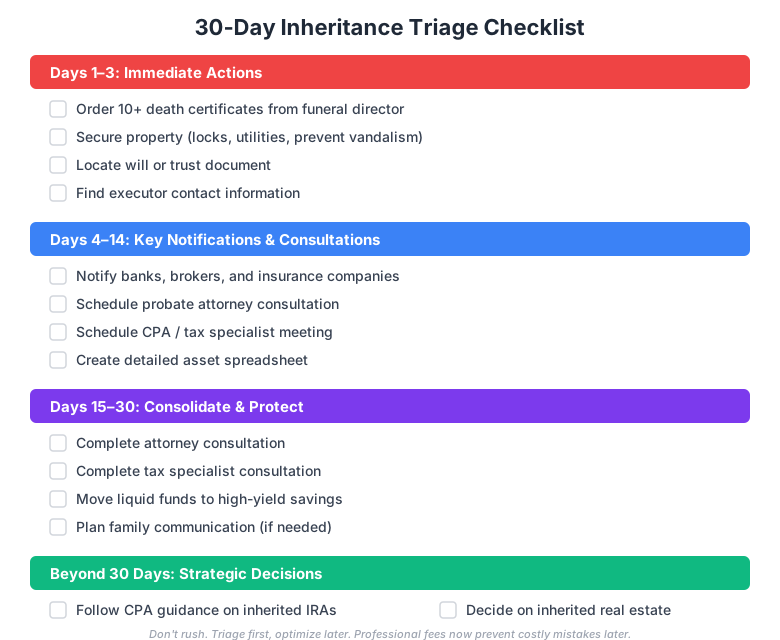
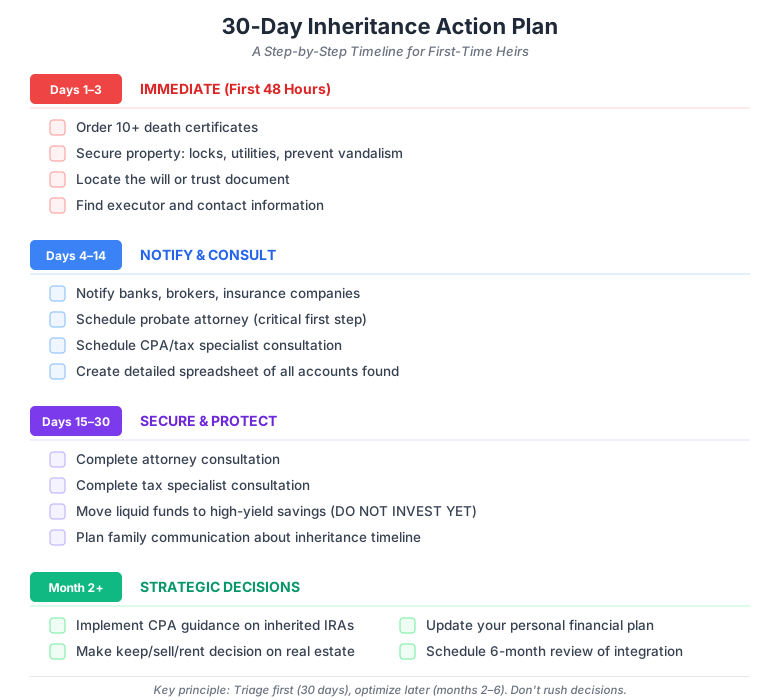
30-Day Action Checklist
Don't try to remember everything. Use this:
Days 1-3:
- Order 10+ death certificates from funeral director
- Secure property (locks, utilities)
- Locate will/trust
- Find executor contact information
Days 4-14:
- Schedule probate attorney consultation
- Schedule CPA/tax specialist consultation
- Create asset inventory spreadsheet
- Notify all financial institutions
Days 15-30:
- Complete probate attorney consultation
- Complete CPA consultation
- Move liquid funds to high-yield savings
- Pause all investment decisions
- Plan family communication if appropriate
Beyond 30 Days:
- Follow CPA guidance on inherited IRAs and distributions
- Make decision on inherited real estate
- Update your personal financial plan
- Schedule 6-month review of inheritance integration
Key Takeaways
-
Don't rush. First 30 days are triage, not investment decisions. Park money in high-yield savings while you understand tax/legal implications.
-
Assemble your team. Probate attorney and CPA aren't expenses—they're investments that prevent costly mistakes.
-
Understand stepped-up basis. Inherited appreciated assets reset cost basis to fair market value at death. This eliminates capital gains tax. Use it to rebalance without tax consequences.
-
Know the 10-year rule for inherited IRAs. All traditional inherited IRAs must be distributed within 10 years. Roth IRAs distribute tax-free. Spread withdrawals to minimize tax impact.
-
Prevent lifestyle inflation. The inheritance disappears as a benefit if you expand your lifestyle. Automate your old savings rate and let it compound.
-
Protect relationships. Communicate transparently. Use mediators for conflicts. Address emotion, not just math.
-
Integrate into your broader plan. Update your financial plan. By how many years does this accelerate FIRE?
A Note on Professional Guidance
Every situation is unique. State laws vary. Your specific circumstances matter.
This is not legal or tax advice. Consult a qualified estate attorney and a CPA. Their upfront cost ($2,000-$10,000) prevents tens of thousands in errors.
Your inherited wealth deserves expert guidance. Take advantage of the 30-day window to get it.
Stay Updated
Get notified about new articles and MFFT build-in-public updates.
Ready to Apply This?
Start tracking your finances today and put these tips into practice.
- Import bank statements in seconds
- AI-powered categorization
- Beautiful visualizations
- Set and track financial goals
Related posts
 Master Your Money
How to Stop Arguing About Money With Your Partner: Our Money Date Is Twenty Boring Minutes Because Nothing Is Left to Decide
Our monthly money date takes twenty minutes and it's deeply boring, and for years I thought that was because we're good at talking about money. It isn't. Half of couples avoid the conversation on purpose to keep the peace, and every article tells them to talk more. Here's the opposite case.
 Master Your Money
One Spouse Manages All the Finances in Our House. It's Me, and That's a Design Flaw.
In our house, one spouse manages all the finances, and it's me. I built the tool, I buy the ETF, I read the numbers out loud while my wife listens. That's a bus factor of one. Here's the 30-minute quarterly drill we run instead of a password folder, and why documents rot.
 Master Your Money
How to Calculate Net Worth (Formula + Worked Example)
Net worth is assets minus liabilities. What counts on each side, how to handle the house, pension and car, a worked example, and why monthly beats once.
 Master Your Money
How to Calculate Your FIRE Number (Formula + Examples)
Your FIRE number is annual retirement spending × 25, from the 4% rule. Three steps, a spending-to-target table, a worked example, and when 25× is wrong.
 Master Your Money
Job Hopping vs Staying in 2026: Both Camps Time the Market
Job hopping vs staying is market timing with a résumé: the switching premium hit a record low in January, then widened by July. I've made that mistake before.