Investing as a Couple With Different Risk Tolerance

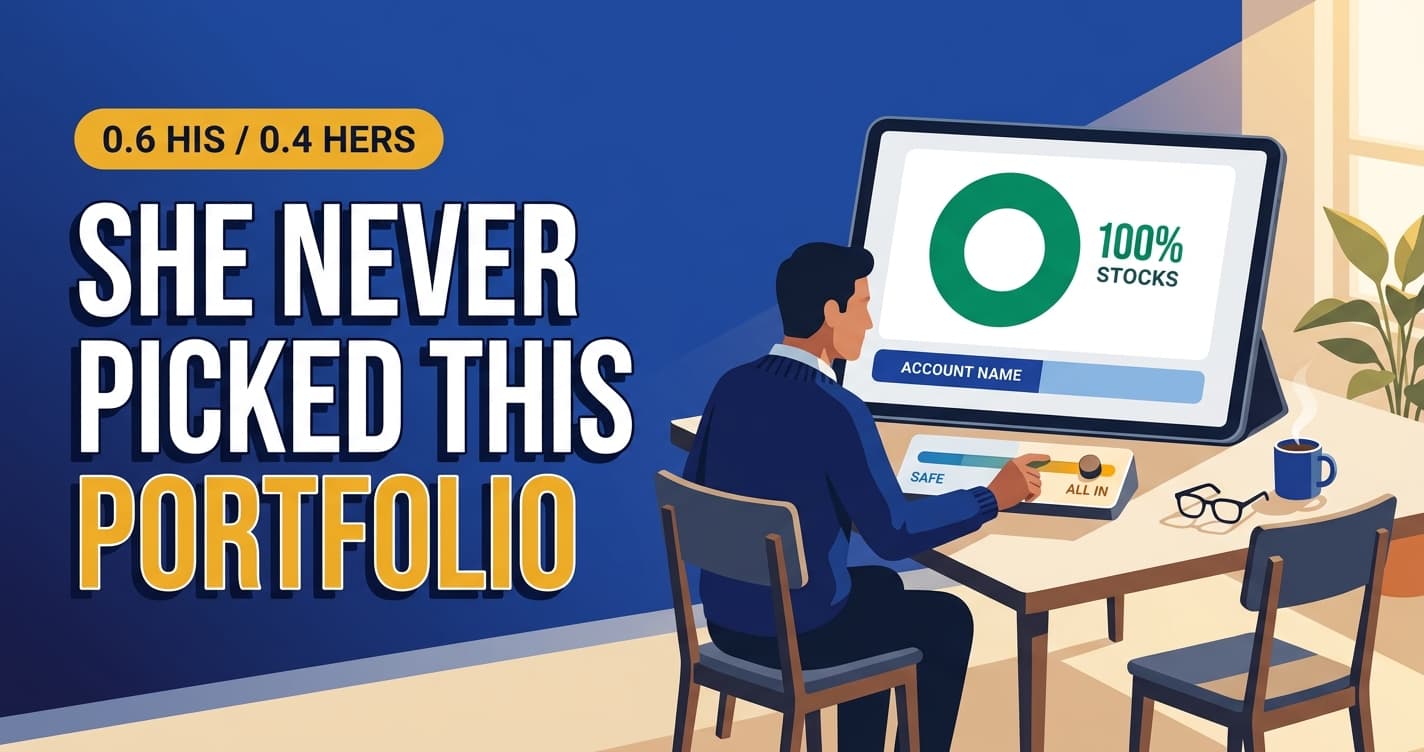
The buy order goes out on the same day every month. One all-world ETF, no bonds, no thinking.
A few weeks ago I read a paper on how households actually pick their portfolios, and it landed on me mid-sentence: half the money in that account is my wife's, and she has never chosen an asset allocation in her life. Not because she got shut out of a meeting. Because there was never a meeting.
That's what investing as a couple with different risk tolerance actually looks like in most houses, including mine. Not two people arguing over a spreadsheet. One person's plan, quietly wearing both names. I hold 100% stocks, decided years ago, and she got the same portfolio by marriage.
I'm the one who runs the money here. I've already called that a design flaw in public, and that piece was about operations: who can log in, who can pay the bills if I'm hit by a bus. This is the other half of the same problem. Not who can operate the plan. Who agreed to it.
And I want to be upfront about something, because it changed the article. I sat down to write the standard version of this. You know the one, because it is the entire first page of Google: your partner is more nervous than you, she will panic-sell at the bottom, so dial the risk down to something she can hold. I had the outline written. Then I read the research and had to throw most of it in the bin.
The panic-selling story is mostly wrong, and I've been one of the people telling it
Here is the load-bearing assumption under every article ranking for this topic: the risk-averse partner is a hazard. Left in a volatile portfolio she will crack at the worst moment and blow up a good plan, so the confident partner's job is to pre-emptively de-risk. Nobody tests it. It just sits there, doing all the work.
Three pieces of evidence say it barely happens.
In May 2026 four academics published a paper in the Financial Analysts Journal with a title that isn't shy: "Bad Timing Does Not Cost Investors 15% of Their Funds' Returns." Fulkerson, Jordan, Riley and Yan took Morningstar's own sample, the one behind the famous behaviour gap, and found that poor timing by fund investors costs about 0.10% a year. Not 1.2%. I wrote about that gap two weeks ago and treated 1.2 as an upper bound and 0.10 as a lower one, which I still think is fair. But if you were about to reorganise your household's entire portfolio around the cost of bad behaviour, you should know the honest range starts at a rounding error.
Then the client data. Vanguard went and looked at what its own retail investors did this spring, when the S&P 500 fell about 9% between 27 January and 30 March. Across that drawdown, 17% of them traded at all, and the ones who did were net buyers of equities by nearly four to one. That is a US retail client base rather than the whole world, so hold it loosely. It still isn't the mass panic finance media describes.
And the last one is the most awkward for my original outline. Guillemette and Finke ran the FinaMetrica risk-tolerance database through the 2008 crash and the recovery that followed, and Michael Kitces did the maths on what they found. The average score moved between 51 and 55 on a scale that runs 0 to 100. The whole crisis. Every 10% move in markets shifted the typical score by about 1.5%, which translates to a change in recommended equity allocation of no more than about three percentage points.
Three points. So when a couple responds to one partner's nerves by going from 100/0 to 60/40, that is a forty-point answer to a three-point problem.
The one part of the behaviour story that does survive is worth keeping, because it is specific. Morningstar sorts funds by volatility and the gap detonates.
 Data: Morningstar, "Mind the Gap 2026" (published 6 August 2026, data to 31 December 2025).
It isn't that people are stupid. It's that volatile holdings push buttons and calm ones don't. That is a real argument for holding something your household can ignore. It is not an argument that your wife is a liability.
So if she isn't going to sell, and her stated tolerance isn't going to collapse in a crash, what exactly is the problem I'm writing about?
Her preference is being weighted at 0.4, and mine at 0.6
This is the part I couldn't get out of my head.
Gu, Peng and Zhang published a paper in the Review of Financial Studies in June 2026 that stops asking couples who decides and instead reads the answer off the portfolio itself. Model the household's risk tolerance as a blend of both spouses' individual tolerances, then work backwards from what they actually own to find the weights. Whoever's preference the portfolio resembles is the person with the power. No survey, no self-report, no arguing about it.
In the average household, the weight on the husband's risk preference is about 0.6 and on the wife's about 0.4. The portfolio reflects his preference by half again as much as hers.
 Data: Gu, Peng & Zhang, Review of Financial Studies 39(6), June 2026.
Germany runs at 69/31. The United States at 61/39. Australia at 60/40. Employment, earnings and cognitive ability together explain only about half the gap. The authors attribute the rest to gender, and they're blunt about it. This is not a quirk of one country's money culture. It shows up on both sides of the Atlantic and in the southern hemisphere, and the country with the most traditional attitudes has the biggest gap.
Then the finding that has my name on it. Being designated the household's financial head carries an additional bargaining weight of roughly 0.3, beyond anything your job, income or cognitive ability explains. Not because you argued for it. Because you're the one who opens the account.
I am the financial head of this house by every definition in that paper. I built the tool. I place the order. I run the scenarios. And the research says that fact alone, independent of anything I earn or know, is doing a large share of the work in an allocation nobody voted on.
The Federal Reserve Bank of Richmond got there first, in a very dry 2017 economic brief on how couples allocate. Their summary of the model: if one spouse has all the bargaining power, the household's optimal allocation ends up exactly where the old single-decision-maker model puts it. Determined entirely by that one person's risk aversion. A household of two with a portfolio of one isn't a compromise. It's a solo portfolio with a second name on the paperwork.
The same brief found that only 43% of couples said influence over financial decisions was equal, and 37% of couples gave answers that contradicted each other about their own household. Both of them believed they were describing the same marriage.
We fight about risk more than we fight about spending
I assumed the couples-and-money problem was spending. It isn't, or at least it isn't what people report.
Scotiabank ran a Harris Poll of 934 married or partnered Canadian adults in January this year and asked what gets in the way of investing toward shared goals. Aligning on risk tolerance came first at 38%. Differences in spending and saving habits came second at 34%. Deciding whether to combine accounts was 28%.
Fidelity's 2024 Couples & Money study, which had 1,794 couples answer separately, found 47% disagree on how much investment risk they're comfortable with. The number I keep coming back to is a different one: in a quarter of couples, one person believes they are the bolder investor and their partner does not agree. A quarter of us are wrong about which of the two is the brave one.
Which means the household where nobody is arguing is not necessarily the household where everybody agreed.
The bill, and I'm not going to call it "slightly suboptimal"
Every article on this subject reaches the word "compromise" and then walks straight past the price tag. So here it is.
Vanguard publishes the range of calendar-year returns for stock and bond mixes back to 1928, updated through the end of 2025.
 Data: Vanguard, range of calendar-year returns 1928–2025 (Vanguard calculations based on Morningstar data to 31 Dec 2025).
All stocks averaged 11.8% a year and had a worst calendar year of −43.3%. Sixty-forty averaged 9.1% with a worst year of −26.9%. Every step you take toward comfort buys a smaller worst year and sells a smaller average one, and that trade is completely fair. What isn't fair is refusing to price it.
Compound those averages for thirty years and €10,000 becomes roughly €284,000 at 11.8% and roughly €136,000 at 9.1%. Moving from all stocks to 60/40 for the sake of household peace doesn't cost you a bit of return. It halves the outcome. The ratio is 2.08.
That compounding is my own arithmetic on Vanguard's published averages, not anything Vanguard forecasts, and every caveat applies: illustrative, nominal, before fees, before tax, before inflation, and a historical average is not an expected return. Vanguard's worst-year figures are calendar years rather than peak-to-trough, so real drawdowns were worse than the table shows. It illustrates a gap, it doesn't forecast your life.
It's still the right order of magnitude, and it's exactly what the genre hides behind "meet in the middle." If someone tells you consent costs almost nothing, they haven't multiplied.
Here's where I land, and I think it's defensible. Consent is worth paying for. A plan both people signed is a genuinely better object than a plan one person imposed, even at a lower expected return, because the second one is fragile in ways that don't show up until something goes wrong. But two point oh eight is a lot to pay, and the interesting question is whether you can buy the same consent cheaper. Going from 100/0 to 80/20 costs a ratio of 1.46 instead of 2.08. Splitting the money into two accounts costs nothing at all in expected return. Blending the whole household down to the most cautious number is the most expensive option on the menu, and it's the one every article recommends by default.
Percentages are useless at a kitchen table. Say the loss out loud, in money.
"Eighty-twenty" is not a thing a person can consent to. It's vocabulary.
The version anyone can answer is the same number in currency. Take what you actually own together, multiply by the worst calendar year for your mix, and say the result out loud. On a €200,000 joint portfolio, all stocks means a bad year takes about €86,600 and leaves you with €113,400. Sixty-forty takes about €53,800. That is arithmetic on the same historical table, so treat it as an illustration and not a prediction.
Then add the part everybody forgets, which is time. MSCI World index data, compiled from MSCI's own factsheets, puts the fall from October 2007 to March 2009 at about 58%, and it took roughly 53 months to get back to where it started. That's the real unit of the agreement. Not "a bad year." Four and a half years of opening the app and seeing less than you put in.
So the rehearsal question, asked on an ordinary evening while nothing whatsoever is falling: if this dropped by that number tomorrow and stayed there until our kid starts school, what would you want me to do?
That needs one honest input, which is what the household actually owns, in one place, property and forgotten accounts included. Ours lives in the tracker I build, which is my own product so weigh that accordingly, and a spreadsheet does the same job. "Our net worth falls by X" is unanswerable if neither of you can say what X is a percentage of.
Three ways of investing as a couple with different risk tolerance, and what each costs
One blended allocation, set at the more cautious number. Simplest to run, simplest to explain, and the most expensive by a distance. See the 2.08 above. It also quietly guarantees that one of you is permanently holding a portfolio you don't believe in, and that person spends thirty years mildly resenting an average.
Two accounts, one shared target. Each of you holds what you can actually hold. The household's overall allocation falls out as a by-product instead of being negotiated into existence. Morningstar's Mind the Gap 2026 leans this way harder than people expect: US stock funds, the simplest single-asset holding in the study, had the narrowest investor gap at 97% of fund return captured, while pre-blended allocation funds captured 92%. The cost is coherence. Somebody still has to decide what happens when the two sides drift apart, and "we'll deal with it later" is how you end up with two plans that never add up to one life.
Genuinely separate portfolios. Lowest friction of all, and honestly fine for some couples. But we already run one household pot with personal fun money on top, and bolting two independent strategies onto that would be solving a disagreement by agreeing not to have it.
I'll say the unpopular thing plainly. The default advice, blend everything down to whatever the nervous partner nods at, is the worst of these three and it's recommended because it's the easiest to write, not because it's the cheapest to live with.
The cautious partner can also be wrong
I don't get to write this article as if deference is automatically the virtuous choice, because there's a version of it that's just a slow loss with good manners.
Six in seven euro-area households hold no investment fund at all, on the ECB's Household Finance and Consumption Survey (Wave 2023). About €66 in every €100 of household assets here is property and about €9 is sitting in a bank account. The ECB's own read is that this comes from caution and habit rather than any calculation about returns.
So: arguing that the under-weighted preference in a household deserves a real vote is not the same as arguing that it's right. Cautious isn't automatically correct, and I'd be doing the identical lazy thing in reverse if I pretended otherwise. Six in seven households can't all have run the numbers. A deposit guarantee protects the number in the account and promises nothing whatsoever about what that number will buy in 2050.
Which is the honest shape of the whole thing. Adjust the allocation to what your household can genuinely hold, then work on the fear itself with time and evidence rather than by winning one argument on a Sunday evening. Behaviour beats maths, but behaviour is also trainable, and a permanent all-cash veto is not caution. It's a guaranteed real-terms loss dressed up as prudence.
What investing as a couple with different risk tolerance is going to cost us
I don't have a tidy ending here, because we haven't finished having this conversation.
What I know is that I've been running our portfolio at 0.6 to her 0.4 without anybody deciding that, and that a good slice of the extra weight came from being the person who opens the app rather than from being right. What I don't know is her actual number, because I've never asked her in a form she could answer. Not "are you okay with stocks," which is a question about trusting me. Something closer to: here is what we own, here is the worst year on record for this mix, here is that number in euros, here is how long it took to come back last time.
So the next monthly money date is going to be longer than twenty minutes. We're each going to answer the same risk questions separately and then compare, which is what the researchers behind that 0.6/0.4 paper actually recommend, precisely because one questionnaire filled in jointly just produces the louder person's answer with two signatures on it. And whatever comes back, the number we end up with is the number we both wrote down.
If that lands at 90/10 instead of 100/0, I'll take it. Investing as a couple with different risk tolerance was never going to be free, and losing a slice of expected return to own a plan two people actually chose seems like a fair price for a guy whose entire strategy is doing the boring thing for a decade without flinching. I got humbled once already, riding a lucky stock pick into a crypto cycle that sat me down and explained I'm not a genius. That taught me my own stated risk tolerance was a claim rather than a fact. It apparently didn't occur to me to wonder whether I'd ever checked hers.
I'll report back after we've done it. I have a feeling her number is closer to mine than I deserve.
Stay Updated
Get notified about new articles and MFFT build-in-public updates.
Ready to Apply This?
Start tracking your finances today and put these tips into practice.
- Import bank statements in seconds
- AI-powered categorization
- Beautiful visualizations
- Set and track financial goals
Related posts
 Invest Smart
VT vs VTI vs VOO: Whole World, All US, or S&P 500?
VOO is the S&P 500, VTI all of the US, VT the whole world. The real choice is how much non-US stock you want. Here's what each one holds, by the numbers.
 Invest Smart
Private Markets for Retail Investors: I Build Products for a Living, and "Democratized" Means They Ran Out of Institutions.
Private markets went retail on both sides of the Atlantic in 2026. I read the launch the way I read any launch at work: the institutional money got hard to raise first, and then I got invited.
 Invest Smart
Is Your House Part of Your Asset Allocation? Mostly, Yes
Main homes are 47% of euro-area household assets. Why your house belongs on the same page as your portfolio, and why it usually argues for more equities.
 Invest Smart
Holding Leveraged ETFs Long Term: The Maths vs the Behaviour
The issuer's own document says these funds are built for one day. The maths is arguable, the behaviour isn't. How to contain one if you hold it anyway.
 Invest Smart
Hedged vs Unhedged World ETF: Is Currency Risk Worth It?
A world ETF is about 73% US dollars. Ten years of hedging priced in euros, and when paying to remove currency risk actually makes sense.