S&P 500 Concentration Risk: 40% of Your Fund Is 10 Stocks

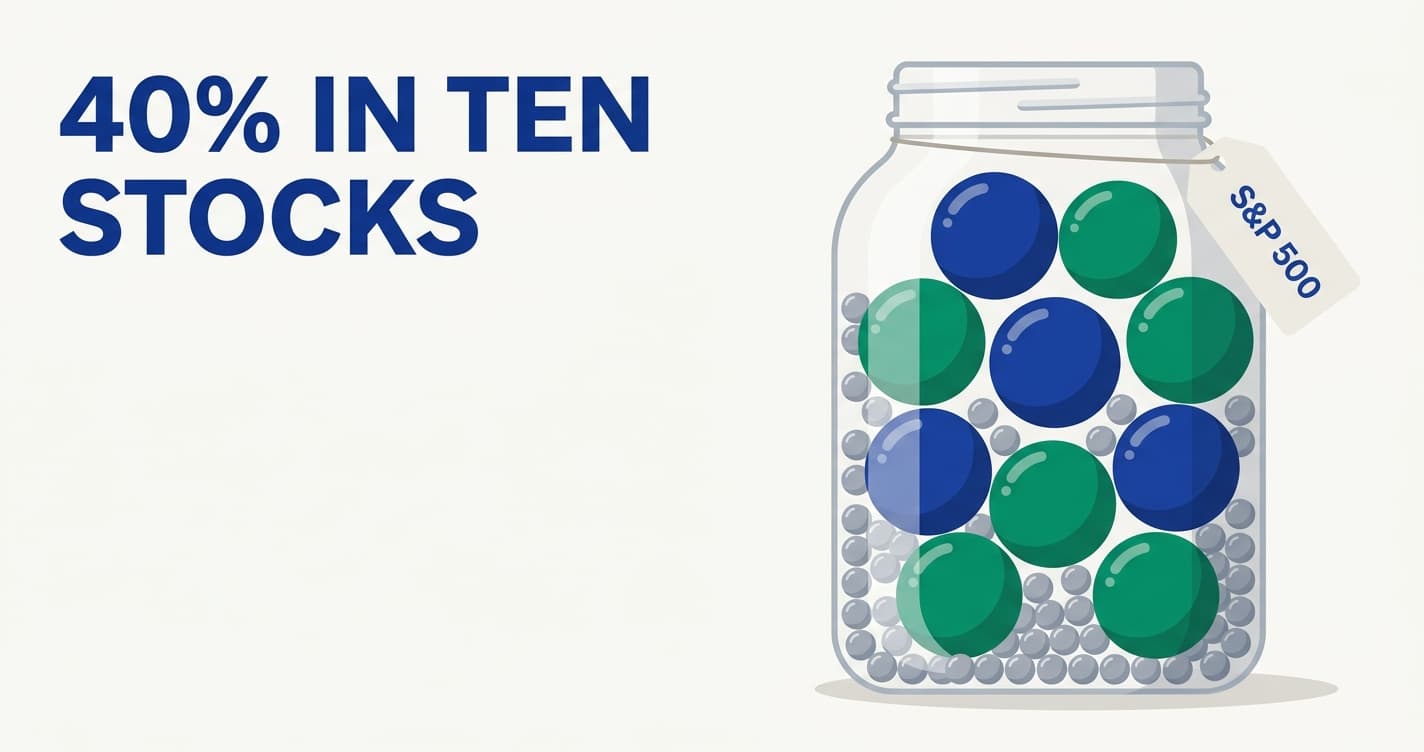
For years my advice to everyone, including myself, was three words: buy the boring index.
Autoinvest on the 1st. Don't touch it. Don't look at it. That was the whole religion. I've written it here more times than I can count, and I believed every word.
Then one evening in June I actually opened the hood on my own broad-market fund. Read the top-10 line. And felt a little stupid.
Because s&p 500 concentration risk stopped being a thing that happens to other people's portfolios. It was sitting right there in mine. At the end of 2025 the ten biggest companies in the S&P 500 hit a record of roughly 40-41% of the whole index. It's eased off a bit since. Call it 37-38% as of this summer, after some of the AI names cooled off. So when the headline says "40%," that's the record from a few months ago, not today's exact number. But honestly? High-30s is still a punch in the face.
I thought I owned 500 companies. I own about ten, and then some rounding.
I was smug about being diversified. I wasn't.
Here's the part that stung.
My whole shtick is that I'm the anti-hype guy. I don't chase the hot stock. I don't buy what the podcast bros are screaming about. I buy the plain vanilla basket and go make dinner. That's supposed to be the safe, adult, diversified choice.
And it mostly is. But somewhere along the way, "the plain vanilla basket" quietly turned into a giant bet on a handful of megacaps I never sat down and chose. Nobody sent me an email about it. There was no vote. The fund just... drifted, and I wasn't looking, because the entire point of the strategy was to not look.
The names, if you're curious: NVIDIA, Apple, Microsoft, Amazon, Alphabet, Broadcom, Meta, Tesla. Most of them riding the exact same wave: AI. When I say I own "the market," what I mostly own is that list, plus a long tail of 490 companies that barely move the needle.
So no, I didn't panic. But I did go do the math I'd been avoiding.
The number that made s&p 500 concentration risk feel real
RBC has a line about this that I can't unsee. They call it the "passive concentration trap": more than $40 of every $100 you put into an S&P 500 fund flows into just ten companies.
Read that again with your own contribution in mind.
I autoinvest a fixed amount on the 1st of every month. I'd always pictured it fanning out across 500 businesses, nice and even, like sprinkling seed on a field. It doesn't. Forty-ish of every hundred dollars lands on ten names, and the biggest slice of that lands on the biggest one.
 Data: RBC Wealth Management.
The trajectory is the wild part. Through most of 1990 to 2015 the top-10 weight sat somewhere around 18-23%. It barely budged for a quarter century. Then it more than doubled in about ten years to that 2025 record. The dot-com peak in 2000 that everybody points to as the scary one? The top ten back then were around 26%. We blew past that a while ago.
A few numbers that made it real for me:
- The Magnificent Seven alone are about 33-34% of the index right now. Seven companies, a third of the thing.
- NVIDIA by itself is around 7%. One stock. That's a bigger chunk of my "diversified" fund than my entire allocation to some whole sectors.
- Information Technology as a sector is about 33% of the S&P 500. Single biggest slice by a mile.
 Data: Slickcharts / RBC Wealth Management.
I'm not going to pretend I wasn't a little rattled. This is a lot of eggs, and the basket is a bit thinner than the brochure suggested.
How a boring fund quietly became a concentrated bet
The mechanics here aren't complicated, and understanding them is the difference between panicking and shrugging.
An S&P 500 fund is cap-weighted. That's the whole thing. It holds more of a company for one reason: the company is already big. When a stock doubles, the fund automatically holds twice as much of it. Not because a manager decided it was a great buy, but because the math forces it. Winners get bigger; the fund holds more of the winners; repeat.
Now add passive flows on top. Every month, millions of us (me included) auto-buy the index without looking at a single price tag. That money gets divided by market cap, so most of it funnels straight into the names that are already the largest. Price doesn't matter. Valuation doesn't matter. The biggest company gets the biggest share of my paycheck by default.
Torsten Slök, the chief economist over at Apollo, put it about as bluntly as a suit ever does: the S&P 500 "basically doesn't offer much diversification anymore." He even reckons that if a few of the big private AI names go public, the top ten could push toward 50%.
Here's what makes today genuinely different from old concentration eras, though. In 1990 the giants were IBM, Exxon, GE, Philip Morris. An oil company, a smoke company, a computer company, a conglomerate. They had almost nothing to do with each other. If oil tanked, tobacco didn't care.
Today the leaders are all clustered around one story: AI. So "diversified across 500 names" has quietly become "a directional bet on AI actually making money." That's not automatically bad. But it's a very different sentence from the one I was telling people. I dug into the valuation side of that AI question separately, if you want the "is this 2000 again?" deep dive, and I keep it out of this piece on purpose so we can stay focused on the plumbing: the Magnificent Seven and the AI bubble question.
Talking myself down: is the s&p 500 too concentrated, or just top-heavy?
Okay. Deep breath. Because the internet's answer to any scary chart is "SELL EVERYTHING," and that's almost always the expensive move.
So I forced myself to argue the other side. And the other side is stronger than the doom-posters admit.
These companies actually earn the money. This is the big one, and it's what separates 2026 from 2000. Back then the concentration was profitless dot-coms selling dog food at a loss. Today? Alphabet alone earned somewhere around $160 billion in a year, the most of any company on the planet. Microsoft, Apple, and NVIDIA aren't far behind. The top ten are about 38-41% of the index by value but roughly 32% of its earnings. That gap is real and worth respecting, but it's a gap, not a fantasy. The weight is running ahead of the profits, not floating on nothing.
 Data: RBC Wealth Management.
Cap-weighting cleans up after itself. The scary story is "the index buys high and sells low." It doesn't, really. When a leader falls, its weight in the fund falls with it, automatically. The index never has to actively dump it at the bottom. The weighting that got me into this also quietly gets me out on the way down. No committee, no timing, no 2 a.m. decisions.
"US index" isn't the same as "US economy." Around 40% of S&P 500 revenue comes from outside the US. So even a pile of American tickers is partly a bet on global demand, not just on whether Americans keep buying stuff.
And the boring truth about picking stocks yourself: J.P. Morgan once ran the numbers back to 1980 and found that about two-thirds of individual stocks underperformed the index, and roughly 40% suffered a permanent 70%-plus wipeout. Only about 7% became the real monster winners. Owning the cap-weighted index is how you guarantee you're holding those few monsters. Trimming the winners to feel "diversified" is, historically, trimming the exact thing you wanted to keep.
Now, the honest caveat, because I'm not here to sell you a bedtime story: high concentration has usually been followed by weaker returns down the road. Goldman Sachs is out there projecting something like 3% a year for the cap-weighted S&P 500 over the next decade, largely because it's so top-heavy. The Nifty-Fifty crowd of 1972 learned this the hard way in 1973-74. "Earnings-backed" doesn't mean "crash-proof." It means you probably won't get zero, but you might get a boring decade if you overpay going in.
Net-net for me: this is a risk to understand and manage, not an emergency to react to. If red numbers make your stomach drop, I wrote a whole thing on what to do when markets crash, and the short version is "close the app." And the longer-horizon reassurance, the reason I don't flinch at any of this, is in do stocks always go up?
How to actually check what you own (5 minutes, do it today)
Enough theory. Go pull your own numbers. This is the part that actually matters, and almost nobody does it.
You've got three easy ways:
- Your fund's own factsheet. Vanguard, iShares, whoever. Look for "portfolio composition" or "top 10 holdings." Fastest possible check.
- A free X-ray tool where you paste your tickers and it shows you what's really inside.
- Your portfolio tracker's breakdown view. This is the one that actually matters if you own more than one fund, because overlapping ETFs hide your true exposure. I got so annoyed at not being able to see my blended top-10 across everything I hold that I built the breakdown into our portfolio analysis tool. Paste your holdings, it peers inside each ETF and gives you one combined picture.
That last point is the sneaky one. If you own, say, a total-world fund and a Nasdaq fund and an S&P 500 fund, you feel diversified. You're not. NVIDIA and Apple show up in all three, and your real tech exposure can quietly hit 40%+ while you're congratulating yourself on holding "three different funds."
Write down three numbers:
- (a) top-10 weight — how much of you is ten companies
- (b) tech sector % — how much is one theme
- (c) single-largest-stock % — how much rides on one name
If you land near ~38% / ~33% / ~7%, congrats, you own the S&P 500 as it looks in mid-2026. Now at least you know.
Your calm-response menu for s&p 500 concentration risk, ranked lazy to involved
You don't have to do anything dramatic. In fact you probably shouldn't. Here's the menu, from least effort to most.
Option 1: Do nothing — on purpose. This is completely defensible. Cap-weighting self-corrects, the leaders are genuinely profitable, and doing nothing keeps your costs and taxes at rock bottom. The only rule is the one I broke: know what you hold and keep contributing. "Set and forget" is fine. "Set and never look" is what bit me. The price of this option is that you eat the full drawdown if the AI trade wobbles. If you can stomach that, do nothing and go live your life.
Option 2: Broaden the base. Small, cheap tweaks that dilute the megacap weight a little.
- Total market instead of just the S&P 500. Holding the whole US market (~3,500 stocks) instead of the top 500 sounds like a big fix. It's a small one. It only trims the top-10 from about 38% down to ~35%. Nearly identical returns. Cheap, harmless, mild.
- Add international. This one actually moves the needle away from US megacap AI, and ex-US stocks are cheaper on valuation right now. The cost is that international has lagged the US for years and you're taking a side. If you want the fund-picking details, I laid them out in the best world ETFs, and how large that side bet should be is the whole question I chewed on in US vs international stocks and the home-bias trap.
- Add small and mid-cap. Dilutes the giants, adds a size tilt, comes with more bounce.
Option 3: Bolt on an equal-weight sleeve. This is the equal weight vs cap weight s&p 500 debate you'll see everywhere. An equal-weight fund (ticker RSP is the popular one) holds all 500 names at roughly 0.2% each and rebalances quarterly. Every company matters the same, whether it's NVIDIA or some sleepy industrial.
And here's the honest scoreboard, because this is where people cheat.
 Data: 24/7 Wall St. / Motley Fool.
Equal-weight is winning in 2026, up about 9.7% year-to-date versus 8.4% for the cap-weighted S&P. Money's noticing, too; the equal-weight fund has pulled in something like $10 billion of new money this year. But zoom out and cap-weight has crushed it over basically every multi-year window. Over ten years it's roughly 15.5% a year for cap-weight versus 12.4% for equal-weight. And equal-weight costs about seven times more (0.20% vs 0.03%) and kicks off more taxable events from the quarterly rebalancing.
So it's not a free lunch and it's not a wholesale swap. If you use it, use it as a sleeve (maybe 10-25% of your stock money alongside a normal cap-weight core), as a bet on the field catching up to the stars. That's a real bet. It might not pay.
What I actually changed (and what I left alone)
So after all that, what did the anti-hype autoinvest guy do?
Almost nothing. And that's the point.
I did not sell my existing position. Dumping it would trigger a fat tax bill and force me to guess the top, and the odds of getting that timing right are lousy. I did not touch the autoinvest habit itself. That's the engine, and the engine's fine.
What I did do: I nudged my future contributions. Going forward, a slightly bigger slice of the monthly buy goes toward broader and ex-US exposure instead of piling more onto the same ten names at record weights. No teardown, no drama, just a gentle turn of the wheel on money I haven't invested yet. Over a few years that quietly dilutes the concentration without me ever selling a share or paying a cent in extra tax.
The bigger lesson is embarrassingly simple, and it's the thing I'd tattoo on my past self:
"Set and forget" still works. "Set and never look" doesn't.
The index is still a fantastic default. I'm not leaving it. But a default isn't a decision you make once and never revisit. It's a decision that keeps making itself while you sleep, and every few years you should check where it drifted. Open the hood once a year. Read the top-10 line. Know what your "boring" fund actually holds this time around.
That, to me, is the real answer to s&p 500 concentration risk: not a panic sell, not a smug shrug, just knowing the number and adjusting on the margins.
I was smug about being diversified. Now I'm just informed. Honestly, that's a better place to invest from.
*Pulled your own top-10 number and it surprised you too? Or think I'm overthinking the whole thing? Tell me — dennis.vymer@myfinancialfreedomtracker.com
Stay Updated
Get notified about new articles and MFFT build-in-public updates.
Ready to Apply This?
Start tracking your finances today and put these tips into practice.
- Import bank statements in seconds
- AI-powered categorization
- Beautiful visualizations
- Set and track financial goals
Related posts
 Invest Smart
Private Markets for Retail Investors: I Build Products for a Living, and "Democratized" Means They Ran Out of Institutions.
Private markets went retail on both sides of the Atlantic in 2026. I read the launch the way I read any launch at work: the institutional money got hard to raise first, and then I got invited.
 Invest Smart
Is Your House Part of Your Asset Allocation? I Call Myself a 100% Stock Investor and Own Two Houses
I hold 100% stocks, have never owned a bond, and own two houses I had never once put on the same page as the portfolio. The euro-area main residence is 47% of household assets. Here is what the real mix says, why it argues for more equities and not fewer, and the paper that says I am wrong.
 Invest Smart
Holding Leveraged ETFs Long Term: The Maths vs the Behaviour
The issuer's own document says these funds are built for one day. The maths is arguable, the behaviour isn't. How to contain one if you hold it anyway.
 Invest Smart
Investing as a Couple With Different Risk Tolerance
Research finds household portfolios weight the husband's risk preference 0.6 to the wife's 0.4. Three ways couples agree on one allocation, and the cost.
 Invest Smart
Hedged vs Unhedged World ETF: Is Currency Risk Worth It?
A world ETF is about 73% US dollars. Ten years of hedging priced in euros, and when paying to remove currency risk actually makes sense.