Tariff Impact on Household Budgets: $570-$1,050 in 2026

TL;DR: Tariffs cost the average U.S. household $570-$1,050 in 2026, with the overall tariff rate at 11% — the highest since 1943 (Yale Budget Lab). The burden is regressive: the bottom 20% of earners lose about 0.8% of income versus 0.3% for the top 20%. Tariffs hit goods, not services — so the strongest defenses are shifting spending toward services, extending product lifecycles, and bulk-buying strategic items before the July 24, 2026 Section 122 expiry.
You're scanning your grocery receipt and notice the total went up 8% since last month — even though you bought the same items. You're looking at a new car and the dealership adds an extra $6,200 to the quote. You're thinking about replacing your aging refrigerator and can't believe the new price tag. This isn't just inflation anymore. Tariffs are hitting your household budget right now, and the impact is real.
I'm Dennis Vymer, and I've spent the last few months studying how tariffs affect everyday Americans. Here's what I found: the average U.S. household faces $570–$1,050 in annual tariff costs in 2026. But the real story isn't in the average—it's in how brutally these costs hit lower-income families hardest.
What Is a Tariff and Why It Matters to Your Budget
Let's start with plain English, not economics jargon.
A tariff is a tax on imported goods. When goods arrive at U.S. ports, the government says: "That shirt from Vietnam? That's 21% more expensive now. That car from Mexico? Add 12%."
Manufacturers face these tariffs, and they pass the costs forward. Your favorite clothing brand pays more for fabric—so your jeans cost more. Toyota pays more for parts—so your next car costs more.
Here's the key: tariffs hit goods, not services. Your haircut, doctor visit, or plumber's rate? Nearly untouched. But that refrigerator, car, laptop, winter coat, or furniture? All vulnerable.
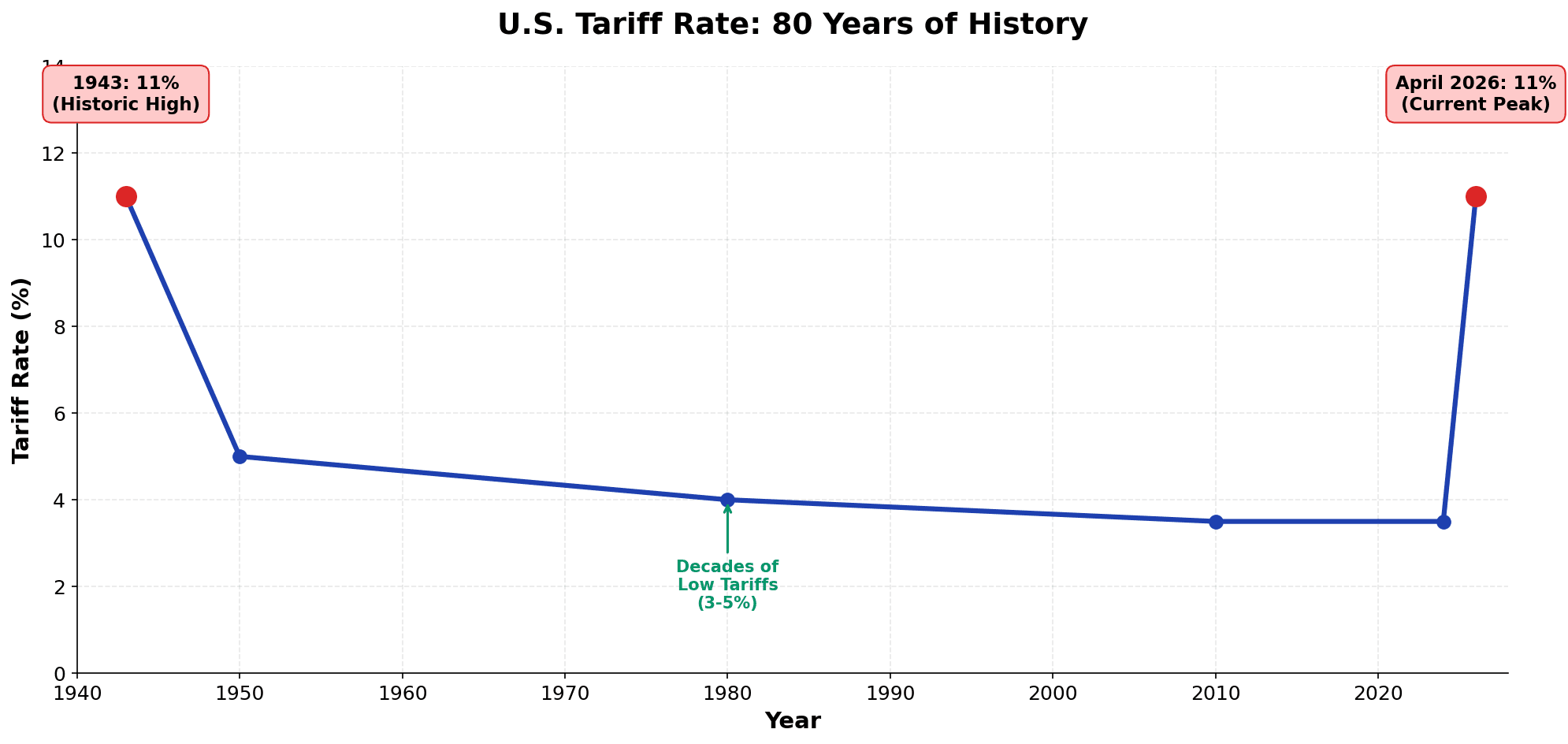
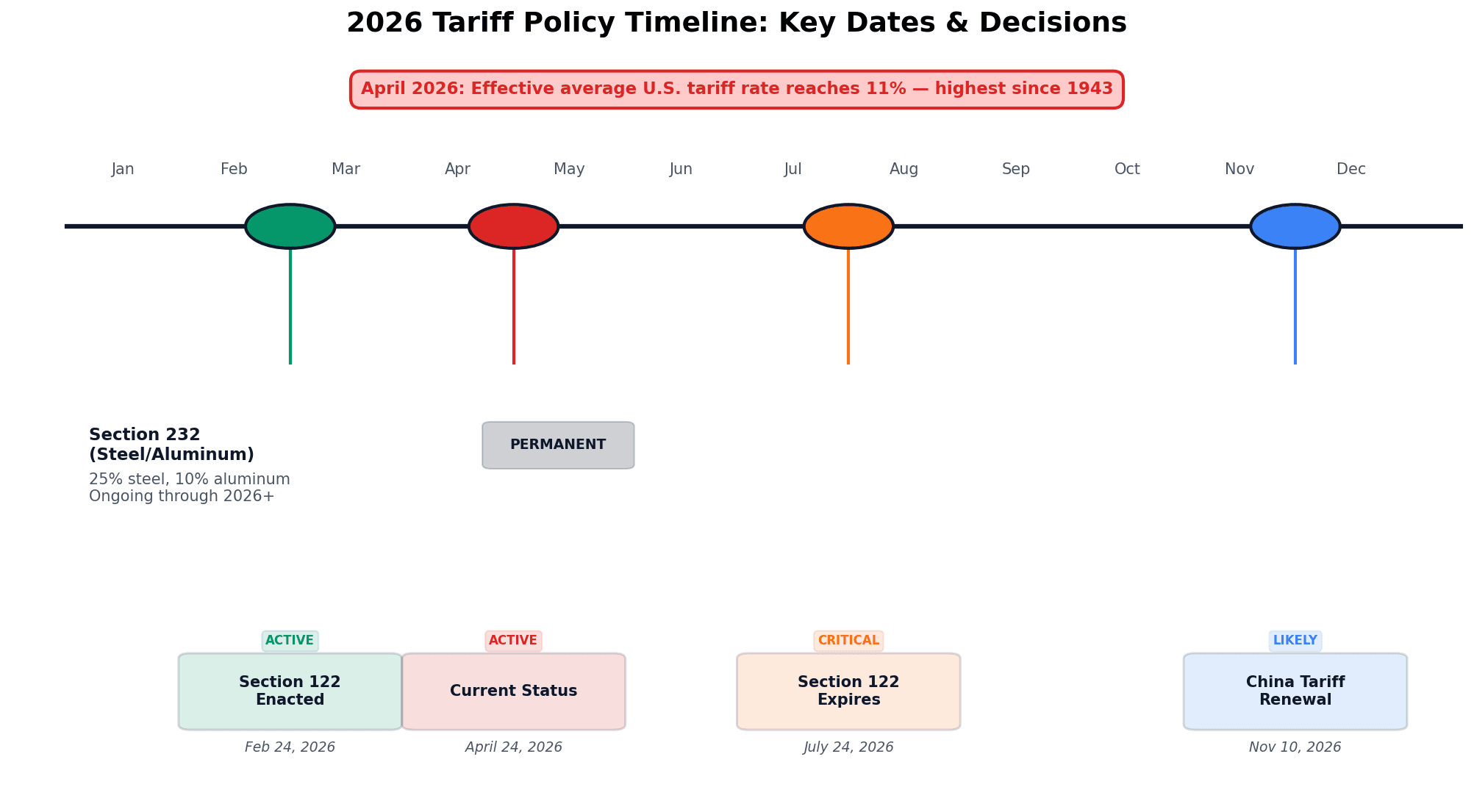
The U.S. tariff rate in April 2026 reached 11%, the highest since 1943. Section 122 tariffs (the main ones) expire July 24, 2026—three months from now—but policy uncertainty means households should plan for continued pressure.
The Real Cost: $570–$1,050 Per Household in 2026
Let me show you the uncomfortable truth with actual data from the Yale Budget Lab.
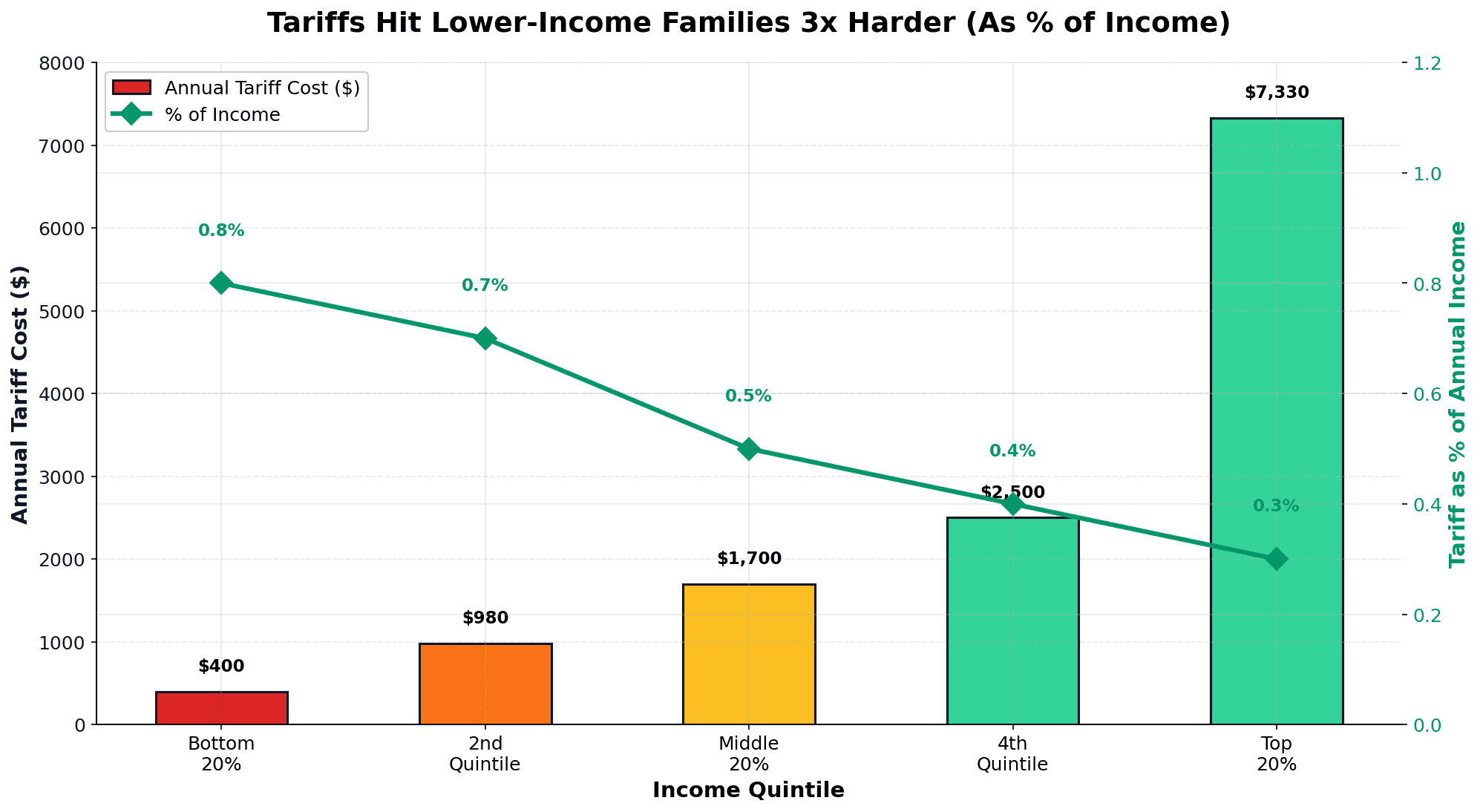
The average household pays between $570 and $1,050 in tariff costs this year. But "average" is misleading because tariffs are regressive—they hit the poor harder, as a percentage of income.
Here's the breakdown by income quintile:
| Income Level | Annual Tariff Cost | Percent of Income | What This Means |
|---|---|---|---|
| Bottom 20% | $400 | 0.8% | Nearly 1 of every 125 dollars |
| 2nd Quintile | $980 | 0.7% | Still above 0.5% |
| Middle 20% | $1,700 | 0.5% | More than half a percent |
| 4th Quintile | $2,500 | 0.4% | Lower pressure relative to income |
| Top 20% | $7,330 | 0.3% | Lowest burden as % of income |
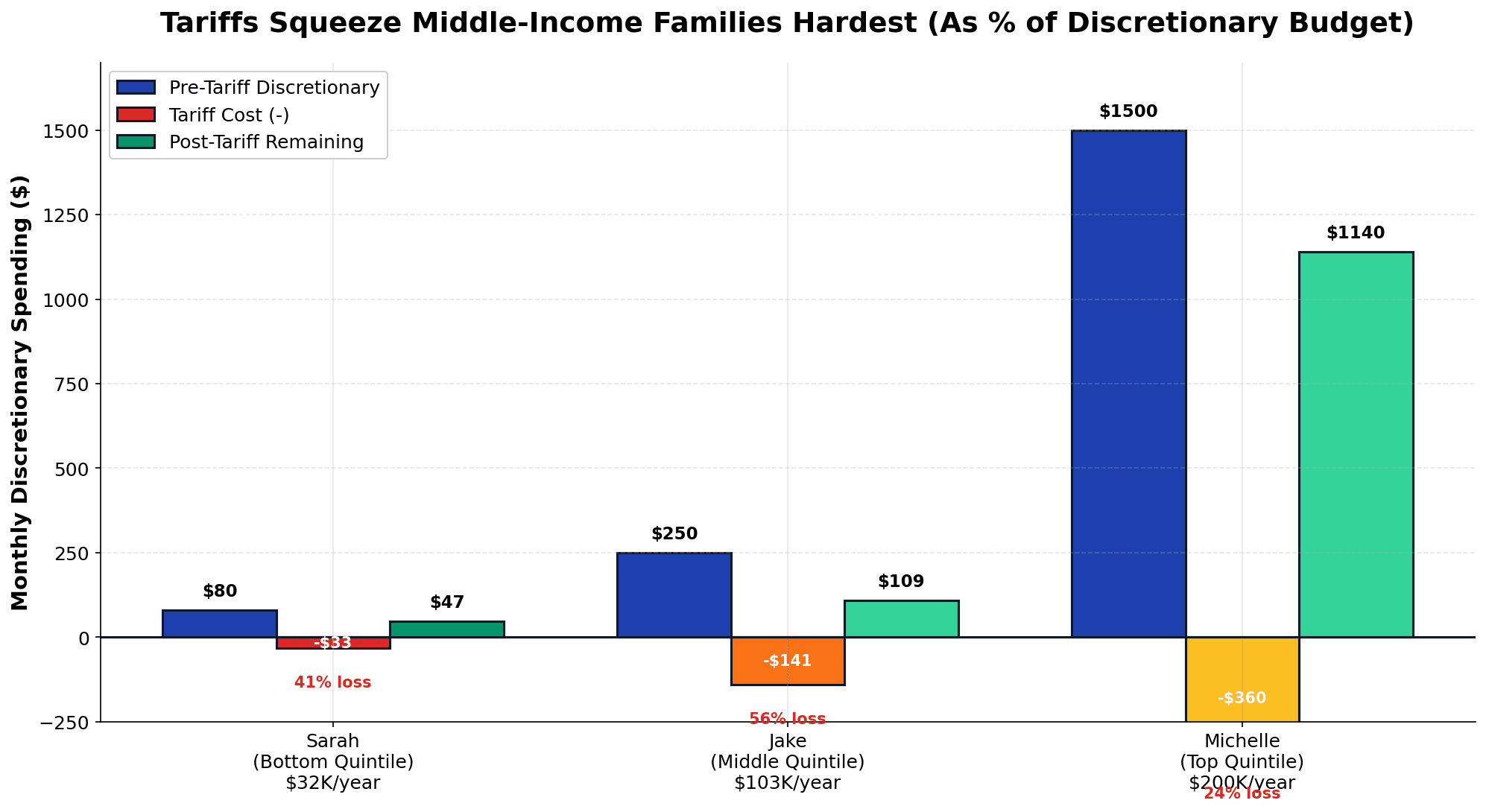
The inequality is stark. A single parent earning $32,000 loses 0.8% of income to tariffs ($33/month). A software engineer earning $200,000 loses 0.3% ($28/month proportionally). Same percentage burden? No. Sarah loses $33; Michelle loses far less relative to her wealth.
This is why financial experts like Ramit Sethi call tariffs "directly a tax on the poor and middle class."
Which Product Categories Are Hit Hardest
Not all tariffs are created equal. Some hit your budget immediately. Others catch you when you least expect them.
Here's what Yale Budget Lab data shows for short-run price increases (2026):
| Product Category | Short-Run Price Increase | Long-Run Increase | Real Impact |
|---|---|---|---|
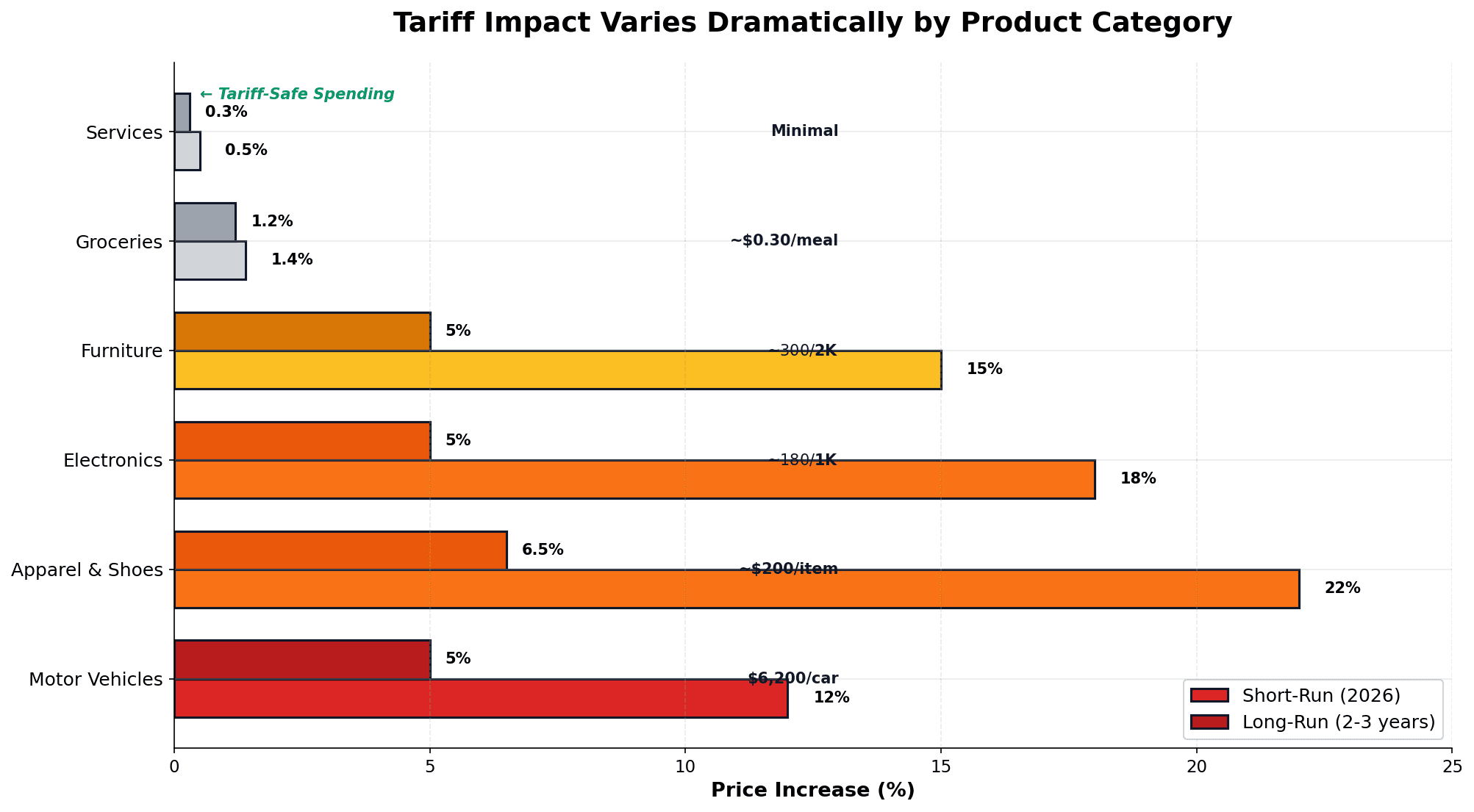
| Motor Vehicles | 12% | 5% | $6,200 per new car purchase |
| Apparel & Shoes | 21–23% | 6–7% | Children's clothes, winter jackets |
| Electronics | 18% | 5% | Laptops, phones, appliances |
| Furniture | ~15% | ~5% | Sofas, beds, office equipment |
| Groceries | 1.4% | 1.2% | Minimal but steady creep |
| Services | < 1% | < 1% | Your budget's safest bet |
What's the difference between short-run and long-run? In the short term (2026), prices spike as tariffs apply immediately. Over 2–3 years, some manufacturers absorb costs into margins, some pass full costs through, and some shift supply chains—so the long-run impact stabilizes but doesn't disappear.
The takeaway? Motor vehicles and clothing are your biggest exposure. If you're a single parent buying your kids new shoes every 6 months, tariffs compound. If you're planning a vehicle replacement, you're looking at thousands of dollars in tariff taxes.
The Tariff Trap: Why Services Are Safer Than Goods
Here's a strategy many people miss.
Tariffs almost exclusively hit tangible goods—things you can touch. Services—which you pay for but don't physically carry home—face minimal tariff pressure.
Think about your budget:
- Goods exposure (tariff-vulnerable): groceries, clothing, electronics, furniture, vehicles, appliances, tools, toys
- Services exposure (tariff-safe): haircuts, gym memberships, health care, car repairs, consulting, streaming, pet grooming, tutoring
A household spending 60% on goods and 40% on services absorbs tariff costs across a larger surface area. A household spending 75% on goods (lower-income families often must) faces concentrated pain.
This is why redirecting discretionary spending toward services—instead of buying more stuff—becomes a conscious budgeting strategy in 2026. Instead of a $300 exercise bike, take a $200 gym membership. Instead of a $400 home office gadget, hire a virtual assistant for four hours ($200).
You're not depriving yourself. You're pivoting away from tariff-heavy spending into resilient categories.
Tariff Calculators and Tools: What Will It Cost You?
Before you panic, you can estimate your personal tariff burden.
The Tax Foundation Tariff Tracker (taxfoundation.org) breaks down tariff rates by product category. The Yale Budget Lab publishes detailed income-level analysis.
But for a quick personal estimate:
- Pull 3 months of your bank and credit card statements.
- Categorize spending: groceries, clothing, vehicles, electronics, furniture, services, rent/mortgage, utilities.
- Calculate your "goods-heavy" spending as a percentage of total.
- Apply the tariff rates from the table above.
Example: Jake spends $2,000/month. Breakdown: $600 groceries (1.4% tariff cost = $8), $200 clothing ($42 at 21%), $0 vehicles (planning replacement next year), $300 electronics/household ($54), $800 services/utilities ($0 tariff). His monthly tariff impact: $104/month = $1,248/year.
Not every purchase faces tariff pressure, so your real burden is likely lower than the headline numbers suggest. But if you're buying a car, replacing major appliances, or refreshing a wardrobe in 2026, you'll feel it.
7 Budget-Hardening Strategies to Offset Tariff Costs
The question isn't "Can I avoid tariffs?" (You can't—they're baked into prices.) The question is: "How do I offset them?" Here are seven concrete tactics.
1. Shift Spending to Services (Your #1 Defense)
Services face minimal tariff exposure. Redirect discretionary spending from goods to services:
- Replace a $400 smart home device with a $150/month home cleaning service
- Skip the $300 office gadget; hire freelance help instead
- Choose a $50 gym membership over a $500 home equipment purchase
Monthly impact: $100–200 savings if you consciously redirect just 20% of discretionary goods spending.
2. Extend Product Lifecycles Through Preventive Maintenance
A $100 car transmission fluid service now saves $1,500 in emergency repairs later. A $200 appliance repair prevents a $600 replacement purchase.
The math: Replacing your car costs $6,200 more (12% tariff). Extending its life by 18 months through maintenance avoids that cost entirely.
Monthly impact: Budget $50–100/month for preventive maintenance (oil changes, appliance servicing, HVAC checkups). This saves 10–20x that amount in deferred replacement costs.
3. Bulk-Buy Strategic Items Before July 24, 2026
Section 122 tariffs expire July 24, 2026. In-stock goods at current tariff-adjusted prices will be your highest-priced option.
Strategic categories to pre-buy (if you have cash flow):
- Winter clothing (buy now for fall)
- Large appliances (fridge, washer, dryer)
- Tires and car maintenance supplies
- Furniture you've been considering
Important: This only works if you have savings to absorb the purchase timing. Don't go into debt to buy early.
Potential savings: $200–500 per household depending on planned purchases.
4. Source Alternative Products and Cheaper Retailers
Not all products face equal tariff pressure. Domestic brands and products with lower import exposure face lower tariff costs.
- Seeking American-made furniture? You'll pay tariff tax on imports, but domestic production costs less.
- Looking for clothing? Fast-fashion retailers often take tariff hits harder than premium brands with diversified supply chains.
- Electronics? Consider refurbished models (tariffs apply to new goods, not resale).
Monthly impact: 5–10% savings by consciously choosing lower-tariff alternatives.
5. Eliminate Discretionary Goods Spending
This is the nuclear option—but it works.
Cut non-essential goods purchases for 6 months:
- Pause clothing beyond basics
- Skip new electronics (use your phone/laptop longer)
- Defer furniture purchases
- Eliminate home décor shopping
Simultaneously, redirect that money to either emergency savings or offset income boosts (see #7).
Monthly impact: $200–500 depending on your current discretionary goods spending.
6. Build a Dedicated "Tariff Buffer Fund"
Separate from your emergency fund, create a savings account specifically for tariff-driven price shocks.
Target: $200/month into a high-yield savings account (currently earning 4–5% APY).
Why separate? Your emergency fund should remain untouched for true emergencies. Your tariff buffer fund is for planned purchases that will arrive at higher tariff-adjusted prices.
Monthly impact: $200/month = $2,400/year, enough to absorb tariff taxes on a vehicle purchase or major appliances.
7. Boost Income to Directly Offset Tariff Burden
The most powerful strategy: earn more. A $150/month side gig (freelance work, gig economy) directly compensates for tariff burden without requiring lifestyle cuts.
How this ties to MFFT: Redirect 100% of side income to either your tariff buffer fund or direct investment. This keeps your lifestyle spending intact while building wealth.
Link for deeper strategy: Check out our guide on Salary Negotiation Data Driven 2026—the same strategies that work for raises work for side income negotiation.
Monthly impact: +$150/month side income = fully offset tariffs for many households.
Using MFFT to Track and Offset Tariff Impact
This is where it gets practical.
The MFFT budgeting framework (zero-based budgeting) is perfect for tariff-era planning because it forces you to assign every dollar to a category. That visibility reveals your tariff exposure instantly.
Here's how to use MFFT to model tariff scenarios:
- Set up a "Tariff Impact" tracking category in your monthly budget. Log purchases in tariff-heavy categories separately.
- Create a "Tariff Buffer" savings goal ($200–300/month). Watch it grow alongside your emergency fund.
- Run "what-if" scenarios. "If I buy a car in July, how does that impact my annual savings target?" MFFT's zero-based framework makes this instant.
- Audit your discretionary goods spending. Which $100/month purchases are services (safe) vs. goods (tariff-exposed)? Shift deliberately.
- Track side income separately. If you earn $150/month from freelance work, direct it to investments instead of lifestyle creep. MFFT's automation helps.
Getting started with budgeting? Our guide How to Start a Budget walks you through zero-based budgeting fundamentals. Apply those principles with tariff-era discipline.
Emergency fund expansion: Standard advice was 3–6 months. Tariff volatility pushes that to 9–12 months, especially for single-income households or gig workers. Link: Emergency Fund Crisis 2026—tariff-specific guidance on why larger buffers now make sense.
Tariffs and Inflation: Understanding the Difference
People ask: "Is this just inflation?"
No. Tariffs are a specific, policy-driven form of inflation affecting goods disproportionately. Inflation is general—everything rises. Tariffs are targeted—goods spike, services stay flat.
Here's the data from the Federal Reserve: tariffs explain 3.1% of core goods inflation since January 2025. That's measurable, distinct, and policy-reversible (when tariffs expire, prices should stabilize).
General inflation rose 2.8% in 2025. Tariff inflation adds another 0.6–0.9% on top, but mainly in goods categories.
The distinction matters for your budget because:
- General inflation hits everything; you budget for it everywhere.
- Tariff inflation is goods-concentrated; you can pivot strategically toward services.
Read more: Inflation for a deeper dive into inflation dynamics and purchasing power erosion.
Political and Economic Outlook: How Long Will Tariffs Last?
Here's what you need to know for planning purposes.
July 24, 2026: Section 122 tariffs are set to expire unless extended. That's 90 days away. Congressional outlook is uncertain, but many economists expect some form of extension or renegotiation.
Key regulatory dates:
- April–May 2026: Ongoing investigations into pharmaceutical and medical device tariffs (potential new tariffs)
- July 24, 2026: Section 122 expiration (critical pivot point)
- November 2026: China tariff agreement renewal (possibility of escalation)
- Ongoing: Section 232 (steel, aluminum, copper) tariffs remain permanent
The bottom line for your household: Plan for tariffs to stick around through at least July 2026, with possibility of extension or new tariff waves. Don't assume relief; plan conservatively. If tariffs expire on schedule, July–August 2026 could be a window for planned purchases (appliances, vehicles) before prices normalize downward—or before tariffs return in new form.
Counterarguments: Do Producers Absorb Some Costs?
I want to give balanced perspective here.
Producers do absorb some tariff costs. Federal Reserve economists note that roughly 32% of manufacturers absorb costs into profit margins while 42% combine price increases with margin compression. Some tariff burden falls on companies, not consumers—just not all of it.
However, the pass-through remains high. A 2025 Federal Reserve study found that tariff inflation passes through to consumer prices faster in essentials (groceries, utilities) than in discretionary goods (electronics, furniture). This means lower-income families—who spend more on essentials—face faster price pressure.
Long-term supply chain reshoring is a real argument from tariff proponents. If U.S. domestic production ramps up (steel plants being built, auto production rising to 54.4% domestic), long-term tariff dependence could decrease. But that takes 1–3 years to realize, offering no comfort to households paying tariff taxes today.
Fiscal benefits are also real: Tariffs collected ~$77 billion in 2024 and are projected to collect $421 billion in 2027. That revenue could fund deficit reduction or infrastructure. But that's a government-level benefit, not a household-level offset.
The honest truth: Some costs are absorbed, but most reach consumers. Reshoring is real but slow. Fiscal benefits exist but don't help your wallet today. Plan for the burden you'll face now while hoping for long-term relief.
Wealth-Building Through Tariff Discipline
Here's the opportunity hidden in constraint.
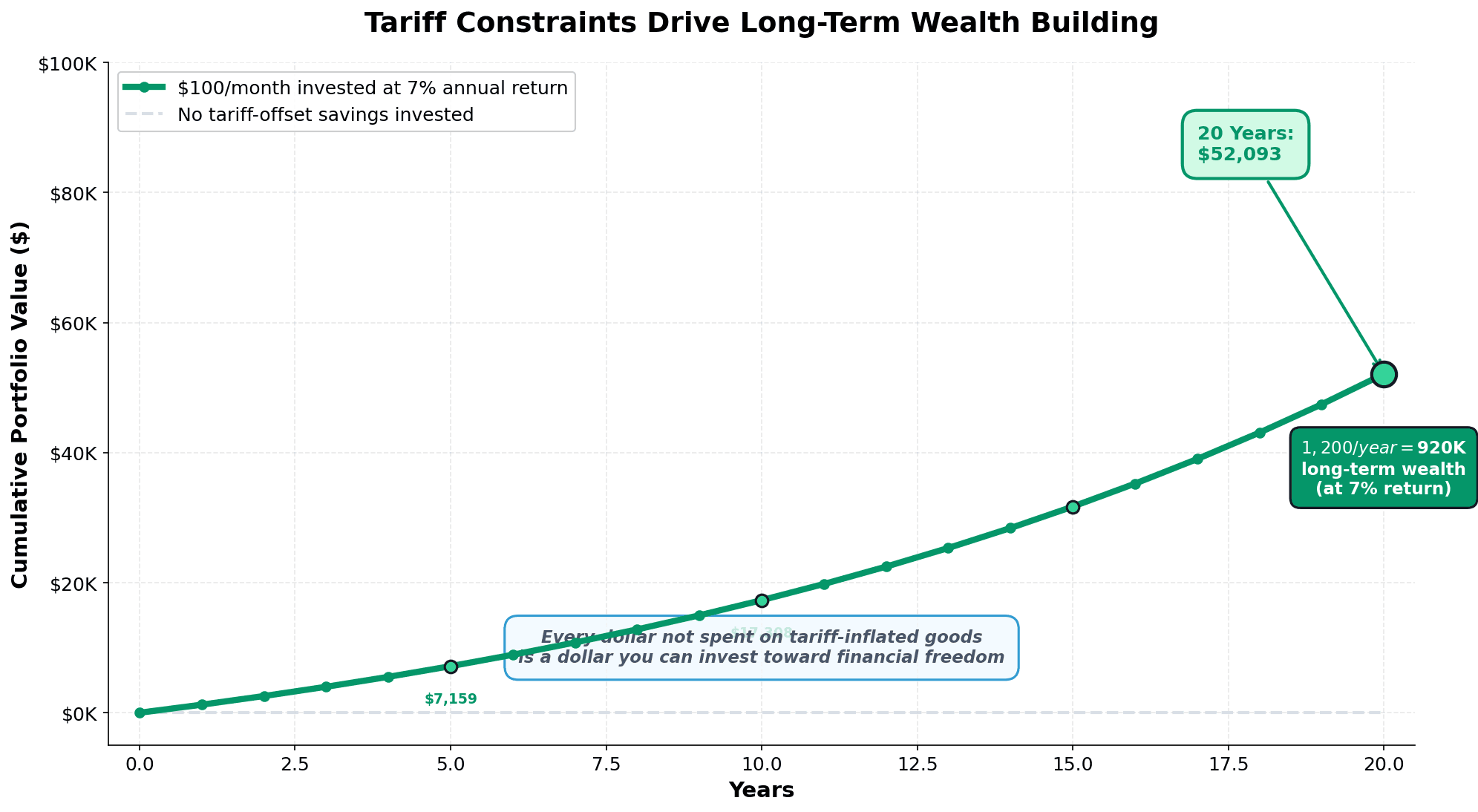
When you're forced to think carefully about goods purchases, you naturally shift toward asset-building instead of consumption. That $100/month you cut from discretionary goods? Invest it.
The math over 20 years:
- $100/month invested at 7% annual return = $77,000
- $1,200/year tariff-offset savings redirected to index funds = $920,000 total portfolio impact
You're not being squeezed into poverty. You're being squeezed into disciplined wealth-building.
This connects directly to our guide on Wealth, Time, and Money Discipline—the idea that constraints force better choices and long-term wealth accumulation beats short-term consumption every time.
Action Plan for April 2026
Here's what you should do this week:
- Pull 3 months of statements. Categorize spending by tariff exposure (groceries, clothing, vehicles, electronics vs. services).
- Estimate your personal tariff burden. Use the tables in this article. Is it $400/year or $2,000/year?
- Identify your three biggest tariff exposures. For most households: vehicles, clothing, electronics, furniture.
- Make a decision on any planned major purchases. Before July 24: buy now (tariff-adjusted prices locked). After July 24: wait for potential relief.
- Set up a tariff buffer fund. $200/month into a high-yield savings account, separate from your emergency fund.
- Audit discretionary goods spending. What $100–200/month can you redirect to services or investments?
- Set up tariff tracking in MFFT. Create a category so you see real impact month-to-month.
Final Thought: Tariffs as a Budget Discipline Tool
I started writing this article worried about messaging. Tariffs do hurt. The regressive impact on lower-income families is real. Sarah (earning $32,000) loses $33/month. That's real money.
But I also realized something: The households that will thrive through tariff cycles are those that respond strategically—not those that panic.
You can't avoid tariffs. But you can:
- Pivot toward services
- Plan major purchases strategically
- Invest the money you save through discipline
- Build emergency buffers before the next shock
That's what MFFT is about. It's not about earning more (though that helps). It's about seeing exactly where your money goes, making intentional choices, and building long-term wealth through discipline.
Tariffs are a short-term shock. MFFT discipline is forever.
Log into MFFT today. Start tracking your tariff exposure. Build your buffer fund. And remember: every dollar you don't spend on tariff-inflated goods is a dollar you can invest toward the financial freedom you actually want.
You've got this.
Dennis Vymer My Financial Freedom Tracker April 2026
Stay Updated
Get notified about new articles and MFFT build-in-public updates.
Ready to Apply This?
Start tracking your finances today and put these tips into practice.
- Import bank statements in seconds
- AI-powered categorization
- Beautiful visualizations
- Set and track financial goals
Related posts
 Master Your Money
How to Stop Arguing About Money With Your Partner: Our Money Date Is Twenty Boring Minutes Because Nothing Is Left to Decide
Our monthly money date takes twenty minutes and it's deeply boring, and for years I thought that was because we're good at talking about money. It isn't. Half of couples avoid the conversation on purpose to keep the peace, and every article tells them to talk more. Here's the opposite case.
 Master Your Money
One Spouse Manages All the Finances in Our House. It's Me, and That's a Design Flaw.
In our house, one spouse manages all the finances, and it's me. I built the tool, I buy the ETF, I read the numbers out loud while my wife listens. That's a bus factor of one. Here's the 30-minute quarterly drill we run instead of a password folder, and why documents rot.
 Master Your Money
How to Calculate Net Worth (Formula + Worked Example)
Net worth is assets minus liabilities. What counts on each side, how to handle the house, pension and car, a worked example, and why monthly beats once.
 Master Your Money
How to Calculate Your FIRE Number (Formula + Examples)
Your FIRE number is annual retirement spending × 25, from the 4% rule. Three steps, a spending-to-target table, a worked example, and when 25× is wrong.
 Master Your Money
Job Hopping vs Staying in 2026: Both Camps Time the Market
Job hopping vs staying is market timing with a résumé: the switching premium hit a record low in January, then widened by July. I've made that mistake before.