Negotiated a Raise? How to Invest the Difference (2026)


Getting the raise is the easy half.
Here's the uncomfortable pattern: most raises disappear. A slightly nicer car payment, a slightly nicer apartment, a few more deliveries a week — and twelve months later your savings rate is exactly where it was. Economists call it lifestyle creep. Your FIRE timeline calls it standing still on a faster treadmill.
This article covers both halves of the problem:
- Getting the raise — the data-driven negotiation playbook: timing, anchoring, scripts, and the total-comp levers that actually move (the research tables are all below).
- Keeping it — the part almost nobody writes about: how routing the difference into investments converts one conversation into years off your working life. The savings-rate math is here if you want to skip ahead.
Why bother negotiating at all? Carnegie Mellon economist Linda Babcock's research puts the cost of not negotiating your starting salary at $1-1.5 million in lost lifetime earnings, compounded across raises and promotions. And Pew Research Center found that only about three in ten US workers asked for higher pay when last hired — but among those who did ask, two-thirds got more than the original offer.
The conversation works. The question is what you do with the money afterward.
The 2026 Salary Negotiation Landscape: Why Context Beats Confidence
Here's what changed: structured pay bands are now the default. In 2026, 70%+ of employers use formal salary ranges, not individual negotiation. That sounds like bad news. It's actually the opposite.
Structured pay bands actually make negotiation easier because you know roughly where flexibility exists. The ceiling is visible. The question isn't "Will they negotiate?" It's "Where do I sit in that band, and what else can I move?"
Here's the data that matters: According to Robert Half, 88% of professionals feel confident negotiating salary. Yet only 50% actually do. And here's the kicker: over 70% of hiring managers expect candidates to negotiate. They budget for it. They plan for it. But they won't offer more unless you ask.
A typical successful negotiation moves an offer by a few thousand dollars a year. That sounds small. It isn't: $5,000 a year, invested at 7%, compounds to roughly $472,000 over a 30-year career — before counting the raises and bonuses that get calculated as percentages of your now-higher base.
Think about what that means: one conversation—properly prepared—can be worth several hundred thousand dollars over your lifetime. If the difference gets invested instead of absorbed.
The other lever people pull for the same raise is leaving, and that's a market-timing bet with a résumé attached: the switching premium hit a record low in January 2026 before widening again by July, so the answer changes depending on the month you ask.
The Golden Rule: Negotiate AFTER the Written Offer
This is the single most important rule, and most people get it wrong.
The mistake: negotiating during the phone call when they extend a verbal offer.
Why it fails: a verbal offer has zero commitment. The hiring manager is still evaluating candidates. Your leverage is weakest. They haven't decided you're definitely hired yet—they're still comparing you to others.
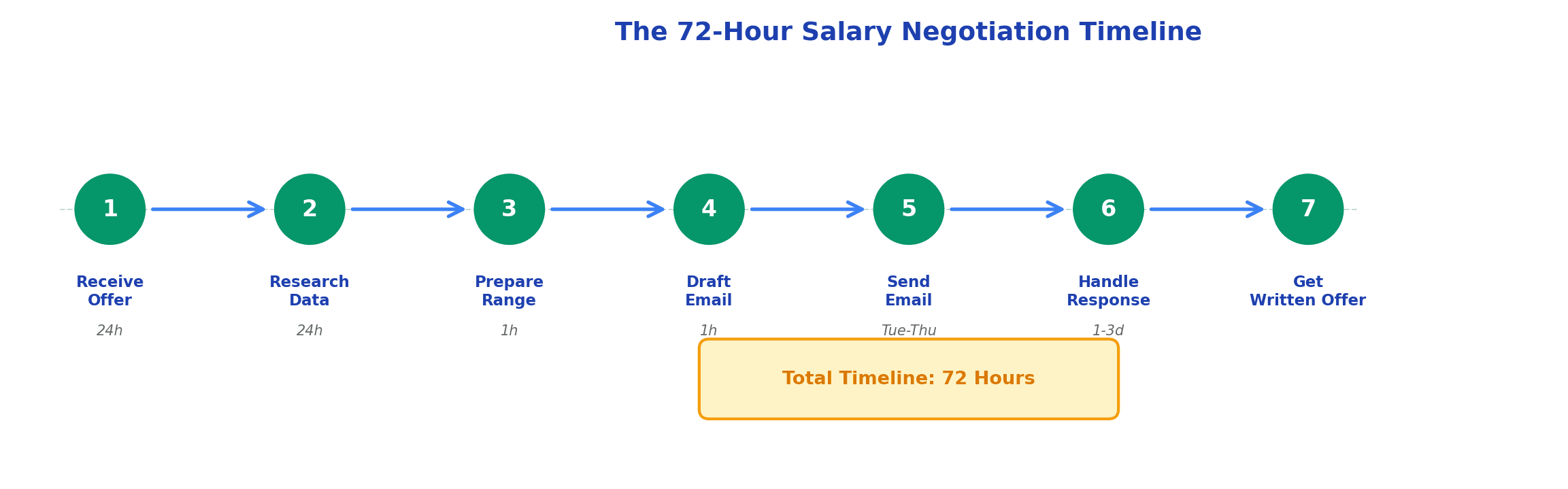
The power move: always ask for 24 hours to review the written offer in writing before responding.
Here's exactly what to say:
"Thank you so much for the offer. I'm genuinely excited about the role and the team. Can I take 24 hours to review the written offer and get back to you?"
This one sentence does three things:
- It signals professionalism (you're not impulsive)
- It gives you time to research market data
- Most importantly, it moves the psychology. Once they've sent the written offer, they've committed. The hiring manager has mentally moved you from "candidate pool" to "future employee." Your leverage just increased dramatically.
Harvard's Program on Negotiation research confirms this: maximum leverage exists after written offer, before acceptance. That 24-48 hour window is gold.
The alternative? Michelle, a 29-year-old operations manager, accepted a verbal offer of $85,000 over the phone, excitedly committing. When the written offer arrived, she wanted to negotiate. HR said, "You already accepted." She lost all leverage and took a role that paid $8,000 less than market rate. That gap compounds for every year she stays at that company.
Don't be Michelle.
Anchoring Strategy #1: The Range Instead of a Number
Single numbers are weak. Ranges are powerful.
When you say "I want $100,000," the employer hears one thing to negotiate down from. When you say "Based on my research, I'm looking at $105,000-$120,000," the employer hears market data plus anchoring.
Here's why ranges work: they feel researched. They create anchoring bias in your favor. The employer naturally negotiates toward the middle of your range, not below it.
How to research your range:
Start with three sources:
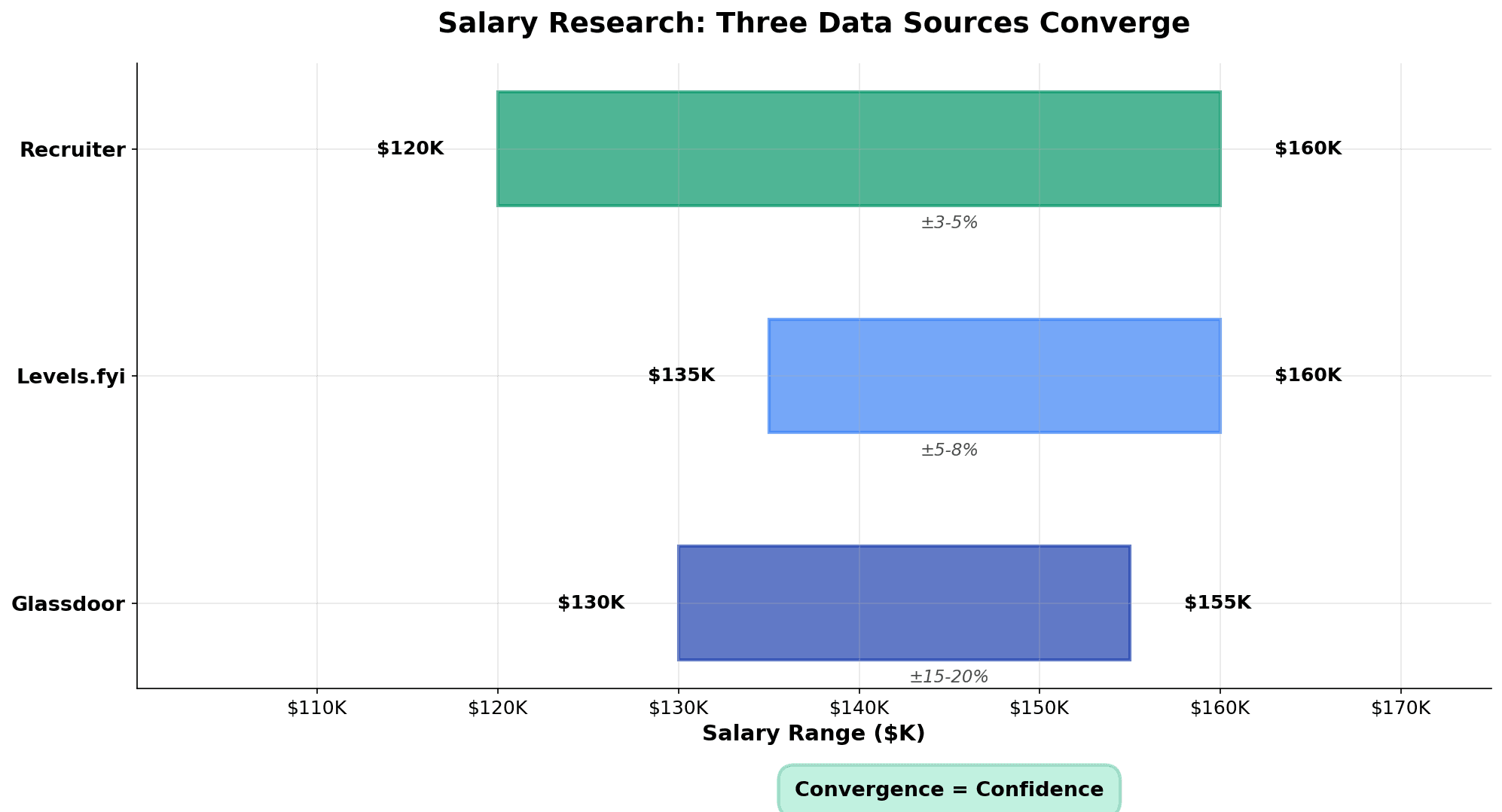
- Glassdoor – Shows broad salary data but has ±15-20% margin of error. Use to understand the ballpark.
- Levels.fyi – Gold standard for tech roles. Includes base salary, bonus, and equity breakdown with ±5-8% accuracy. If you're in tech, this is your primary source.
- Recruiter insight – If you know a recruiter in your industry, they have insider knowledge of actual pay bands at specific companies (±3-5% margin of error).
Let's say you're researching a Senior Product Manager role in the Bay Area with 7 years of experience:
- Glassdoor shows: $130K-$155K
- Levels.fyi shows: $135K-$160K
- Recruiter tells you: "The band is $120K-$160K, we typically start at $135K"
Your anchor range: $145K-$160K (slightly above what they typically offer, grounded in three sources, with room to negotiate down).
This range isn't aggressive—it's data-backed. And if the employer counters at $150K, you're celebrating because that middle ground became your expectation.
Anchoring Strategy #2: Frame Around Company Value, Not Personal Need
Here's what doesn't work: "I want $110,000 because I have student loans and rent is expensive."
Here's what works: "Based on my track record in cost-saving initiatives that delivered $2M in value at my last company, I believe I can contribute $150K+ in measurable impact in year one. I'd like to discuss how that aligns with compensation."
One is emotional. One is ROI.
Employers care about return on investment. They're paying you X to generate Y in value. When you frame negotiation around company value, you're speaking their language.
Real scripts that work:
If you're a designer: "I've led redesigns that increased conversion rates by 18-23% on average. Based on our conversation about product roadmap priorities, I believe I can deliver similar impact here. Market rate for someone with that track record is $95K-$110K. I'd like to target $105K."
If you're an engineer: "I've built systems handling 10M+ requests/day and reduced infrastructure costs by 30%. Given your scaling challenges at [company name], I'd target someone with that operational experience. That role typically sits at $155K-$175K in this market. Can we discuss $165K?"
If you're an operations manager: "I've managed teams of 8-12 people and implemented processes that reduced operational costs by $150K annually. Looking at your org structure and growth plans, I'd be the person who makes that kind of impact. What does the budget look like for someone at my level?"
Notice the structure: (1) specific past achievement, (2) connection to their stated need, (3) market data, (4) your ask.
This approach works because it's not personal pleading. It's strategic framing.
Total Compensation Leverage: Where Employers Actually Have Flexibility
Here's the frustrating reality: base salary is often locked in the band. Once you hit the top of the range, there's no room without changing the role or title.
But total compensation? That's where flexibility lives.
When an employer says "base salary is locked at $140,000," they're often telling the truth. But they're also leaving $50,000+ in flexibility on the table in other components.
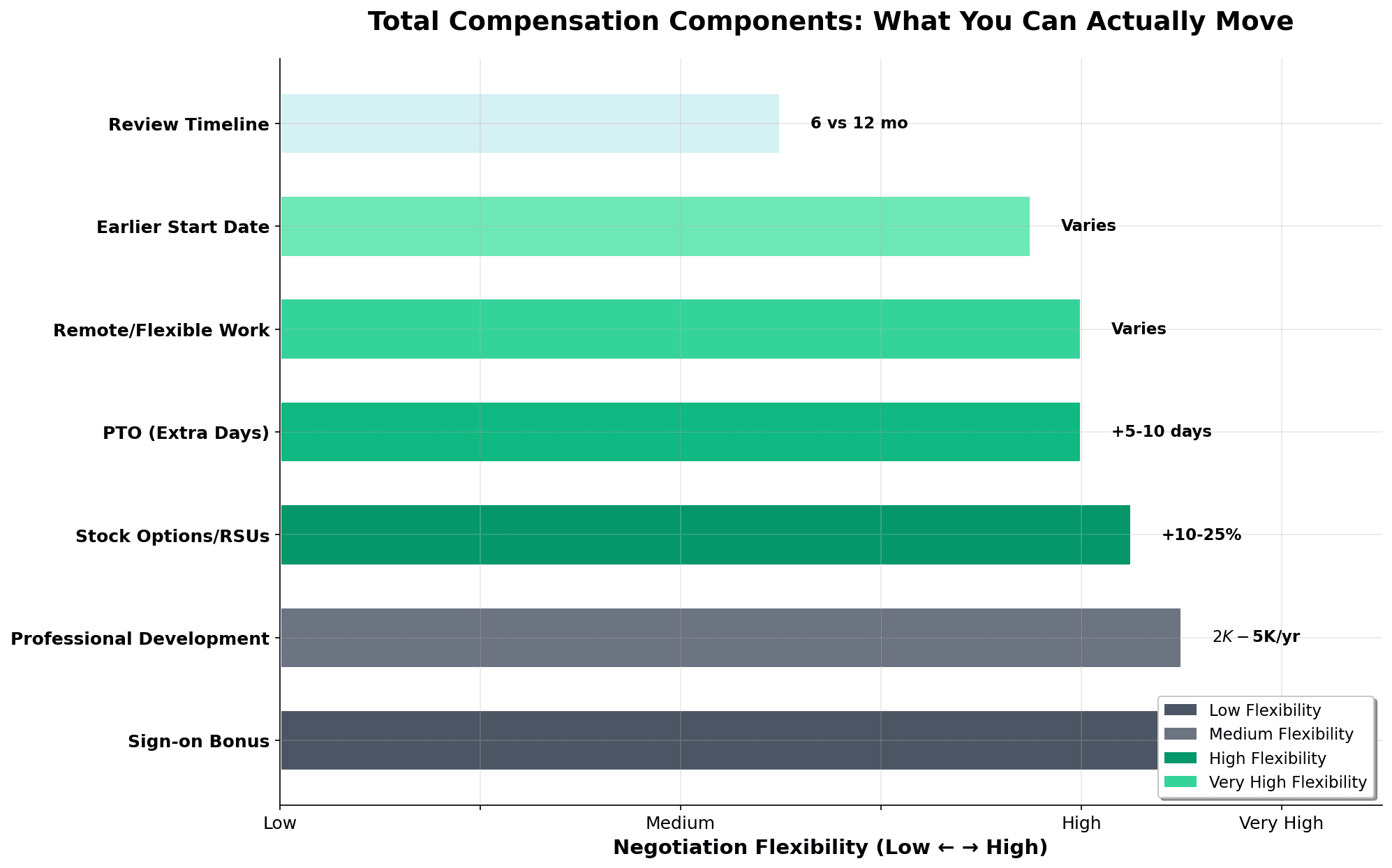
Here's what's actually negotiable (ranked by employer flexibility):
| Component | Flexibility | Typical Range | How to Negotiate |
|---|---|---|---|
| Sign-on bonus | VERY HIGH | $10K-$50K | "If base is fixed, can we discuss a signing bonus?" |
| Stock options/RSUs | HIGH | +10-25% equity | "What's the equity breakdown?" Ask for acceleration or additional grants |
| PTO (extra days) | HIGH | +5-10 days | "Can we add 5 extra vacation days?" Worth ~$3K-$8K |
| Professional development budget | VERY HIGH | $2K-$5K/year | "Can we allocate $3K/year for courses, conferences?" Easy yes |
| Remote/flexible work | HIGH | Hybrid → Full remote | "Can the role be fully remote?" Saves commute time + costs |
| Review timeline | MEDIUM | 6-month vs. 12-month review | "Can we revisit compensation in 6 months instead of 12?" Path to raise without changing title |
| Earlier start date | HIGH | Varies | If you're coming from PTO restrictions, negotiating earlier start = more vacation time |
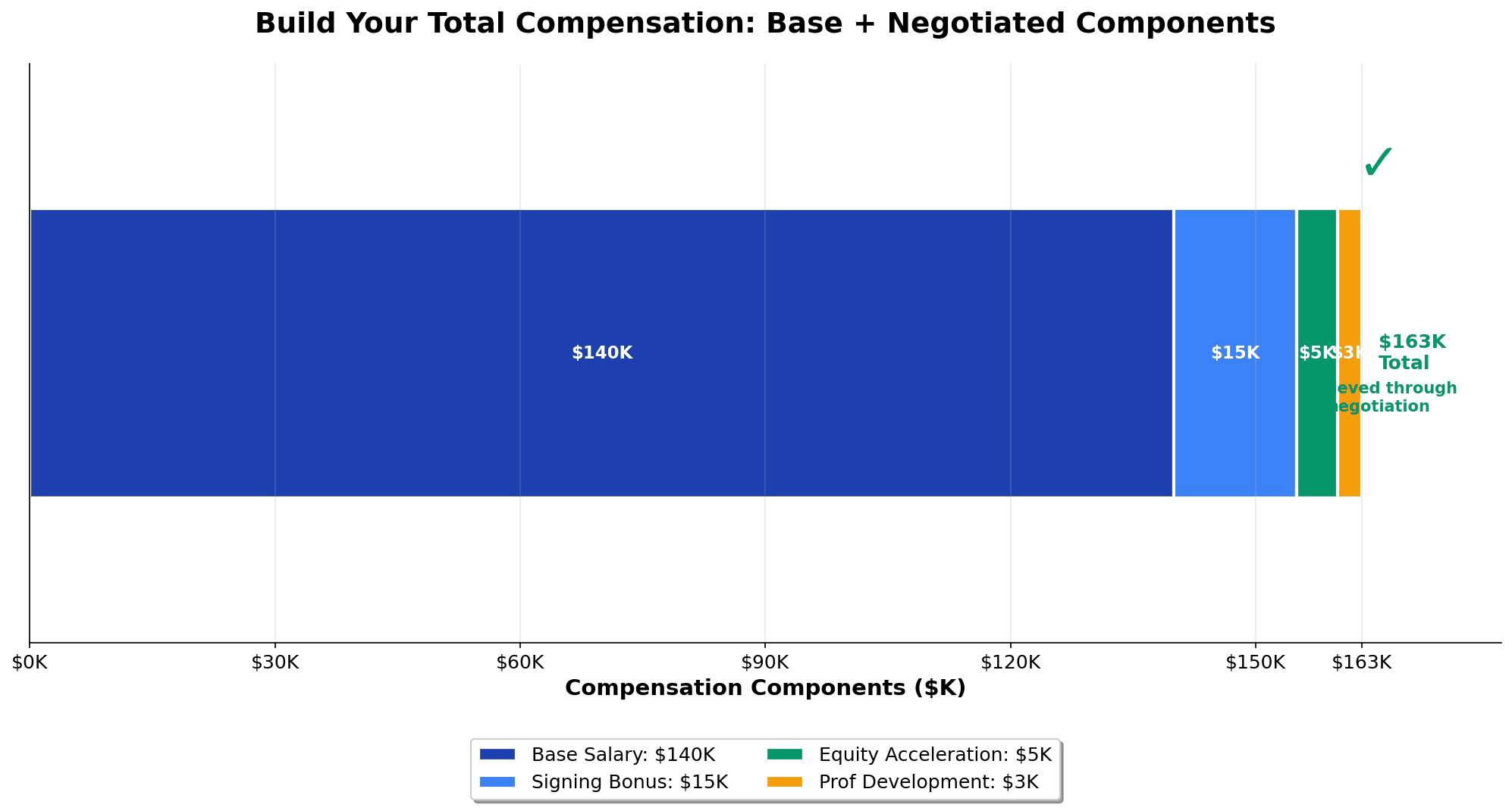
Real example: Jake, a software engineer, received a $140K offer. The hiring manager said base was locked in the band. Instead of fighting, Jake asked:
"I understand base salary is set. What flexibility do we have on signing bonus, equity, professional development, or starting date?"
Result: Employer granted:
- $15K signing bonus
- Accelerated equity vesting (6-month cliff → 3-month cliff, worth ~$5K in practical value)
- $3K annual professional development budget
- Immediate start date instead of 2 weeks later
Total package value: $140K base + $15K signing + $5K equity acceleration + $3K pro-dev = $163K total compensation instead of $140K. That's a 16% increase without touching base salary.
This is where real negotiation happens in 2026. Base salary is the headline. Total comp is the actual value.
Understanding Salary Bands: Why Knowing the Ceiling Matters
Most 2026 employers have structured bands like this:
- Role: Senior Product Manager
- Band: $120K-$160K
- Entry point (typical): $135K
- Midpoint: $140K
- Maximum: $160K
If you're offered $155K, you're near the ceiling. Asking for $165K won't work—it breaks the band structure.
Here's what you should do instead:
Ask the right question first: "Where does this role sit in your salary band?"
If they tell you: "The band is $120K-$160K and we're offering you $155K" — you're at 97% of the ceiling. Base salary negotiation is over.
Pivot immediately: "I understand the band ceiling. What flexibility exists on [sign-on bonus / equity / professional development / timeline to next review]?"
If they tell you: "The band is $120K-$160K and we're offering you $135K" — you have room. You're at 13% from the top. This is where you negotiate up to $150K-$155K.
The key insight: knowing the band lets you stop wasting energy on impossible asks and focus on what actually moves.
Red Flags & When to Walk Away
Not every offer is worth negotiating for. Some employers have genuinely zero flexibility. Others signal they'll be difficult to work with through how they handle negotiation.
Walk-away red flags:
-
Salary band is at 45th percentile of market – If market rate is $120K-$140K and their band tops out at $105K, they're fundamentally underpaying. Even if you negotiate, you'll be underpaid vs. peers.
-
No flexibility on ANY component – Employer says: "No negotiations. Take it or leave it." That attitude typically persists in career development and raises. You'll spend years fighting for marginal improvements.
-
Unwilling to discuss total compensation – When you ask about signing bonus, professional development, or timeline, and they shut you down, they're signaling inflexibility across the board.
-
Insulting initial offer + resistance to discussion – If the offer is 20%+ below market AND they push back on negotiation, that's a sign they undervalue talent.
-
Salary secrecy culture – If they explicitly forbid discussing salary with peers or mention "confidentiality," red flag. Healthy orgs have pay transparency.
Here's the math on walking away: A company offering 10% below market, with no willingness to negotiate, costs you roughly $100K in year-1 earnings. Over 30 years with 3% annual raises, that gap becomes $400K+ in lifetime losses, plus you're building your career on a lower baseline.
Sometimes declining is the right move.
From Raise to FIRE Timeline: The Savings-Rate Math
This is the section the rest of the article exists for. You negotiated. The new number is signed. What you do in the first 90 days decides whether that raise becomes wealth or lifestyle.
The key insight: a raise you don't spend improves your savings rate twice. Your income goes up while your spending stays flat — so both the amount you invest each year AND the share of income you save jump at once. And savings rate, not income, is what sets your FIRE timeline.
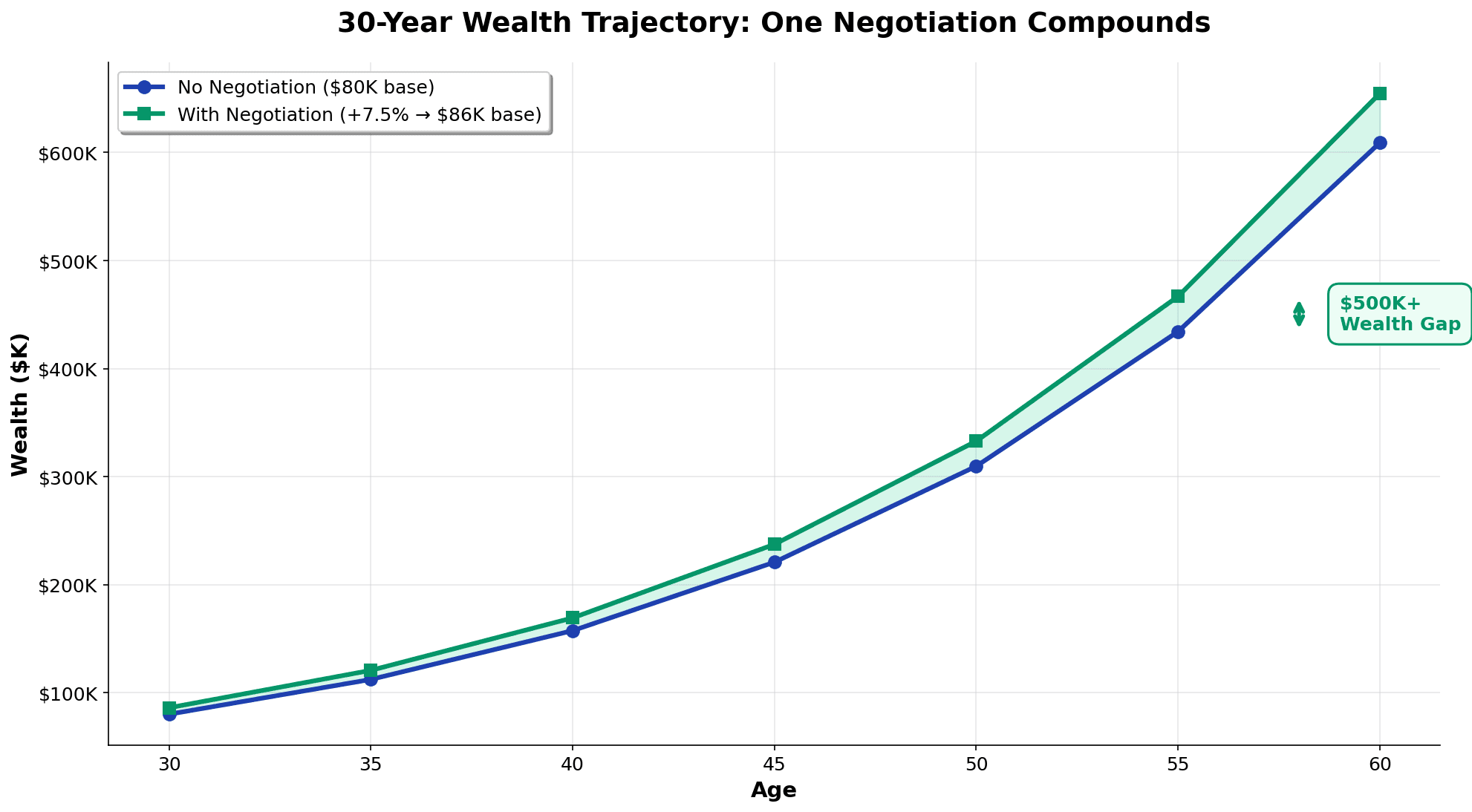
Here's the worked math. Say you earn $80,000 and spend $56,000 a year — you're saving $24,000 (a 30% savings rate). Using the 4% rule, your FIRE number is 25 × $56,000 = $1.4 million.
| Scenario | Income | Invested/yr | Savings rate | Years to $1.4M* |
|---|---|---|---|---|
| No raise | $80,000 | $24,000 | 30.0% | ~24 years |
| $6,000 raise, fully banked | $86,000 | $30,000 | 34.9% | ~21.5 years |
| $12,000 promotion, fully banked | $92,000 | $36,000 | 39.1% | ~19.5 years |
*Starting from $0, 7% average annual return, spending unchanged. Run your own numbers — current net worth, real savings, your return assumption — in the FIRE calculator; it shows your FIRE number and the projected date you hit it.
Read that table again: banking one $6,000 raise buys back roughly 2.5 years of your working life. A promotion banked whole buys back 4.5. No side hustle required — the money was already coming; the only decision is whether your spending gets to absorb it.
In isolation, that $6,000/year is about $380,000 after 25 years at 7% — compound it yourself with different amounts in the compound interest calculator.
How to actually capture it (the 90-day window):
- Redirect it before you see it. The same week the raise is confirmed, increase your 401(k) contribution percentage by the size of the raise. Pre-tax, so the full $6,000 compounds instead of the after-tax remainder — and it never lands in checking where lifestyle creep can find it.
- Already maxing the 401(k)? Set an automatic monthly transfer ($500/month for a $6K raise) to your IRA or brokerage, dated to your payday.
- Check whether the raise already finished the job. If you've been investing for a while, a higher contribution rate may mean your existing portfolio now coasts to retirement without another dollar — that's Coast FIRE, and the calculator tells you in 60 seconds.
- Let the percentages work for you. Future raises and bonuses are usually computed from your base — every negotiated dollar quietly raises every future raise.
As covered in our wealth equation article, wealth compounds through income × discipline × time. Negotiation moves the income variable; the 90-day redirect is the discipline variable. Skip the second one and the first was just a conversation.
The Step-by-Step Negotiation Playbook: Template & Email Scripts
Okay, you understand the strategy. Here's the exact playbook, step by step.
Step 1: Receive the Written Offer (and Don't Accept Verbally)
When the offer comes via email, respond within 2 hours:
Subject: Thank You for the [Role Title] Offer
Dear [Hiring Manager Name],
Thank you for the [Role Title] offer. I'm excited about the opportunity to contribute to [specific project or goal you discussed].
I'd like to take 24 hours to review the offer details carefully before I respond. Can we plan to connect tomorrow at [suggest specific time]?
Looking forward to our conversation. Best, [Your Name]
This buys you time and signals professionalism. Do not accept or commit verbally.
Step 2: Research (24 Hours)
- Glassdoor: Search "[Role Title], [Location]" and note the range
- Levels.fyi: If tech, get the detailed breakdown
- LinkedIn Salary: Note the trend
- Recruiter contact: If you have one, reach out: "I received an offer for [role]. What's the typical range for this position in [market]?"
- Company pay transparency: Some companies publish salary bands publicly (check their careers page)
Document your findings in a spreadsheet:
| Source | Low | High | Notes |
|---|---|---|---|
| Glassdoor | $130K | $155K | 85 reviews, Bay Area |
| Levels.fyi | $135K | $160K | Tech-specific, includes bonus |
| Recruiter | $120K | $160K | Band range, typical start $135K |
| Consensus | $135K | $158K |
Your offer: $140K. You're in the range but below the high end.
Step 3: Prepare Your Range
Set your anchor 10-15% above the offer, grounded in your research:
- Offered: $140K
- Your ask range: $152K-$160K
This feels aggressive, but remember:
- It's within the researched market range
- They'll likely negotiate you down to $150K-$155K
- You're anchoring them upward, not downward
Step 4: Prepare Your Value Proposition
Write 2-3 bullet points of specific value you bring:
"Based on my background, here's what I bring to this role:
- 7 years leading product strategy in B2B SaaS
- Track record: 3 product launches that combined for $50M+ in revenue
- Direct experience with [specific technology/challenge they mentioned] that typically costs companies $200K+ to solve externally"
This is your defense if they push back. You're not asking for more because you "deserve it." You're asking because you deliver value.
Step 5: Draft Your Negotiation Email
Here's a template that works:
Subject: [Role Title] Offer – Compensation Discussion
Dear [Hiring Manager Name],
Thank you again for the offer. I'm very excited about the opportunity and genuinely impressed by the team.
I've had a chance to review the offer and conduct market research. For a Senior Product Manager position in the Bay Area with my background, market data from Glassdoor, Levels.fyi, and recruiter contacts shows the typical range is $145K-$165K. Given my specific experience in [key skill/achievement], I was hoping we could discuss $155,000-$160,000.
I'm committed to making this work. If base salary has constraints, I'm also open to discussing [sign-on bonus / equity / professional development / flexible work] to reach a total compensation package that reflects market value.
What works for you?
Best regards, [Your Name]
Key elements:
- Express enthusiasm (they need to hear this)
- Cite market data (not emotion)
- Name your ask as a range (gives negotiation room)
- Offer alternative solutions (shows flexibility)
- Keep it brief (don't over-explain)
Step 6: Handle Their Response
If they accept your range: Confirm in writing immediately. "Excellent, thank you. I'm excited to join the team." Don't renegotiate further.
If they counter lower (e.g., $150K instead of your $155K):
- Evaluate: Is $150K acceptable? If yes, accept it.
- If no, counter once more: "I appreciate the movement. Would $152K work? That's between our two numbers and I'm confident I can deliver $200K+ in value in year one."
- Be prepared for a final yes or no.
If they say base is locked but offer flexibility elsewhere:
- Negotiate total compensation: "I understand base is at $145K. Can we discuss a $15K signing bonus, 5 extra vacation days, and $3K professional development budget?"
If they refuse all negotiation:
- Make a decision: Is the package acceptable as-is? If yes, take it and build wealth through performance. If no, respectfully decline: "I appreciate the opportunity, but I need to make a decision that aligns with market value for my experience. Thank you for the consideration."
Step 7: Get Everything in Writing
Before you start, ensure the final offer letter includes:
- Base salary
- Signing bonus (if negotiated)
- Equity (vesting schedule, cliff date)
- PTO (days)
- Benefits start date
- Sign-on date
- Any special arrangements (remote work, review timeline, etc.)
Don't start your job based on a verbal promise.
Common Negotiation Mistakes to Avoid
Mistake #1: Negotiating Before the Written Offer
You either lose leverage (verbal) or don't have your research ready (immediately after receiving offer).
Fix: Always wait for written offer, then take 24 hours to prepare.
Mistake #2: Anchoring With a Single Number
"I want $125,000" sounds like a request. "I'm looking at $120K-$135K" sounds like research.
Fix: Always present ranges, grounded in three data sources.
Mistake #3: Negotiating Only Base Salary
You're leaving $50K+ in total compensation on the table.
Fix: When base hits the ceiling, immediately pivot to other components.
Mistake #4: Accepting the First "No"
Most hiring managers' first response is pushback. It's negotiating theater. Push back once.
Fix: Counter once, then make a decision. But don't accept "no" without exploring alternatives.
Mistake #5: Showing Desperation
Talking about your bills, debt, or financial needs makes you seem weak.
Fix: Always frame negotiation around company value and market data, never personal circumstance.
Mistake #6: Comparing to Peers
"My colleague makes $20K more" creates friction. Employers assume you're recruiting discord.
Fix: Reference market data instead ("Market data shows..."), not colleagues.
Total Compensation Components Ranked by Negotiation Flexibility
When base salary hits the ceiling, focus your energy where employers have actual flexibility. Here's the ranking of what actually moves:
Industry & Role Differences: Where Negotiation Flexibility Varies
Negotiation flexibility isn't universal. Context matters.
Tech companies: Highest flexibility on equity, signing bonus, and remote work. Moderate flexibility on base salary due to pay bands.
Finance/consulting: Higher base salary floors, less equity. More flexibility on bonuses and annual review timelines.
Government/public sector: Rigid salary scales. Almost no flexibility on base. You can negotiate benefits or start date, but not much else.
Healthcare: Moderate flexibility. Often tied to credentials/certifications rather than negotiation.
Sales: High flexibility everywhere—base, commission, bonus structure, territory. Negotiation expected.
Early-stage startups: Lower base salaries, higher equity percentages. More flexibility on total comp but less cash available.
Public companies: Structured bands, less flexibility on base, more on bonus/equity. Risk-averse HR.
What this means: tailor your approach. At a startup, negotiate equity heavily. At a government job, don't waste energy on base salary. At a tech company, use equity and remote work as leverage.
The Alternative: When to Accept, When to Decline
Not every offer deserves negotiation. Sometimes the right move is accepting or declining.
Accept as-is when:
- The offer matches or exceeds market data
- The company has demonstrated inflexibility, and you're okay with that
- You're in a time-pressured situation and the offer is acceptable
- The non-monetary factors (role, team, mission) are so compelling that the salary gap is worth it
Decline when:
- The offer is 15%+ below market with no room to negotiate
- The company signals they undervalue talent through how they handle negotiation
- The role doesn't align with your long-term goals (don't accept a bad role for a slightly better salary)
- You have other offers (use them as leverage, but decline if the best option still doesn't meet your threshold)
Remember: negotiation is one conversation. Your career is 40+ years. A company that pays you below market from the start will likely continue undervaluing you. Sometimes declining and waiting for a better offer is the right move.
Your Action Plan: Next Steps
If you're currently between offers, here's what to do this week:
Today:
- If you have a verbal offer, respond: "I'm excited. Can I take 24 hours to review the written offer?"
- If you have a written offer, take it.
Tomorrow:
- Research three sources (Glassdoor, Levels.fyi, recruiter)
- Document your findings
- Set your anchor range
Day 3:
- Write your value proposition (2-3 bullets of specific value you bring)
- Draft your negotiation email
- Get feedback from a trusted mentor if possible
Day 4:
- Send your negotiation email (Tuesday-Thursday mornings are best—HR is less reactive)
- Wait for response
Day 5 onward:
- Handle their response using the playbook above
- Get the final offer in writing
- Set up the investment redirect the same week — bump your 401(k) percentage or schedule the automatic transfer before your first new paycheck lands (the 90-day plan above)
- Start your job
Conclusion: Negotiate Once, Invest the Difference, Repeat
Here's the bottom line: per Pew Research, only about three in ten workers ask for more — and two-thirds of those who ask get it. Most people leave the money on the table; most of the rest spend it within a year.
You now have both halves:
- Timing matters – Negotiate after written offer, not before
- Data beats confidence – Market research > personal belief in your worth
- Base salary is one lever – Total compensation includes signing bonus, equity, PTO, remote work
- Context shapes strategy – Salary bands, industry norms, employer flexibility all matter
- The raise only counts if you keep it – A $6,000 raise banked whole is ~$380K after 25 years at 7%, and roughly 2.5 years off a typical FIRE timeline. Absorbed into lifestyle, it's zero.
The person who negotiates their first job offer is typically the person who negotiates their second, third, and fourth roles. And the person who redirects their first raise into investments builds the habit that actually ends the working-for-money phase. Patterns compound — in both directions.
So here's my ask: if you're between offers right now, use the playbook. Send the email. And before the first new paycheck arrives, run your new savings rate through the FIRE calculator and set up the redirect.
One conversation, one auto-transfer. That's the whole trick.
Have questions about your specific situation? Email me at dennis.vymer@myfinancialfreedomtracker.com. I'm interested in what you're negotiating for and how you can maximize it.
Ready to see how each raise moves your net worth and FIRE date? Track it with My Financial Freedom Tracker.
Stay Updated
Get notified about new articles and MFFT build-in-public updates.
Ready to Apply This?
Start tracking your finances today and put these tips into practice.
- Import bank statements in seconds
- AI-powered categorization
- Beautiful visualizations
- Set and track financial goals
Related posts
 Master Your Money
Your Job Is the Biggest Position in Your Portfolio. I Diversified Everything Except the Thing That Pays for It.
My world ETF is spread across an entire developed-market index, and every euro that buys it comes from one employer, one country, one currency. Your job is the biggest undiversified position you own. Here is what actually reduces the risk, and why seven income streams does not.
 Master Your Money
How to Stop Arguing About Money With Your Partner: Our Money Date Is Twenty Boring Minutes Because Nothing Is Left to Decide
Our monthly money date takes twenty minutes and it's deeply boring, and for years I thought that was because we're good at talking about money. It isn't. Half of couples avoid the conversation on purpose to keep the peace, and every article tells them to talk more. Here's the opposite case.
 Master Your Money
One Spouse Manages All the Finances in Our House. It's Me, and That's a Design Flaw.
In our house, one spouse manages all the finances, and it's me. I built the tool, I buy the ETF, I read the numbers out loud while my wife listens. That's a bus factor of one. Here's the 30-minute quarterly drill we run instead of a password folder, and why documents rot.
 Master Your Money
How to Calculate Net Worth (Formula + Worked Example)
Net worth is assets minus liabilities. What counts on each side, how to handle the house, pension and car, a worked example, and why monthly beats once.
 Master Your Money
How to Calculate Your FIRE Number (Formula + Examples)
Your FIRE number is annual retirement spending × 25, from the 4% rule. Three steps, a spending-to-target table, a worked example, and when 25× is wrong.