What Is Coast FIRE? Definition, Math, and Examples

Coast FIRE is the point where what you have already invested will grow into a full retirement pot on its own. You keep working to pay today's bills, but you can stop saving for retirement, because compound growth does the rest. The number is your FIRE number discounted back by the years you have left. This article gives you the formula, your number by age, three worked examples with the arithmetic shown, and what the bad decades do to the plan.
Updated October 3, 2026: the by-age table now has two return assumptions and the real crossover ages, the examples are recomputed, the US account limits are the 2026 figures, and the return claims cite their sources.
Coast FIRE meaning, in one sentence
Invest enough, early enough, and compound growth carries that money to your retirement target without another dollar from you. From that moment on, your paycheck only has to cover your life, not your future.
The word "coast" means to glide on momentum. You push hard at the start, then you coast. It sits between two other shapes of financial independence: regular FIRE, where the portfolio replaces your whole income right now, and Barista FIRE, where part-time income covers the gap. Coast FIRE needs the smallest pile of the three, which is why it is the most reachable.
| Traditional FIRE | Coast FIRE | |
|---|---|---|
| Goal | Replace all income from investments | Secure retirement, keep working for living expenses |
| How much you need today | Your full FIRE number (25 × annual spending) | $50K–$534K depending on age (table below) |
| What you do after | Work only if you want to | Work to cover current expenses, on your terms |
| Who it's for | High earners with extreme discipline | Practically anyone who starts early enough |
In the FIRE guide I wrote about the full path. Mr. Money Mustache's shockingly simple math puts it at 22 working years on a 40 % savings rate and 12½ on 60 %, at 5 % real returns and a 4 % withdrawal. Not everyone wants, or can, save like that for a decade. Coast FIRE asks for a few years of it.
The Coast FIRE formula
Coast FIRE number = (annual spending × 25) ÷ (1 + real return)^(years until retirement)
Three inputs.
Annual spending × 25 is the 4 % rule turned around. William Bengen's 1994 paper "Determining Withdrawal Rates Using Historical Data" found that a first-year withdrawal of 4 %, raised with inflation each year, had never exhausted a portfolio of half stocks and half intermediate-term Treasuries in under 33 years, in any US retirement starting from 1926 on. The Trinity Study (Cooley, Hubbard and Walz, 1998) tested the same idea across every historical window from 1926, and the authors' 2011 update, "Portfolio Success Rates: Where to Draw the Line", extended the data through December 2009. Spend $3,500 a month, that is $42,000 a year, times 25 is $1,050,000. That is the FIRE number every example below uses.
The real return is what the market gives you after inflation. Over 1900 to 2025, US equities returned 6.6 % a year after inflation (9.8 % before it, against 2.9 % inflation), per the UBS Global Investment Returns Yearbook 2026 summary. The tables below use the round 7 % that most Coast FIRE pages use, and show 5 % beside it, which is the rate I actually plan with; the section on risk explains why.
Years until retirement is the exponent, and it is doing most of the work. Every year you add to it shrinks the number you need today by about 6.5 %.
Because the return is already a real (after-inflation) figure, every number in this article is in today's dollars. When I write "$1 million", I mean $1 million of today's purchasing power. You do not need to adjust anything.
Where compound growth comes from
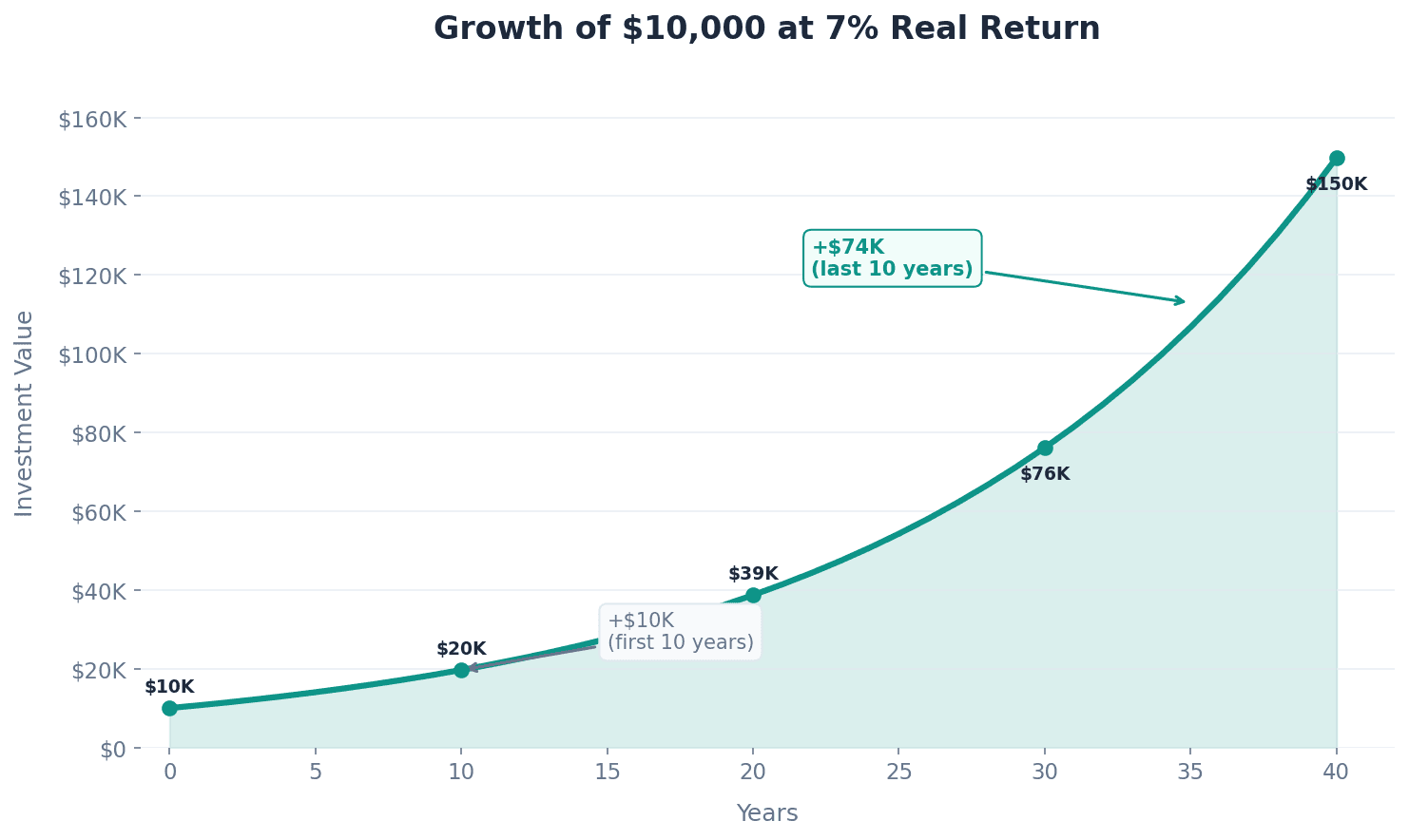
You invest $10,000, it earns 7 % a year after inflation, and you never add another dollar:
| Year | What happens | Balance |
|---|---|---|
| 0 | You invest $10,000 | $10,000 |
| 1 | 7 % of $10,000 = +$700 | $10,700 |
| 2 | 7 % of $10,700 = +$749 | $11,449 |
| 10 | Interest on interest adds up… | $19,672 |
| 20 | …and accelerates… | $38,697 |
| 30 | …and accelerates… | $76,123 |
| 40 | …and keeps accelerating | $149,745 |
In the first ten years you gained about $10K. In the last ten, from year 30 to 40, you gained $74K, with the same original money. The longer it works, the harder it works.
Coast FIRE number by age
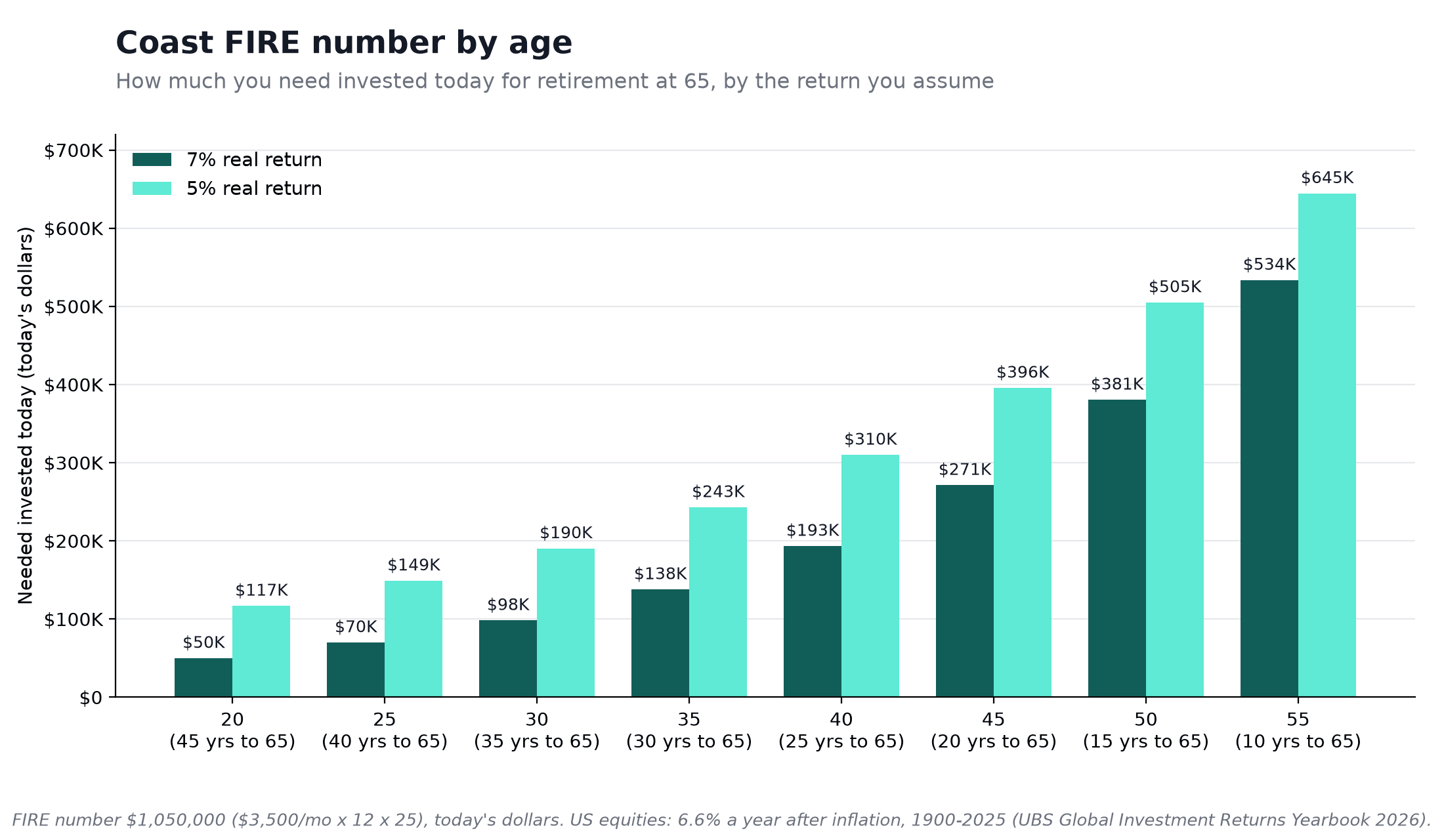
Finish line $1,050,000 ($3,500 a month × 12 × 25), retirement at 65, two return assumptions. One thing about the last column: your number rises every year you are still saving, because each year leaves fewer years to compound. A 25-year-old needs $70K today, but if it takes her nine years to get there she is 34, and the number at 34 is $129K. The crossover below is where a steady monthly contribution finally meets that moving target, not the frozen number from the first row.
| Age today | Years to 65 | Number at 7 % real | Number at 5 % real | Saving this much a month… | …you cross at (7 %) |
|---|---|---|---|---|---|
| 20 | 45 | $50,000 | $117,000 | $600 | age 29 |
| 25 | 40 | $70,000 | $149,000 | $850 | age 34 |
| 30 | 35 | $98,000 | $190,000 | $1,500 | age 37 |
| 35 | 30 | $138,000 | $243,000 | $1,500 | age 46 |
| 40 | 25 | $193,000 | $310,000 | $2,000 | age 52 |
| 45 | 20 | $271,000 | $396,000 | $2,500 | age 59 |
| 50 | 15 | $381,000 | $505,000 | $3,000 | after 65 |
| 55 | 10 | $534,000 | $645,000 | $4,000 | after 65 |
All figures in today's dollars. At 5 % real the crossovers come much later (a 30-year-old on $1,500 a month crosses at 45, not 37), which is the plain reason the return assumption matters more than anything else on this page.
What the table says:
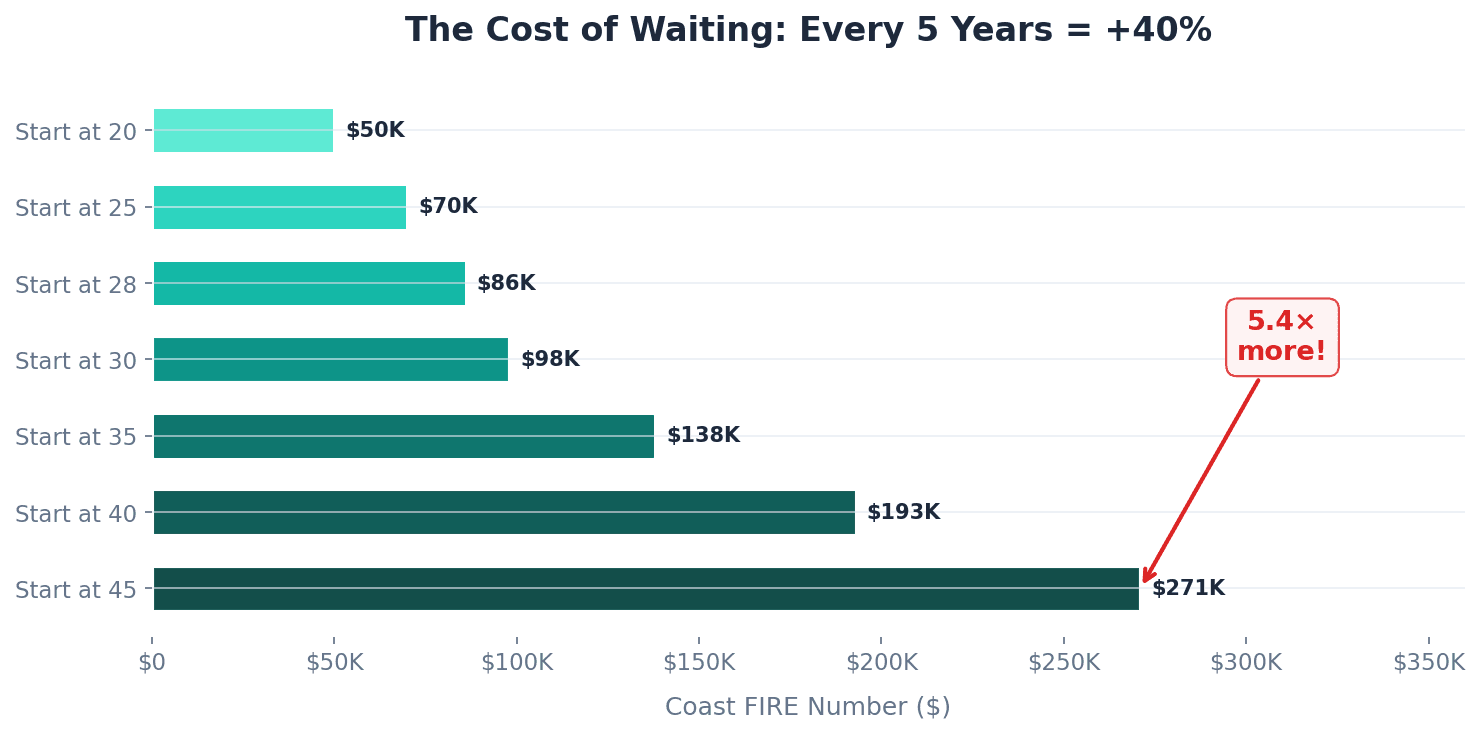
The earlier, the better. A 20-year-old needs $50K. A 45-year-old needs $271K, 5.4× more for the same result.
From 50 on, Coast FIRE stops being a strategy and becomes ordinary retirement saving. The target moves up faster than a normal contribution can chase it; the lever at that age is the contribution rate, not the compounding.
The numbers under 45 are achievable. Tens to low hundreds of thousands, not millions. The first two rows, $50K and $70K, are about a year of the median US worker's pay ($1,251 a week in the second quarter of 2026, roughly $65,000 a year); the rows to 40 are two to three years of it.
Coast FIRE examples, with the arithmetic
Jake, 25
Jake has 40 years ahead of him. His number today is $1,050,000 ÷ 1.07^40 = $70,000. If he had it in hand this year and never added a dollar, it would grow to $1,050,000 by 65.
He does not have it in hand. He invests $850 a month. After six years he has about $75K, but by then he is 31 and his target has moved to $105K. He crosses the moving line at 34, with about $132K invested. From that day on, the pot reaches $1,050,000 at 65 on its own, and his $850 a month is his to redirect: a down payment, a sabbatical, or, as I would, more investing.
If you test his savings against the frozen $70K instead, he "arrives" at 31, but $70K at 31 grows to only about $698K by 65 at 7 %. The nine-year version is the one that reaches $1,050,000.
Michelle, 35
Michelle has 30 years. Her number today is $1,050,000 ÷ 1.07^30 = $138,000, almost double Jake's, because her money has ten fewer years to grow.
Investing $1,500 a month, she crosses the moving target at about 46, with roughly $289K. That is eleven years, not the six a frozen target suggests, and eleven years of a four-figure monthly contribution.
Sarah, 27, with a smaller target
Sarah spends $3,000 a month, so her FIRE number is $900,000 and her Coast FIRE number at 27 is $900,000 ÷ 1.07^38 = $69,000. On $1,200 a month she crosses the moving target a little before her 33rd birthday, with about $102K, and from there the pot reaches $900,000 at 65 with nothing more from her.
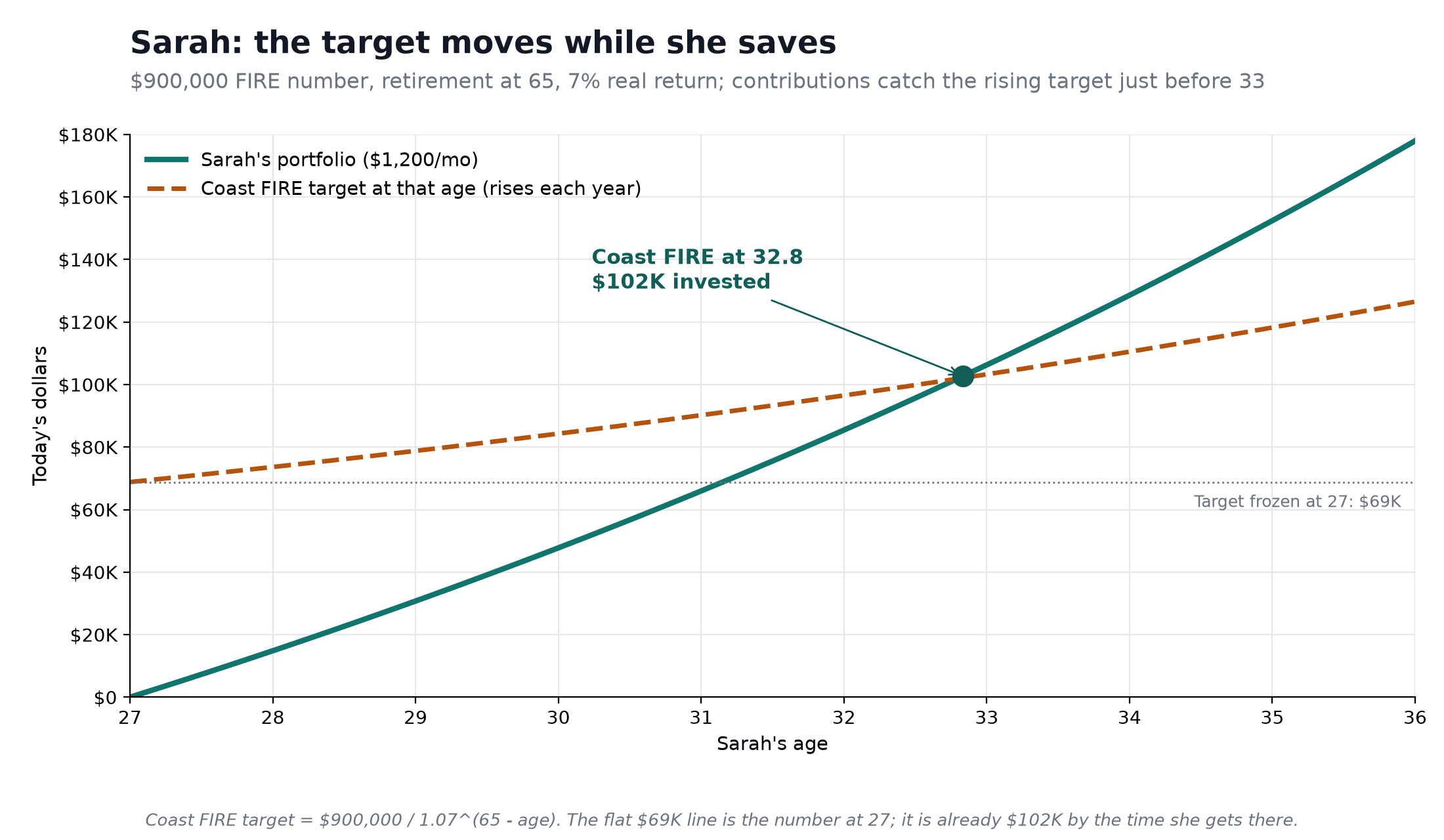
From then on the $1,200 a month is hers to redirect, and her retirement is funded whether or not she ever invests again.
Calculate your own number
The arithmetic is three steps, and the Coast FIRE calculator does them for you, with your own age, spending, current portfolio and return assumption, and needs no sign-up. It also shows the moving target, so you see the real crossover rather than the frozen one.
By hand:
Step 1: Estimate your monthly expenses in retirement. Not sure? Take your current expenses minus your mortgage.
Step 2: Annual expenses × 25 = your FIRE number.
Step 3: Divide your FIRE number by the divisor for your age (7 % real, retirement at 65):
| Your age | Divisor | Your age | Divisor |
|---|---|---|---|
| 20 | 21.00 | 40 | 5.43 |
| 25 | 14.97 | 45 | 3.87 |
| 30 | 10.68 | 50 | 2.76 |
| 35 | 7.61 | 55 | 1.97 |
Example: you are 30, retirement expenses $3,500 a month. FIRE number = $3,500 × 12 × 25 = $1,050,000. Coast FIRE number = $1,050,000 ÷ 10.68 = $98,300.
The cost of waiting
| If you start at… | Instead of… | You need extra | How much more |
|---|---|---|---|
| 25 | 20 | +$20,000 | +40 % |
| 30 | 25 | +$28,000 | +40 % |
| 35 | 30 | +$40,000 | +40 % |
| 40 | 35 | +$56,000 | +40 % |
| 45 | 20 | +$221,000 | +443 % |
Every five years of waiting costs about 40 % more (1.07^5 = 1.40). Wait 25 years and you pay 5.4× for the same result.
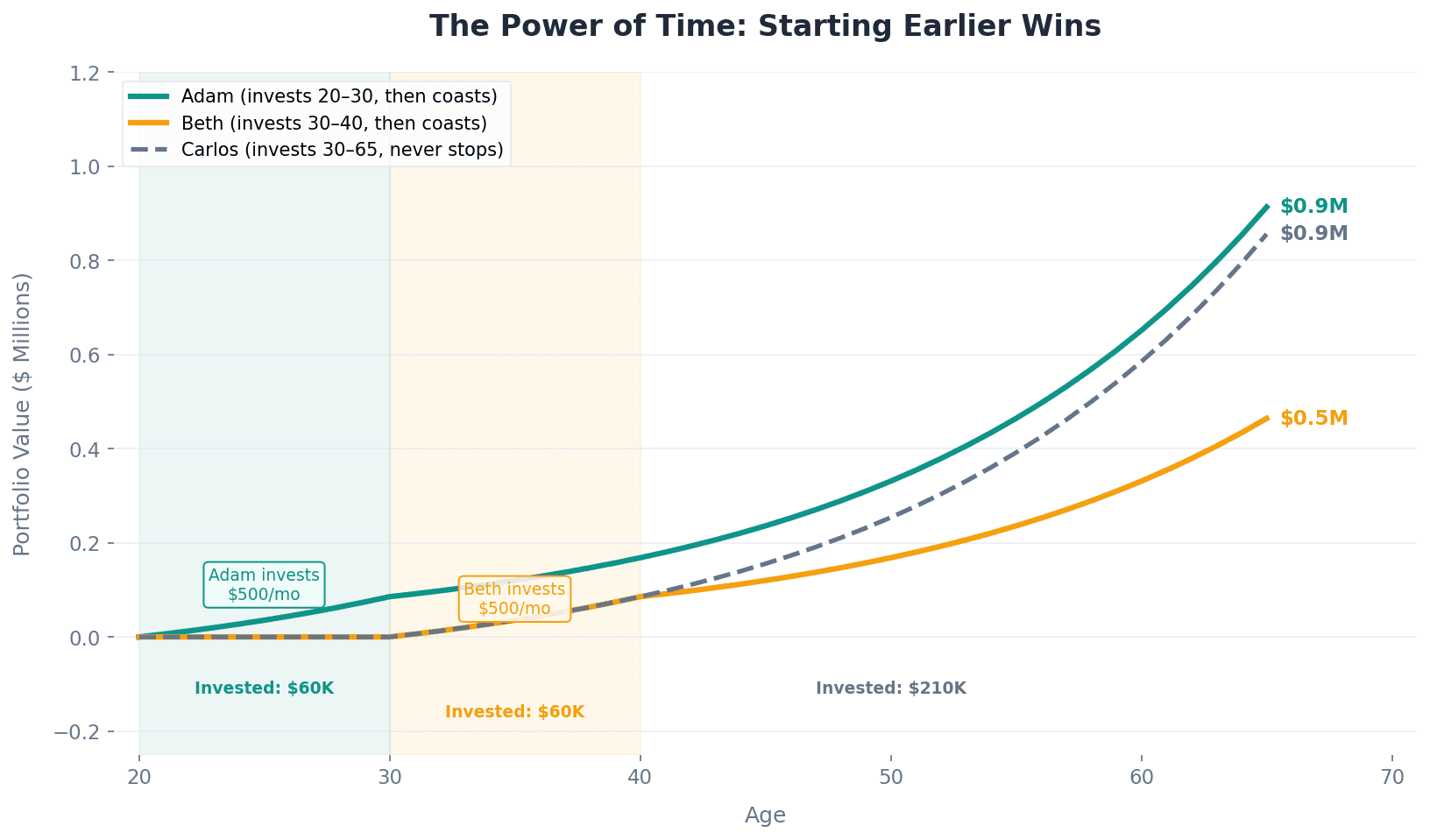
Adam, Beth and Carlos make the same point from the other side. All three invest $500 a month at 7 % real. Adam does it from 20 to 30 and stops; Beth from 30 to 40 and stops; Carlos from 30 to 65 and never stops.
| Person | Total invested | Value at 65 |
|---|---|---|
| Adam (20–30, then stops) | $60,000 | $910,000 |
| Beth (30–40, then stops) | $60,000 | $460,000 |
| Carlos (30–65, never stops) | $210,000 | $860,000 |
Carlos invested 3.5× what Adam did, for 25 more years, and still ended with less. Adam's ten early years did more work than Carlos's extra $150,000.
Why I plan with 5 %, not 7 %
Here is the part the Coast FIRE pages leave out, and the reason I have not treated our own coast number as a finish line.
The 7 % is an average. Coast FIRE removes your last lever, the contribution, and then hands the result to whichever twenty or thirty years you happen to get. I pulled Robert Shiller's US stock market data (the open dataset is the same series) and worked out rolling 20-year real total returns, dividends reinvested. The median is about 6.8 %, a shade under the 7 % in the tables above. But:
- 22 % of all 20-year windows since 1871 came in under 4 % a year. The worst, mid-1901 to mid-1921, was slightly negative over the whole twenty years; January 1962 to January 1982 managed 0.7 %.
- Since 1926, 19 of the 78 twenty-year windows starting in January were under 4 %. None was negative, and that is the sentence people lean on. It does not help much: a 1 % decade-pair still leaves a coast plan at a third of its target.
- The "lost decade" was worse than flat. From January 2000 to January 2010 the S&P 500 lost about 3 % a year in real terms, roughly a quarter of its purchasing power.
 Data: Robert J. Shiller, US equity real total returns 1871–2024. The same chart, and what it did to our plan, is in Coast FIRE isn't a permission slip.
So I plan with 5 %. It sits below the 5.2 % that world equities returned after inflation over 1900 to 2024 (the UBS yearbook figure I used in Coast FIRE isn't a permission slip), well below the US 6.6 %, and if it is wrong it is wrong in the direction I can live through. My wife and I have not crossed our coast number yet; it lands around 40, six to eight years out, and when we do we intend to keep investing and buy a four-day week rather than stop. Coast FIRE is the floor of a plan, the month it stops being fragile. It is not the month you are allowed to walk out.
The practical rule that follows: if the market hands you a bad decade, restart contributions for a few years. You do not have to coast no matter what.
What Coast FIRE changes about work
Before: "I have to stay at this job because I need to save for retirement."
After: "My retirement is handled. I just need to cover my monthly expenses, and I can do that with work I actually enjoy, even if it pays less."
Once the floor is in, a pay cut for better hours, freelancing, a business, a four-day week, or a calm job hunt all stop being existential. You still need to earn a living, an emergency fund of three to six months, and a yearly recalculation, because lifestyle creep moves the FIRE number and therefore the coast number with it.
US tax accounts: the 2026 limits
The US tax code is generous to long-term investors, and for Coast FIRE a tax-free wrapper means the compounding is never taxed on the way up.
| Account | 2026 limit | Why it matters for Coast FIRE |
|---|---|---|
| 401(k) | $24,500 (+$8,000 catch-up at 50) | Take the employer match first; it is the best return you will get |
| IRA (Roth or traditional) | $7,500 (+$1,100 catch-up at 50) | A Roth compounds tax-free and comes out tax-free; the best Coast FIRE wrapper there is |
| HSA (with a high-deductible plan) | $4,400 self-only, $8,750 family | Deductible in, tax-free growth, tax-free out for medical costs; after 65, taxable withdrawals for anything |
| Taxable brokerage | no limit | Long-term gains are taxed at 0 % below $49,450 of taxable income for a single filer in 2026 ($98,900 married) |
Order of operations: 401(k) up to the match, then the Roth IRA, then the HSA if you have one, then the brokerage account. What to invest in: total stock market index funds (VTI, VTSAX) or total world funds (VT, VTWAX). Broad and cheap.
Common objections
"7 % a year? That's optimistic."
For the US it is slightly above the record since 1900 (6.6 % real), and the risk section above shows what the bad decades look like. Use 5 % if you want a plan that survives them; the calculator lets you set either.
"What if I need that money earlier?"
Your Coast FIRE portfolio is untouchable until retirement; that is what makes the exponent work. Emergencies come out of the emergency fund and your expenses out of income. If you have to raid the pot, recompute the number from what is left.
"Why would I stop investing?"
You do not have to. Coast FIRE is the floor, not the ceiling. Everything above it retires you earlier or richer, and it is the only defence you have against a 1962 or a 2000 start.
"$3,500 a month in retirement won't be enough."
Then use your own figure. In retirement most people have no mortgage, commute or childcare, so the number is usually lower than today's spending, but the formula works with any target.
Conclusion
Coast FIRE is not about becoming a millionaire. It is about one thing: time is your greatest ally, and the sooner you put it to work, the less you have to do yourself. A few years of real commitment at the start, a return assumption you can defend, a yearly check that the target has not moved, and the math carries you.
Run your own numbers in the Coast FIRE calculator: age, spending, what you already have, and the return you believe in.
Where to go next
- Coast FIRE isn't a permission slip — what the worst two decades on record do to a coast plan, and what we intend to do on the day we cross ours
- My FIRE journey — how my wife and I are doing it
- The best index funds and ETFs — where to put the money
- Understanding inflation — why every figure here is in today's dollars
New to all of this? Start with How to start a budget and Investing made simple.
Questions? Email me at dennis.vymer@myfinancialfreedomtracker.com.
Frequently asked questions
- What is the Coast FIRE formula?
- Coast FIRE number = (annual spending × 25) ÷ (1 + real return)^(years until retirement). The 25 comes from the 4% rule, the real return is the market return after inflation (about 6.6% a year for US stocks since 1900; many people plan with 5%), and the exponent is the years your money has left to grow. Spending $3,500 a month at age 30 with retirement at 65 gives $1,050,000 ÷ 1.07^35, about $98,000 at 7% real.
- Is a 7% annual return realistic for Coast FIRE?
- It is slightly above the 125-year US record: 6.6% a year after inflation from 1900 to 2025, per the UBS Global Investment Returns Yearbook. The catch is the range around that average. Since 1871, 22% of all 20-year windows returned under 4% a year in real terms, and 2000 to 2010 lost about 3% a year. A plan built on 5% real survives most of those; one built on 7% needs you to restart contributions after a bad decade.
- How much do I need for Coast FIRE at 30?
- For $3,500 a month of retirement spending ($1,050,000 FIRE number) and retirement at 65, about $98,000 at a 7% real return or $190,000 at 5%, in today's dollars. If you are saving toward it rather than holding it already, the target rises every year you are still saving; at $1,500 a month you cross the moving line at about 37 (7%) or 45 (5%).
- Do I have to stop investing after reaching Coast FIRE?
- No. Coast FIRE is the floor, not the ceiling. It means you no longer have to invest for a standard retirement, not that you must stop, and continuing to invest is the only defence you have against a bad twenty years. Everything above the floor retires you earlier or richer.
- What if I need my Coast FIRE money before retirement?
- Treat the Coast FIRE portfolio as untouchable until retirement; the exponent only works if the money stays invested. Emergencies come out of an emergency fund and living costs out of income. If you do have to take money out, recompute the number from what is left.
- What if $3,500 a month won't be enough in retirement?
- Use your own figure. In retirement most people have no mortgage, commute or childcare, so the number is usually lower than today's spending, but the formula works with any target: annual spending × 25, discounted by the years you have left.
- Is Coast FIRE the same as Barista FIRE?
- No. With Coast FIRE your existing investments grow to the full retirement target on their own and your job only has to cover today's expenses. With Barista FIRE you have already stopped saving and you draw part of your living costs from the portfolio, with part-time income covering the rest. Coast FIRE needs the smaller portfolio of the two.
Stay Updated
Get notified about new articles and MFFT build-in-public updates.
Ready to Apply This?
Start tracking your finances today and put these tips into practice.
- Import bank statements in seconds
- AI-powered categorization
- Beautiful visualizations
- Set and track financial goals
Related posts
 Start Here
How Long Will Your Savings Last in Retirement? (Table)
At 4% a year and a 3% real return, savings last about 44 years; at 6%, about 22. Two bad years at the start can cut a 37.4-year plan to 21.5.
 Start Here
One More Year Syndrome Starts the First Time You Raise Your FIRE Number
Our daughter is the first thing in five years I'd accept as a reason to change our FIRE number. One more year syndrome doesn't wait for the finish line: it starts the first time a good market year talks you into a bigger target. Market moves the date. Life moves the number.
 Start Here
Retire Early Abroad: Why the Cheap-Country Discount Shrinks
Moving somewhere cheaper does cut your FIRE number, by less than advertised and not for good. A view from Czechia, one of the countries on those lists.
 Start Here
Lean FIRE vs Fat FIRE: Price Your Spending Floor First
Top pages can't agree if fat FIRE starts at $100,000 or $200,000 a year. The tier is an output: price your spending floor first, then see which FIRE fits.
 Start Here
I Want Free Wednesdays at 40. I Can Buy One This Friday.
I'm saving for free Wednesdays twelve years out and had never once asked what one costs today. So I ran it: on my own model a four-day week at 80% pay delays financial independence by 21 to 49 months. And if your spending falls with your income, by exactly nothing.