Our Daughter Moved Our FIRE Date by Six Months, Not Years

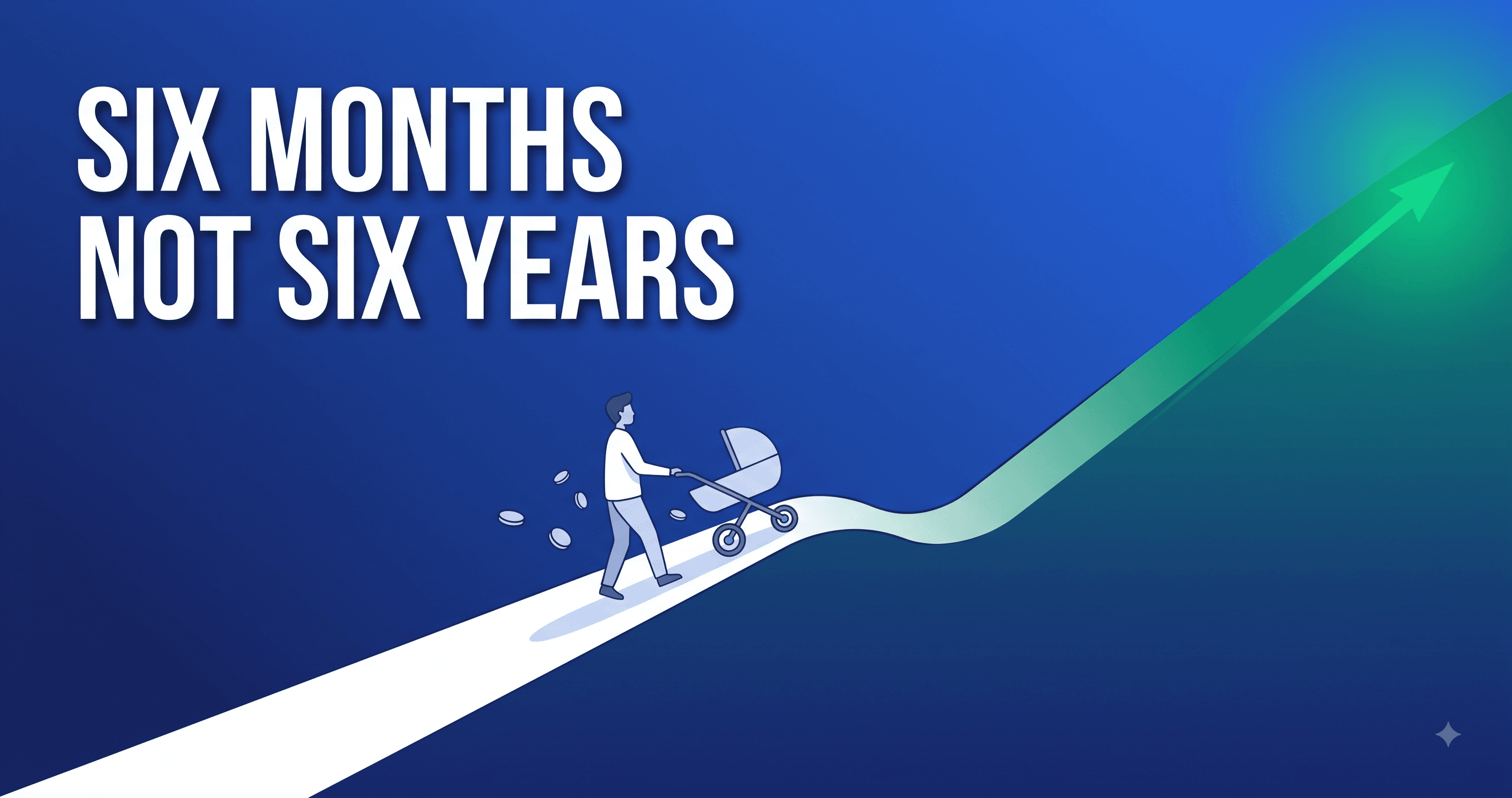
At three in the morning, a few weeks after we found out our daughter was coming, I was lying in bed adding up strollers on my phone.
Not one stroller. All of them. I had a tab open for the pram, a tab for the car seat, a tab for a breathing monitor I hadn't known existed two days earlier, and underneath all of it a calculator with a number in it I did not like. My wife was asleep next to me. I was quietly trying to work out how much a baby delays FIRE, and the answers I was getting made me want to go sell something.
That was the low point, and I want to be honest that it happened, because two months into actually having her the answer turned out to be boring. Our savings rate went from around 60% of household income to around 50%. Our financial independence date moved by roughly six months.
Six months. Not six years. And almost none of that six months was the baby.
Here's the part the spreadsheet never had a cell for. She is, by an embarrassing margin, the best thing that has ever happened to either of us. I spent a week of sleepless nights running arithmetic about a person who now falls asleep on my chest and quietly rearranges what I think a good day looks like. So while the rest of this is me showing my work — savings rates, charts, the whole nervous apparatus — hold it next to the actual outcome: the numbers turned out small, and she turned out to be everything. That's the real headline. Everything below is just the footnotes.
How much a baby delays FIRE, and why my first answer was wrong
The math that terrified me at 3am is the most-quoted table in the FIRE world: Mr. Money Mustache's savings rate chart. Save 60% of your take-home and you're done in about 12.5 years. Save 50% and it's about 17. So a ten-point drop in savings rate costs you four years and change.
Four years. For one baby. I sat with that number for about a week before I noticed the sentence sitting right above the table in his own post: "starting from a net worth of zero."
That's the whole trick. The table answers "if I owned nothing at all and saved X% forever, when would I be free?" It doesn't answer the question every existing saver has, which is "I already have a portfolio and my savings rate is about to change for a while." Those give wildly different answers, and the internet quotes the first one at people living the second.
We already had a portfolio doing its own work. That portfolio does not care that we bought a car seat.
What nine months of warning is actually worth
Here's the unglamorous version of what we did, and I want to be clear it wasn't clever. It was just early. We hold a proper financial date every January, longer and more serious than our usual monthly 10-minute coffee session over the bank statement. That January we planned the baby year like pessimists on purpose: my wife home for two to three years, household income down, expenses up, no heroic assumptions anywhere. Then I modeled the scenarios in the life planning side of the tracker I've been building, mostly because I wanted the worry to become a number instead of a feeling.
The long-term effect was, and I mean this literally, nothing much. That was the moment the pressure came off, and we could go back to being excited about a baby instead of doing arithmetic at three in the morning.
Then we spread the shopping across nine months. This is the part I'd tell anyone. You don't need the whole nursery in one weekend, and pregnancy hands you the one thing personal finance never gives you: a deadline you know about in advance. So we reprioritized rather than cut. That year's "random expenses" pot didn't buy a new TV. It bought a stroller. Then a month later, a cot. Then a car seat.
Vinted did more of the heavy lifting than I expected. The stuff arrives barely used, because of course it does, a baby wears something for a couple of months and then never fits in it again. We got a stroller second-hand I'd have paid full price for without blinking. Bazoš handled a couple of the bigger items. The car seat and the mattress we bought new anyway, because safety gear with a crash history you can't see isn't where I want to save 3,000 CZK.
And we built a buffer of roughly one month's salary on top of the emergency fund, purely for baby surprises. I'm glad past me was paranoid, because we used it. Not on anything dramatic. Just the steady drip of things nobody warns you about, arriving faster than the budget expected.
A bad year costs you months. A bad habit costs you years.
Once I stopped panicking I ran the scenarios properly, and the result is the most useful thing I've learned this year.
 My own model, not a citation. A household starting from zero at a 60% savings rate, 5% real return, 4% withdrawal rate, monthly compounding, FI target of 25× current annual spending, change applied in year 6. Assumptions deliberately match Mr. Money Mustache's so the two are comparable.
One genuinely hard baby year, where income drops a fifth and spending jumps a quarter and then everything returns to normal, costs about four months.
Permanently deciding that life now costs 25% more costs three years and change.
Same household, same savings rate, and the permanent version is roughly ten times more expensive than the temporary one. And the mechanism is simple once you see it. A temporary income dip only costs you the contributions you missed while it lasted. The pile you already have keeps compounding right through it, completely indifferent to your situation. But a permanent spending increase hits you twice: you save less every month and your finish line moves away from you, because the finish line is a multiple of what you spend.
Even half that creep, a permanent 12.5%, costs a year and a half. And the bar at the bottom is the scary table I started with, still predicting four and a half years for a household that owns nothing.
The baby lowers your income for a while. Lifestyle creep raises your target forever.
So the honest headline isn't "kids are cheap." It's that the years people lose after a baby get lost to the decisions made around the baby, when everyone's tired and scared and the big irreversible purchases feel justified because, well, we have a child now. The bigger house. The bigger car. The permanent upgrade to everything, locked in during the worst six weeks of sleep of your life. I understand the impulse completely. It's just expensive in a way the baby isn't.
I went looking for a stat that would make me feel better
I'd read somewhere that parents out-earn non-parents, and I went hunting for the research, mostly so I could put a reassuring number in this article. I found it, and then I kept reading, which ruined it.
There is a real "fatherhood premium" — studies of US panel data put it as high as 11.6%, but the careful reassessments whittle it down to maybe 4%, and only for married dads living with their kids. It isn't earned by working harder, either; employers just seem to read fatherhood as stability and hand it over. So there might be a small raise coming. I'm not building a plan on it.
And I can't quote it honestly without the other half. The same research finds a motherhood penalty of around 4% per child that no amount of controlling for hours or "family-friendly jobs" explains away, and the cleanest study in the field finds kids open a long-run gender earnings gap near 20%. Which leaves me with an open question I don't love the answer to: the tidy "parents earn more" story mostly means some fathers get a nudge up while most mothers take a bigger cut. If there's a bonus in becoming a family, it isn't landing evenly — and that uneven landing is a thread I have to pick up again in a minute.
The part where our FIRE delay is partly a Czech passport
I have to put an asterisk on our six months, because a good chunk of it was bought for us by where we happen to live.
A Czech family with a child born from 2024 onward gets a parental allowance of 350,000 CZK in total, and the family decides how fast to draw it, up to the child's third birthday. Take it at the 15,000 CZK monthly ceiling and it covers about 23 months. Stretch it across the full three years and it's around 9,700 CZK a month. So the one thing my spreadsheet actually cared about, how steeply our income dipped and for how long, is a dial we were allowed to set ourselves.
An American family gets twelve unpaid weeks under federal law, and only if the employer has at least fifty staff. In 2023, the last year the Bureau of Labor Statistics managed to publish the figure, 27% of private-sector workers had any employer-paid family leave at all. Infant childcare runs somewhere around $17,000 a year, and as of March 2025 only 13% of private-sector workers get any childcare benefit. When US parents say kids make FIRE much harder, they are not being dramatic. They're describing a bill we mostly don't get. The one thing they do now get in the other direction is a federal seed for every newborn — $1,000 into a Trump Account at birth, which is rounding error against $17,000 of childcare but compounds for eighteen years.
But the Czech version has a cost, and it isn't ours to feel comfortable about. It lands on my wife.
 Data: Child Penalty Atlas (Kleven, Landais & Leite-Mariante, LSE). Employment penalty, not earnings.
Czechia has the highest child employment penalty in Europe, around 50% averaged across the decade after a first birth. That statistic gets used to argue Czech mothers are permanently wrecked, and the year-by-year data says something more interesting. The penalty peaks above 90% in year one, when mothers are on leave and simply not in the labour force. By year ten it's 21.6% against America's 22.9%, which given the confidence intervals means level, not better. So Czechia takes the whole hit up front and then most of it comes back. The American line barely moves, because there was never a pause to come back from. Worth knowing before you quote that 50% at anyone: the Czech estimate is built on survey waves ending in 2016, when the leave still ran to four years rather than three.
And Budig's own conclusion is the part that stings: extended parental leaves, the three-year kind, are associated with larger wage penalties for mothers, not smaller ones. The generous three-year leave that makes our FIRE math look tidy is also a real risk to my wife's earning trajectory. Our six months isn't a free lunch. It's a cost that lands somewhere other than the spreadsheet, and pretending otherwise would make this a worse article.
What we cut, and what we wouldn't
The adjustments were smaller than the fear suggested. Fun money took the hit. We each have a personal pot we never justify to each other, and both got trimmed, mine more than hers. A few other "wants" categories got pulled down for the next couple of years. That's the whole tightening, honestly.
What we didn't touch: food quality, the proper creams, the things that matter for a small human developing properly. Second-hand the stroller, not the nutrition. She gets the good stuff. The version of me that agonised over a car seat at 3am is very relaxed about spending on her now that she's here and looking up at us — funny how that works.
Ask me again when she's five
Here's my honest caveat, and it's a big one: she's two months old. I have a sample size of one child and two months of data, and I'm generalizing to eighteen years. Year one is the cheap year in Czechia, and it isn't in the US, where infant childcare is the single biggest line item.
Teenagers are more expensive than babies. University exists. And the strongest argument against my whole thesis is that we planned this pessimistically in January and then beat our own plan, which means what I'm really claiming isn't "a baby is cheap." It's that the plan is the variable, and we got lucky enough to have made one. So when someone asks how much a baby delays FIRE, the useful answer isn't a number at all. It's a question back: did you model it, or are you guessing at 3am like I was? The families whose FI date slips by years are disproportionately the ones who never sat down with a coffee and did the boring version first.
If you want the mechanics of the rest of our plan, I wrote up our actual path to financial freedom and how we run money as a couple. If the baby math has you wondering whether the aggressive-forever version is even necessary, Coast FIRE is the version I'd point most new parents at, and the savings rate is still doing more work than your returns no matter what the market does this year. I ran our scenarios in the tracker I build, which is obviously my own product, so take that for what it's worth. A spreadsheet would have told us the same thing. The tool just meant I actually did it instead of intending to.
Two months in, we're settled. It does mean tightening up for the next couple of years, and I'd do it again tomorrow. The trade we made was some fun money for a lot of time with her while she's small, and I've never made a better one.
She looks at me and the six months stops being a number.
Stay Updated
Get notified about new articles and MFFT build-in-public updates.
Ready to Apply This?
Start tracking your finances today and put these tips into practice.
- Import bank statements in seconds
- AI-powered categorization
- Beautiful visualizations
- Set and track financial goals
Related posts
 My Journey
Health Is the One Asset in Our FIRE Plan I Can't Buy Back at 40 — and This Year I've Been Quietly Spending It
Health and skills compound like the ETF does, and they're the only assets in our FIRE plan I can't buy back at 40 with a bigger number. This year, the first baby year, is the first time I've run a real deficit on one of them. No morning routine at the end.
 My Journey
I Never Sold My Wife on FIRE. I Sold Her a Free Wednesday.
Six months before the wedding we opened every account to each other. It was tough. What we never did, then or since, was say the word FIRE. Eight years on, I still think buy-in is agreement on a Wednesday, not agreement on a number.
 My Journey
I Don't Believe in Cutting Coffee. One Fixed-Cost Audit Freed 4,000 Kč a Month.
I've argued for years that cutting coffee is the weakest lever in personal finance. Then one Sunday with our contracts freed 4,000 Kč a month and I had to rewrite it.
 My Journey
We're Investing for Our Daughter. She Won't Get Any of It at 18.
Investing for your child gets argued about as if it were an account problem. We use the same boring world ETF we buy for ourselves, nothing with her name on it, and she won't be told the number for years. Everyone argues about how much and where. Almost nobody argues about when.
 My Journey
Our Monthly Money Date Takes 10 Minutes. The Only Money Meeting That Matters Happens in January.
I timed our monthly money date: eleven minutes, four of them the coffee. The internet prescribes eighty. I think the length of that meeting isn't discipline — it's a readout of how much money is still waiting for someone to decide something.