One Lucky Tesla Pick Made Me Feel Like a Genius. Crypto Sent Me the Invoice.

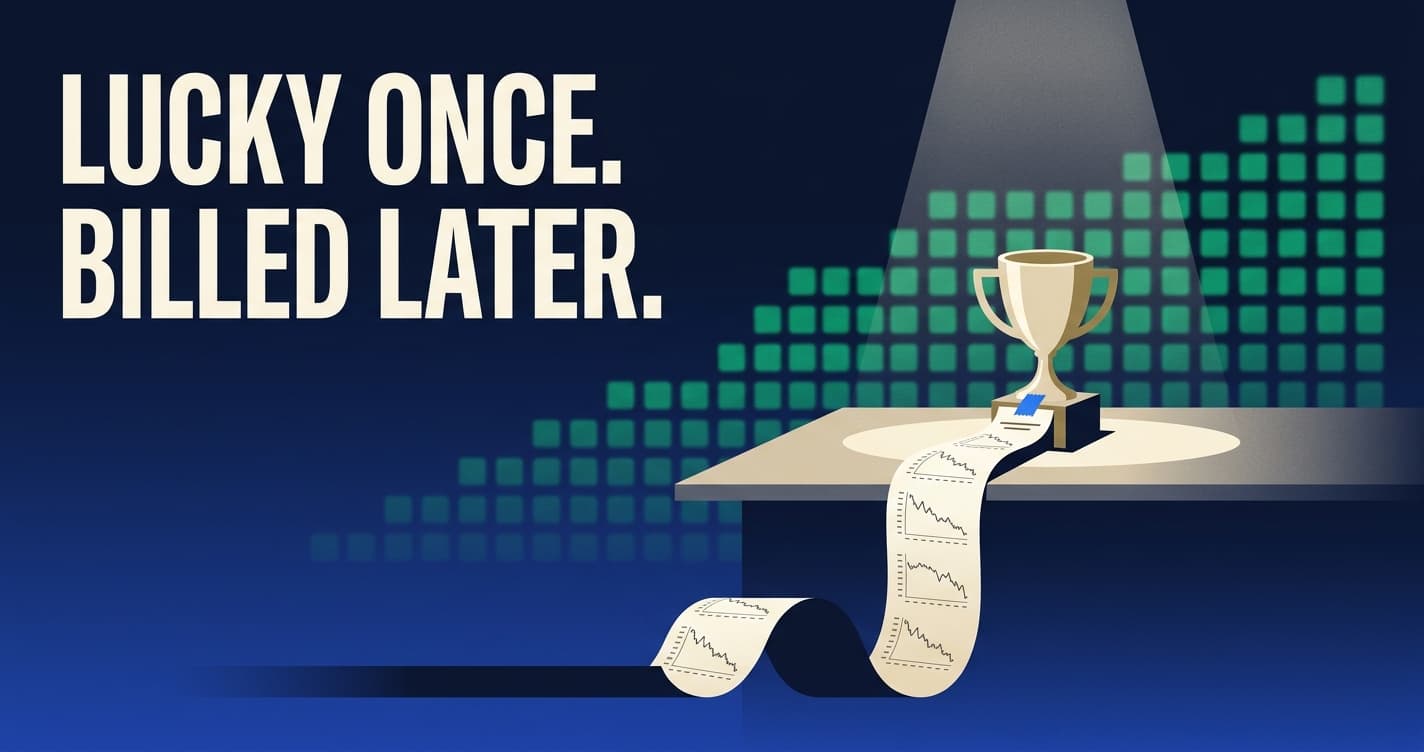
I was somewhere around twenty when I put everything I had into Tesla.
"Everything" needs an asterisk. It was money from jobs, scraped together over a couple of years, and by any adult standard it was not a lot. But it was 100% of what I had set aside. One company. No position sizing, no plan B, no thesis I could have written down if you'd asked me to defend it.
It worked.
And that is the part I'm still paying for, because the money was never the expensive bit. The expensive bit was the story the win wrote about me.
What a lucky stock pick actually buys you
Nothing dramatic happened. I didn't start posting charts or calling myself a trader. What happened was quieter and worse: I walked around for a couple of years with a small, unearned belief sitting in the back of my head that I could read markets. That I had some feel for it. That when I looked at a company and had a hunch, the hunch meant something.
I never said that out loud. You don't have to. It just quietly changes what you do next.
There's a paper that describes this better than I can. Simon Gervais and Terrance Odean modelled a trader who doesn't know how good he is and has to learn it from his own results, and their finding is uncomfortably specific: "in assessing his ability the trader takes too much credit for his successes. This leads him to become overconfident." Then the line that made me put my coffee down: "Overconfidence does not make traders wealthy, but the process of becoming wealthy can make traders overconfident." And the worst moment for it is early: their model says overconfidence peaks "when a trader is inexperienced and successful," and that "the greatest overconfidence in a trader's life span comes early in his career." That is a finance journal from 2001 describing me at twenty, down to the adjectives.
Inexperienced and successful.
The price tag on that is measurable, which I find grimly funny. Barber and Odean went through 66,465 households at a discount broker between 1991 and 1996 and found the most active traders earned 11.4% a year while the market did 17.9%. Six and a half percentage points a year, handed over for the privilege of feeling clever.
I didn't trade like that. I just went looking for the next one.
The next one was crypto, and I was very good at it for about eight months
I was in it for a year or two. Bitcoin, Ethereum, Cardano. At some point I was up around 5x on paper, and I want to be precise about "on paper," because that number never touched my bank account and never will. It was a screen. I looked at the screen a lot.
Then it fell over, and here's the confession that actually matters: I didn't sell because I was certain it was coming back. Not hopeful. Certain. I knew. I'd been right before, remember. The dip was other people panicking and I was the guy who understood.
Richard Thaler and Eric Johnson named this in 1990 and it's not a compliment. After a gain, people take more risk with what they see as "house money." After a loss, gambles that offer a shot at getting back to even become weirdly attractive. I hit both in sequence, which is apparently the standard route.
I wasn't alone, either. The Bank for International Settlements built a database of retail crypto app downloads and found that 73% of users downloaded their app when Bitcoin was above $20,000. Running a simple simulation where each new user buys $100 a month from the moment they sign up, 81% would have lost money, with the median investor down 48% of the $900 they'd put in. The BIS summary line is "73–81% of global investors have likely lost money on their crypto investment." That's a simulation on download timing rather than audited profit and loss, and it's worth saying so, but the shape of it is right and I was inside the shape.
Eventually I stopped waiting and moved the money into companies that actually make things. Not because I'd had a revelation. Because I'd become a product manager and couldn't unsee what I was looking at.
The thing nobody tells you: I was half right, and half right is worse
Here is the part that would be easy to leave out, so let's put it at the top of the section.
Bitcoin came back.
 Data: Yahoo Finance daily closes (BTC-USD, ETH-USD, ADA-USD, ACWI). World equities are dividend-adjusted; crypto is price only.
From the peak week of November 2021 to the end of August 2026, Bitcoin is up about 22%. My conviction that "it comes back" wasn't stupid. It was just aimed at the wrong noun. Ethereum is still down about 46%. Cardano, the one I could argue for most enthusiastically at a party, is down roughly 90% — and against its own all-time high from September 2021 it sits about 93% lower as I write this.
Meanwhile the boring thing I wasn't buying, a plain global equity index, is up around 66% over the same stretch. Just sitting there. Doing nothing. Owned by people with no opinions.
So the lesson isn't "crypto is a scam." I don't think that, and I'd be lying if I pretended the last five years proved it. The lesson is narrower and more embarrassing: I was certain, I was partially right, and being partially right while holding the wrong three-letter ticker is functionally identical to being wrong. Certainty is the product being sold, and certainty is the one thing nobody in this market is qualified to have.
Why I ended up buying companies instead
The reason I got out wasn't a crash. It was a job.
I'd started taking product management seriously, and the whole discipline is basically a machine for asking "who does this actually help, and how do we know?" Once that machine is running in your head, you can't switch it off when you open your portfolio.
Look at a company you own a share of. Take Apple. Whatever you think of them, there are tens of thousands of people who got up this morning and went to work trying to make that product marginally better. Is all of it good? Obviously not. Plenty of it is wasted, misdirected, or a rounding error. But the direction of the effort is toward someone eventually paying for something because it improved their day.
Then I looked at what I owned in crypto and tried to run the same question. And I couldn't answer it. There was the NFT wave, which I found genuinely strange at the time and which aged how you'd expect — one widely reported 2023 study of 73,257 NFT collections found 95% of them had a market cap of zero. There were other value propositions along the way. None of them caught on hard enough that ordinary people started assigning the thing durable, long-term value. Not "no innovation happened." Just: nothing arrived that made me able to answer the question.
That's the whole switch. Not fear, not a crash, not a lecture from anyone. I just stopped being able to explain to myself who was doing the work.
Why stock picking stopped making sense to me
Now it's one accumulating world ETF, bought every month through Interactive Brokers, automatically, whether or not I have an opinion that week. The fund I use holds 3,782 companies. I have no view on 3,781 of them. That's the feature.
I know how that sounds after the story I just told. So let me hand you the numbers that convinced me, rather than the anecdote, because the anecdote proves nothing.
Hendrik Bessembinder and colleagues went through more than 64,000 global stocks from 1990 to 2020. Over that period, 55.2% of US stocks and 57.4% of non-US stocks failed to beat a one-month Treasury bill. Not failed to beat the index. Failed to beat cash.
 Data: Bessembinder, Chen, Choi & Wei, Financial Analysts Journal 2023 (global); Bessembinder, Journal of Financial Economics 2018 (US).
The top 2.4% of firms accounted for the entire $75.7 trillion of net global wealth creation. Everything else, collectively, netted out to roughly what you'd have earned in bills. In his earlier US study the single most common lifetime outcome for an individual stock was a loss of essentially everything, and the median stock's lifetime return was slightly negative.
Read that as a job description for stock picking and it stops sounding heroic. You aren't trying to find a good company. You're trying to find one of the two per cent, hold it through a drawdown that will make you feel physically unwell, and not sell. I did in fact find one of them. Tesla returned something like thirty-four times its money from the end of 2013 to today. It also fell 73.6% from November 2021 to January 2023 and lost 65% in the calendar year 2022 alone. Would twenty-year-old me, who thought he had a gift, have held through that? I genuinely don't know, and that uncertainty is the most honest sentence in this article.
If professionals can't do it, my hunch isn't going to. Over ten years, 98.44% of euro-denominated global equity funds failed to beat the S&P World index — people doing this full time, with teams, with terminals. I wrote about the wider version of that self-inflicted damage in the gap between what funds return and what investors actually get, and about picking the boring vehicle itself in world ETFs.
2026 is manufacturing a fresh batch of geniuses right now
This is why I'm writing it this year rather than any other.
SanDisk is up about 560% in 2026. Moderna about 387%. Micron about 242%. Somewhere out there are thousands of people who bought one of those, are up triple digits, and are currently having the exact experience I had at twenty. The half-year debriefs are full of them, and most of the "my biggest investing mistakes" posts you'll read this year are written by someone whose regret is that they didn't bet bigger.
And Tesla, the stock that made me feel clever, is down about 22% year to date while the world index is up around 11%. The chart that built my confidence is now the cautionary chart. Same company. Nothing about me changed.
I'm not telling anyone to sell their winner. I'm telling you the winner is going to try to explain itself to you, and the explanation will be about your judgement. It isn't. If you want the fuller argument about what happens when everyone crowds into the same handful of names, I went through the AI concentration case separately.
Where my own argument falls apart
Three places, and I'd rather say them than have someone else say them.
The first is that my "boring" world ETF is already a tech bet. Information technology is 30.28% of the MSCI ACWI, the top ten holdings are 24.21% of it, and the US is 63.55% of the "world." I still carry a small tech tilt on top of that, which I've never fully justified to myself. The best defence I have is a real one but a narrow one: I didn't stop owning tech. I stopped choosing which tech. Index concentration is an outcome of what other people are willing to pay, not a forecast I have to be right about. That's a genuine difference. It's also not the same as being diversified, and I've written about why an index fund is less spread out than it looks.
The second is that Bessembinder himself points out the concentration finding is partly mechanical. Pure randomness produces some concentration after the fact, and big long-lived firms get more weight by construction. Anyone quoting "2.4% of stocks" as though it were a moral fact, me included, is leaning on it a bit hard.
The third is the one that actually bothers me. I won on Tesla and got out of crypto with my capital intact. Someone who lost on Tesla and rode Cardano all the way down would be writing this same essay with the same confidence and a different moral. My conclusion is drawn from a sample of one life, and it's a life where things went fine. That's exactly the self-attribution problem I opened with, just pointed in the humble direction. Which is why the argument has to rest on 64,000 stocks and not on my twenties.
What I actually do now
I still watch crypto. Not for entry points, for ideas — I'm curious whether anything shows up that I could finally answer the "who does this help" question about. So far, for me, not really. That could easily be my failure of imagination rather than the technology's failure to deliver, and I'll take that on the chin.
Mostly, though, I stopped putting effort into being right about companies and started putting it into being worth more at work. That's where my returns have actually come from, and it's the least glamorous sentence I've ever published. The tracker I build exists partly so I can look at where our money actually sits without a story attached to it — the whole plan is here, and yes, that's my product, weigh it accordingly.
Getting proven wrong early, while the amounts were still small enough to be a lesson rather than a catastrophe, is the best thing that ever happened to our portfolio.
I got a cheap invoice for an expensive belief.
If you're up 300% on something right now, I hope it keeps going. I do. But you might want to write down, today, what you'd say the reason was. Then come back to it in three years and see whether the reason was ever really about you.
Stay Updated
Get notified about new articles and MFFT build-in-public updates.
Ready to Apply This?
Start tracking your finances today and put these tips into practice.
- Import bank statements in seconds
- AI-powered categorization
- Beautiful visualizations
- Set and track financial goals
Related posts
 My Journey
The Money Talk Before Marriage: We Did It in One Evening
Before our wedding we each put every number on one sheet: assets, debts, income, habits. Why that beat a list of questions, and why we then merged it all.
 My Journey
Accumulating vs Distributing ETF: Why Mine Pays Nothing
I buy one accumulating world ETF every month and it has never paid me a cent. Why I skip distributing funds while building, and why I'll sell shares later.
 My Journey
Coast FIRE Isn't a Permission Slip. For Us It's a Deadline — and We Won't Downshift When We Hit It.
Our coast FIRE number lands around 40 and I haven't crossed it yet. The internet treats that day as permission to quit and go part-time. I pulled 150 years of returns and ran the numbers: buying a four-day week costs one year of full FI, stopping costs sixteen.
 My Journey
We Bought Almost Everything for Our Daughter Second-Hand. The Money Was the Smallest Part.
The stroller, the cot, the chairs and most of her clothes came from someone else. The money we saved was small enough to be embarrassing. We bought second-hand baby gear anyway, because new is what the baby industry charges for reassurance.
 My Journey
When the Market Drops, I Do Nothing. Not Because I'm Disciplined — Because I Deleted the Decision.
The market fell in September and I did nothing. Not out of discipline — there was no decision left to make. Why I think buying the dip is panic selling with better manners, and the one exception I allow.