We Bought Almost Everything for Our Daughter Second-Hand. The Money Was the Smallest Part.

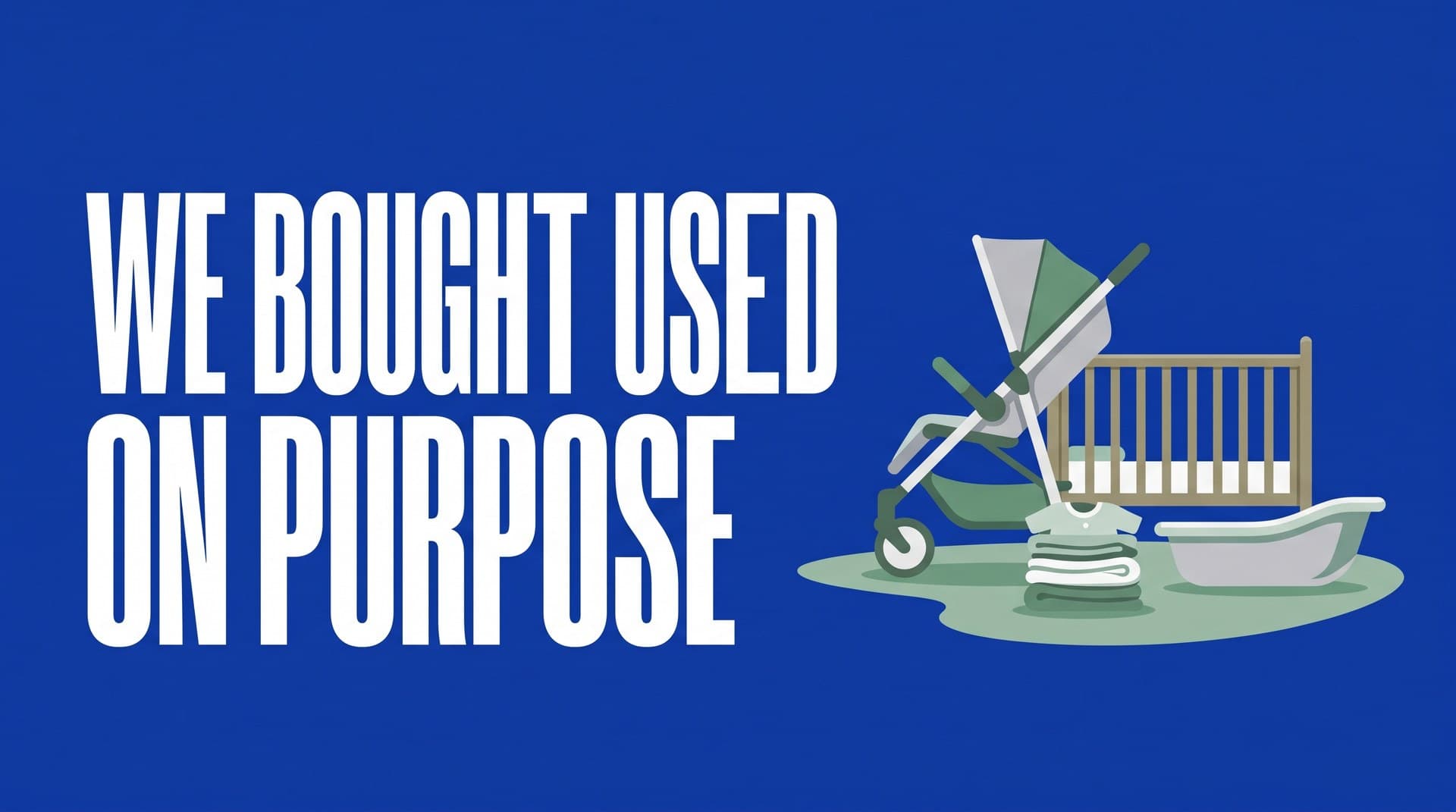
There are three baby bathtubs in our flat right now.
Two of them don't work. Not broken, not cracked, nothing you could describe to a seller. They just don't work, for reasons neither my wife nor I can put into words, and we found that out one at a time, buying the next one in a faintly annoyed way until the third one was fine. All three are second-hand baby gear, which is the only reason a mistake repeated three times stayed cheap enough to be worth making.
Almost everything else our daughter has used in her first months arrived the same way. The stroller came off Bazoš. The cot, the chairs, the bottle warmer, the little bath seat, most of the gadgets whose names I still don't know. A friend handed over a bag of clothes she'd finished with. Used was the default, not the fallback, and we never once sat down and decided it — we just kept not buying new things.
This is the point in the article where you expect a number. Total saved: X. I'm not going to give you one, and not for privacy reasons. I ran it in my head while writing this and it's small enough to be embarrassing, which is awkward, because I've spent two years on this blog arguing that cutting small purchases is the weakest lever in personal finance and that the only frugality that ever moved our numbers was one Sunday with our fixed contracts.
I still believe that. We bought used anyway, and not to save money.
We bought used because the first weeks of parenthood are when the wire between spending money and being a good parent gets soldered shut, and I wanted it cut before my daughter was old enough to watch me choose.
Baby gear is 5% of the first year. That's the entire money argument.
BabyCenter's 2025 survey of American mothers put the first year at $20,384, and the breakdown is the interesting part, not the total.
 Data: BabyCenter 2025 first-year cost survey, reported by Deseret News.
Childcare is $10,107 of it. Nearly half. Gear — the stroller and the car seat, the things this entire genre of article is about — is $956. Under five percent. Halve that line and you've saved roughly $478 across a year in which you'll also be paying for feeding, nappies and childcare.
That's not a savings strategy. That's a rounding error with a story attached.
The total doesn't survive contact with a second source either. The UK's MoneyHelper site quotes £600 for the first month plus around £95 after it, roughly £1,645 for the year, and then on the same page quotes an insurer's figure of up to £12,400. Two numbers seven times apart, both honest, measuring different sets of decisions.
Nobody discovers the first-year cost of a baby. You assemble it out of a few hundred decisions, and the expensive ones are childcare, housing and the contracts you sign. I modelled our baby year in the tool I built before she arrived, deliberately pessimistically, and the line that actually moved our savings rate from around 60% to around 50% was the fixed monthly stuff. It was never the gear.
So the money case for buying used baby things is real and small. Which leaves the question of why it felt like it mattered so much.
What is the word "new" actually selling?
Here's the most useful sentence I read while writing this, and it comes from the American Academy of Pediatrics, not from a personal finance blog. Writing in 2022 about the category of consumer products marketed to prevent sudden infant death, their safe-sleep policy statement says there is no evidence that any of these devices reduce the risk, and that they "may provide a false sense of security and complacency."
A paediatric body, in a policy document, describing a product category whose function is reassurance.
Once you've read that, the marketing stops looking like marketing and starts looking like a business model. Researchers went through 341 UK baby food products from 13 brands in 2024 and counted 1,666 marketing claims, a median of five per product, plus 1,003 emotional keywords. The single biggest emotional theme was love, at 36% of the emotional content. Their conclusion was that the labels may be exploiting parental vulnerabilities, which is a polite way of saying the pouch is selling you an answer to a question you were already asking at 4am.
The sociology is older than I expected. Afflerback and colleagues found in 2013 that mothers use consumer choices to demonstrate competent, responsible motherhood — cultural anxiety converting fairly directly into purchases. Ishizuka's survey experiment of over 3,600 parents found 75% rated intensive, high-investment parenting as very good or excellent, at nearly the same rate whether or not they had a degree. Everyone has absorbed the standard. Not everyone can afford it.
I'm not above any of this, by the way. Two of the four things we bought new for our daughter are on that list for exactly the reason this section describes, and I'll name them in a minute.
Most writing about baby gear argues about which items you should buy new. I think that's the wrong argument. The question underneath it is what you believe the newness is doing, and for a lot of items the honest answer is that it's doing something for you, not for the baby.
Buying second-hand baby gear here isn't brave. It's just normal.
I want to be careful not to dress this up as bravery, because nothing happened.
I expected judgement from somewhere — a relative, another parent, a look at a pickup. It never came, because in Czechia forwarding a bag of clothes and buying a used stroller is simply what people do. When I checked while writing this, the children's section of Bazoš had over 147,000 live listings, nearly 2,800 of them posted in the previous day. Vinted has more than a million users in a country of ten and a half million people. In the UK, Which? found a third of parents own a second-hand pushchair, and 89% of those parents are satisfied with it.
So I didn't swim against a current. I joined a queue that was already moving, and that's the bit that won't travel. The habit is nearly free where it's normal and genuinely expensive where it isn't. If you'd be the only person in your circle turning up to a baby shower with a used pram, you're paying in awkwardness what we paid in nothing. That's a real cost. I just didn't have to pay it.
The shame seems to be draining out of it elsewhere, too. Babylist added an "open to secondhand" flag to its registries at the end of 2024, and by its own figures the items parents mark that way are worth on average 73% more than the ones they don't. Company numbers, so hold them loosely. But the direction is telling. Parents aren't shy about used gear — they just flag the expensive things.
The short list we bought new — and two of the four are just preference
We did buy new, and I want to go through the list honestly rather than presenting it as a safety doctrine.
The car seat, which I'd defend to anyone. The AAP's position is that you shouldn't use a used seat if you don't know its history, and to reject anything crashed, recalled, cracked, missing its labels, or more than about six years past manufacture. Germany's ADAC published a six-point inspection for used seats in 2025 and concluded that a blind purchase is not recommendable. A seat that has absorbed a crash can look perfect and be finished, and a stranger on a marketplace has every incentive not to mention it.
Although new isn't the same as safe either. The European Commission bought child car seats off the shelf and tested them against the current i-Size rules, publishing the results in April 2026. Of the nine put through the dynamic crash test, seven failed. One seat passed everything. The failures included headrests breaking and inadequate protection of the head, neck and chest. All new, all on sale, all reassuring right up until the test sled fired.
The cot mattress, for a reason I can't fully stand behind. The study everyone cites is Tappin and colleagues in the BMJ in 2002: 131 infant deaths against 278 controls, with an odds ratio of 3.07 for routine use of a second-hand mattress, rising to 4.78 when it came from another home. The part that never makes it into the listicles is that when the mattress came from within the same family, the odds ratio was 1.64 and not statistically significant, and the authors wrote that there was insufficient evidence to judge whether the relation was cause and effect. The Lullaby Trust treats it as actionable advice. Australia's Red Nose reviewed the same paper and says there's no evidence of raised risk from a firm, clean, well-fitting mattress in good condition.
I read both positions and bought a new mattress anyway. That wasn't a data-driven decision. It was a decision about which version of 4am I wanted to be lying awake in.
The bottles and some of the cloth, which I can't defend at all. I went looking for a guideline while writing this and couldn't find one. Which? puts bottles and teats squarely in the fine-used column. No paediatric body I could find recommends buying them new. We bought them new because of a hygiene instinct we never examined, which is precisely the instinct the rest of this article is about.
So: two items on my new list are reasoned, and two are me paying for reassurance exactly like everyone else. I'd rather write that than pretend I ran a risk assessment.
And one in the other direction, since I'm listing my sins. We bought a used milk pump. The FDA treats pumps that aren't explicitly labelled for multiple users as single-user devices, because there's no way to guarantee one can be properly cleaned between owners. I didn't know that when we bought it.
Three bathtubs and a pump that didn't work
The pump also didn't work. It arrived dead.
That story has the dullest possible ending: I reported it through Vinted's own checkout, which we'd used instead of arranging a bank transfer, and the money came back quickly. No argument, no drama. The system worked, and the reason I'm still buying on that platform is that it worked when I needed it to rather than when I was reading the terms.
Then there are the bathtubs. Three of them, two useless, bought in sequence by two tired adults who were increasingly cross about the whole category. If I'd bought one new instead, for roughly what the three cost together, I'd have had a coin flip's chance of ending up with one of the two that don't work.
Used gear isn't frictionless. It costs evenings, messages that go unanswered, a drive across town, and occasionally a bathtub nobody will ever use. The reason it was still worth it has nothing to do with the money we didn't spend. It's that every one of those evenings was an evening I didn't spend confusing a purchase with parenting.
The honest case against buying second-hand baby gear
The counterarguments here are better than the internet's version of them, so here are the three that actually landed.
On a resale platform, you are the last line of defence, and that turns out to be a real job. Consumer Reports went looking this year and found all four categories of federally banned US baby sleep gear listed on Facebook Marketplace: drop-side cots, cot bumpers, inclined sleepers, in-bed sleepers. Their evaluators stopped counting after finding 50 in-bed sleepers inside a sample of 65 listings. Inclined sleepers and cot bumpers are associated with 180 reported deaths, which is why they were banned. Recall systems don't fix this either. The CPSC's own commissioned review of recall effectiveness found response rates running from 68% down to 28% depending on the product, and in one case 85% of owners knew about a recall while 44% bothered to check their own unit.
This is the strongest argument against me and it isn't close. Everything we bought used sits in a category where looking at the thing is enough — a stroller either rolls or it doesn't. I wouldn't buy a sleep product second-hand, and that list is the reason.
Standards also genuinely moved, so old is often worse. In the US, cots changed in 2011, strollers in 2015, high chairs in 2019, infant sleep products in 2022; in the UK, painted furniture from before 1973 and toys from before 1993 are their own problem. "Used" and "old" aren't the same word, and plenty of second-hand gear is both.
And fraud is not marginal. Which? surveyed over 1,300 second-hand buyers and found 32% had been scammed within two years. Vinted came out best of the nine platforms they ranked, and it was still 22%. Our pump was in that 22%. We got the money back because we used the platform's checkout, which is the entire trick and the one piece of tactical advice in this article.
And then the charge I like least, which is that for a household saving half its income this is theatre. Gear is under 5% of the first year. Halving it saves a few hundred dollars. It's a symbolic act, not a financial one. I can't rebut that, because I conceded it in the third paragraph. The defence is only that I wasn't buying savings. I was buying a default — the same reason I'm still driving a four-year-old Golf I had every excuse to replace.
She isn't old enough to watch yet
That's the whole reason to do it now.
She's a few months old. Nothing about how we buy her things is legible to her, and won't be for years — which is exactly why this was the cheap moment to set the default. A habit costs almost nothing to establish while nobody is watching and a great deal to change once someone is. By the time she can register what a new box means and what a stranger's hallway means, I'd like the answer to have been settled long enough that it isn't a lesson, just how her family does it.
We haven't sold anything on yet. Everything she's outgrown is still in the flat, which makes me a consumer of second-hand baby gear rather than a participant in it, and I'm more interested in that next part than I was in the buying. The day she's old enough to help photograph the outgrown bouncer and watch it go off to someone else's first months is the version of money I actually want her to inherit, years before she inherits anything with a number on it.
The bathtubs, though. Those two are staying, as a monument to a man who bought the same object three times and still thinks he's above marketing.
Stay Updated
Get notified about new articles and MFFT build-in-public updates.
Ready to Apply This?
Start tracking your finances today and put these tips into practice.
- Import bank statements in seconds
- AI-powered categorization
- Beautiful visualizations
- Set and track financial goals
Related posts
 My Journey
When the Market Drops, I Do Nothing. Not Because I'm Disciplined — Because I Deleted the Decision.
The market fell in September and I did nothing. Not out of discipline — there was no decision left to make. Why I think buying the dip is panic selling with better manners, and the one exception I allow.
 My Journey
When the Market Drops, I Do Nothing. Not Because I'm Disciplined, But Because I Deleted the Decision.
I found out about the June sell-off on the Monday, from a colleague at lunch who wanted to know if I was alright. My answer to what to do when the market drops is nothing, and it isn't discipline. I once put a third of my net worth into Cardano, and I still hold the wreckage as a reminder.
 My Journey
Health Is the One Asset in Our FIRE Plan I Can't Buy Back at 40 — and This Year I've Been Quietly Spending It
Health and skills compound like the ETF does, and they're the only assets in our FIRE plan I can't buy back at 40 with a bigger number. This year, the first baby year, is the first time I've run a real deficit on one of them. No morning routine at the end.
 My Journey
I Never Sold My Wife on FIRE. I Sold Her a Free Wednesday.
Six months before the wedding we opened every account to each other. It was tough. What we never did, then or since, was say the word FIRE. Eight years on, I still think buy-in is agreement on a Wednesday, not agreement on a number.
 My Journey
I Don't Believe in Cutting Coffee. One Fixed-Cost Audit Freed 4,000 Kč a Month.
I've argued for years that cutting coffee is the weakest lever in personal finance. Then one Sunday with our contracts freed 4,000 Kč a month and I had to rewrite it.