Rent vs Buy 2026: I Kept Renting, Invested the Difference

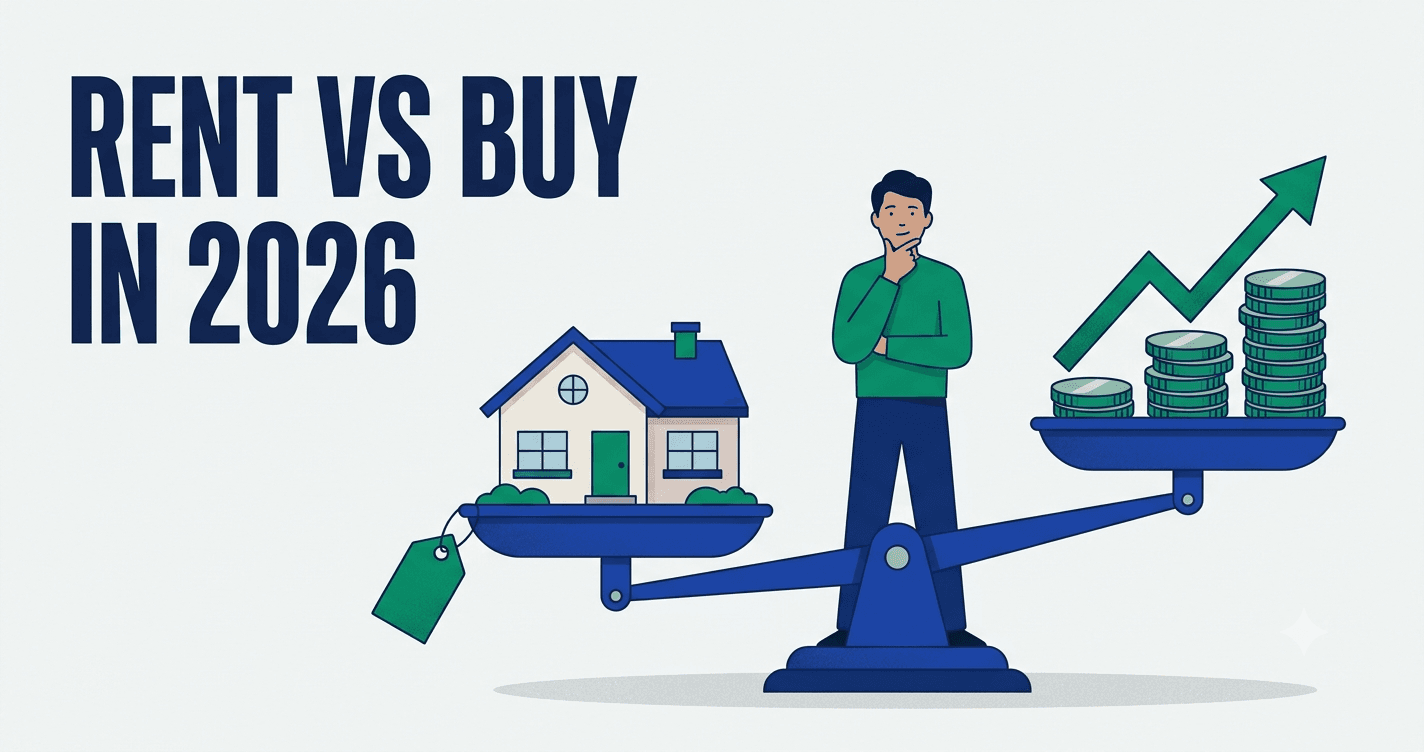
My uncle has given me the same speech at three Christmas dinners in a row. Somewhere between the turkey and the second glass of wine, he leans over and tells me renting is throwing money away. A mortgage is forced savings. Every check I write to a landlord is a check I could be writing to myself. The first year I argued. The second year I nodded and passed the potatoes. The third year I went home and built a full model of the rent vs buy 2026 decision, because a spreadsheet is the only thing that ever settles a fight like this.
The model kept telling me something my uncle keeps leaving out. Rates are sitting near 6.5% (6.55% the week I'm writing this, per Freddie Mac), roughly double the 2.96% people locked in back in 2021.
So I kept renting. For years. And I set up an automatic transfer that quietly turned his favorite insult into a monthly index-fund buy. This is the story of that decision and the one honest catch that means it doesn't work for most people.
"Renting is throwing money away" is the most expensive myth in personal finance
The myth survives because it quietly cheats on the math. It counts every mortgage payment as saving and every rent payment as pure loss. But pull up an actual mortgage statement in year one. At 6.5%, the vast majority of that payment is interest, and interest builds you exactly as much equity as rent does: none. Add property tax, insurance, and the roof you'll eventually replace, and a big slice of an owner's check is just as gone as mine is. None of that slice comes back to you as equity; it is simply what it costs to live in the place, the same way my rent is what it costs to live in mine.
The portfolio manager Ben Felix has a clean way to see this. Every housing choice carries unrecoverable costs. For a renter it's the rent; for an owner it's property tax, maintenance, and the return you gave up sinking a down payment into drywall instead of the market. Add those up and an owner's unrecoverable cost often runs near 5% of the home's value a year. Rent below that number and renting is literally the cheaper way to house yourself. Not wasted money. Paying less for the same thing.
In 2026 that's the base case. A Realtor.com report from March 2026 found renting is cheaper than buying in all 50 of the biggest U.S. metros once you count the full cost of ownership. Average cost to buy: $2,589 a month. Average rent: $1,669. That's a $920 gap, every month, before you've touched the down payment. Buying runs about 55% more. And rent isn't even the villain anymore, it's fallen for 32 straight months, while the mortgage rate is the part that's stuck.
 Data: Freddie Mac PMMS.
None of this makes buying wrong. It makes "renting is throwing money away" wrong, a much bigger and lazier claim than my uncle thinks he's making.
The rent vs buy 2026 math nobody puts in the realtor's brochure
This is where the brochure goes quiet. People compare rent to the mortgage payment and stop. But the mortgage is just the visible slice of ownership. The expensive stuff never shows up on the loan.
The typical U.S. owner spends about $15,979 a year on top of the mortgage. I want to be precise about that number, because a lot of articles butcher it and report the whole thing as maintenance. It isn't. You get there by adding three separate lines together: roughly $10,946 in maintenance, $3,030 in property tax, and $2,003 in insurance. Call it $1,325 a month on top of principal and interest, before a single improvement anyone would notice.
 Data: Zillow / Thumbtack.
Insurance is the line I'd watch closest, because it's moving fastest. Home insurance now eats 9.6% of the average mortgage payment, the highest share on record, up roughly 70% in five and a half years, and 19.5% in California in a single year. When I renew a lease, none of that is my problem. It's my landlord's. (Renters' insurance went up too, but mine runs about 15 bucks a month, not 200.)
Then there's the exit. Buying and selling isn't free. Buyers pay 2 to 5% in closing costs, sellers 6 to 10%, mostly commission. On a $400,000 home a buy-then-sell round trip can run 8 to 10% of the price, the tax you pay for changing your mind, and the single biggest reason short stays lose to renting. The hidden costs of buying a house aren't a footnote. They're most of the case.
How long you actually have to stay for buying to win
So does buying ever catch up? Yes, just slower than people expect.
At 2026 rates the break-even, the point where owning finally beats renting, generally lands somewhere between 5 and 7 years. Under five years those transaction costs eat any equity you built, and you'd have been better off renting and keeping the cash liquid. The honest question isn't "should I rent or buy a house in 2026." It's "how long am I actually going to stay," and most people are worse at predicting that than they'd admit.
Now the part that trips up even careful people. One report says renting wins in all 50 metros; another says buying is cheaper in about half of them. Both are true, because they measure different things. The "buying is cheaper" version, an Empower analysis from January, compares rent to principal and interest only, and on P&I alone buying looks competitive in 23 of the 50 biggest metros. The "renting wins everywhere" version from Realtor.com adds taxes, insurance, and maintenance back in. Same houses, same month, two definitions of "cost." Add that phantom $1,325 a month back and buying loses everywhere. So when someone quotes you a rent-versus-buy number, your first question should be: P&I only, or all in?
 Data: Empower / Zillow.
For a 30-second gut check, use the price-to-rent ratio: home price divided by annual rent. Under 15 leans buy. Over 21 leans rent, national average around 18. San Jose sits near 55, which is a polite way of saying nobody there should be buying to save money. Where you live decides more than a national headline ever can.
Renting only wins if you actually invest the difference
Fine. Everything above is the case for renting. Now the catch that quietly demolishes it for most people.
Renting only beats buying if you take the money you saved and invest it. Not "mean to." Not "probably will." Actually do it, every month, automatically. The whole renter's edge is an opportunity cost that only exists if you seize it. That $920 monthly gap, plus the down payment you never buried in a foundation, has to land somewhere that compounds. If it goes to a nicer car and more takeout, my uncle wins, and he wins clean.
On the median $396,800 home, 20% down is $79,360, a five-figure pile a buyer locks into an illiquid asset on day one. A renter keeps it. Empower ran the example: $79,360 invested at 6%, plus an extra $100 a month, grows to about $159,000 over ten years. That's the number the "throwing money away" crowd never puts on the other side of the ledger.
 Data: Empower.
You dollar-cost-average it, the boring way you'd fund any long-term position. If you've got a lump sitting there, like a freed-up down payment, the lump-sum-versus-drip question is its own decision, and I walked through it in Lump Sum vs Dollar-Cost Averaging. Either way, the invested difference is headed toward the milestone that actually changes your life, and I wrote about why that one is so brutal in Why the First $100k Is the Hardest.
Now the honest part, the one contrarian renting articles love to skip. Homeowners have a median net worth of about $430,000. Renters, about $10,000. Owners are 43 times wealthier, and it has nothing to do with houses being magic. It comes down to forced savings. A mortgage payment isn't optional; miss it and you lose the house, so people pay it, and every payment quietly buys a sliver of equity whether they have the discipline or not. "Invest the difference" asks for that discipline with none of the enforcement, and most renters don't follow through. Does renting build wealth if you invest the difference? Yes. The load-bearing word is if.
What my model actually showed, and why we kept renting
Back to the spreadsheet I built after that third Christmas.
I made it deliberately fair to my uncle. Two columns. The owner: equity building as the loan amortized, minus every phantom cost, plus whatever modest appreciation I felt honest assuming. The renter: rent going out, but the full monthly difference and the un-spent down payment dropped into a plain global ETF to compound.
At the rates we faced, the renter line won for an uncomfortably long stretch, not because rent was cheap, but because the owner column bled out through a dozen little holes while the renter's freed-up capital kept working. So we kept renting. And I did the thing that made the plan real instead of theoretical: an automatic monthly buy into VWCE, my boring accumulating world fund, sized to the exact gap. My uncle's insult, on a standing order, pointed at an index fund.
Here's what I got right: flexibility I actually used, compounding on money that would otherwise sit frozen in a foundation, and dodging the escrow shock owners keep eating while I just signed another lease.
Here's what I underestimated, because I'd rather tell you than let you find out. A mortgage is a savings machine disguised as a bill. It does not care how you feel on the 15th of the month. The automatic transfer I set up was me trying to build that same machine by hand, and it only held because I made it as non-negotiable as a mortgage and then refused to touch it. On the months I got twitchy and thought about pausing it, an actual mortgage would not have let me. If we hadn't automated the gap, my uncle would have been completely right, and I'd have a stack of old lease agreements and nothing else to show for it.
There's a punchline he'd enjoy. That invested difference, the "wasted" rent money, is a big part of how my wife and I eventually bought a place without a mortgage at all. Renting and investing was never the enemy of owning. It's what let us own on our terms instead of a bank's.
Watching two net-worth lines race each other is exactly what I built My Financial Freedom Tracker to do, and yes, this is the part where I admit it's my product, so weigh it accordingly. It's manual-first, no bank linking. The tool matters less than the habit it forces: you can't manage a race you refuse to watch.
When buying is the right call (I'm not the anti-house guy)
I need to say this plainly, because contrarian renting takes usually curdle into something smug. Buying is often the right move. Just not for the reason my uncle gives.
Buy if you're genuinely staying a long time. The break-even math flips decisively in your favor past year seven and keeps improving, because your principal-and-interest payment is frozen for 30 years while rent is not. Rents rose faster than incomes in 88% of U.S. counties between 2000 and 2020, and they're still about 21% above their early-2021 level. A fixed mortgage bets your housing cost stops climbing while everyone else's keeps going, and over a long life in one place, it pays.
Buy if the math where you actually live says so. In Pittsburgh the all-in gap is about $64 a month, a rounding error, and on principal and interest alone buying is already cheaper there. My model was run in my metro; in Pittsburgh or Detroit it might have told me to buy, and I'd have listened.
Buy if you know yourself and you know you won't invest the difference. I mean this sincerely. If the automatic transfer is going to get "paused" every time life gets interesting, then the forced savings of a mortgage is genuinely better for you than a strategy you won't run. Honesty about your own behavior beats a spreadsheet you'll abandon. If you land here, the next fork is whether to pay the thing down early or invest alongside it, which I mapped out in Invest vs Pay Down the Mortgage.
And buy for the reasons that were never financial. Roots. A yard for the kid. Not getting a non-renewal notice the year your child starts school. There's a real tax perk too, up to $250,000 of gains tax-free when you sell, $500,000 if married. All legitimate. Just call them what they are instead of dressing them up as "renting is throwing money away." Weighing this as a family with more moving parts? I laid out the wider playbook in Housing Affordability Strategies.
And if the plan is to buy a place someone else lives in, price the labor before you price the yield — I own a second house, and it is emphatically not passive income.
How to run your own rent vs buy 2026 numbers
Rules of thumb are fine for a gut check and terrible for a decision. This is how I'd actually run it.
Start with the 5% rule for a fast read. Take the price of the home you're eyeing, multiply by 5%, divide by 12. On a $400,000 house that's about $1,667 a month. If you can rent the equivalent for less than that, renting is the cheaper way to consume it. Then check your metro's price-to-rent ratio for a territory read.
Then build the real thing, because your situation isn't a national average. Gather the honest inputs: your rent, the all-in cost of owning (P&I plus that $1,325-ish of taxes, insurance, and maintenance, not P&I alone), your down payment, and how long you truly plan to stay. Use grown-up assumptions for the rest: around 7% real for the invested difference, the long-run S&P average, not the 15% a year the last decade spoiled everyone with, and something modest for appreciation, since Zillow expects about 0.9% nationally this year.
Then do the one thing no realtor's calculator will make you do: put both paths side by side as net-worth lines and run them to year 10, owner equity against the renter's portfolio plus the un-buried down payment. The number that matters is the total at the end, not the payment at the start. If you'd rather not rebuild my spreadsheet from scratch, our rent vs buy calculator runs exactly that comparison in real terms and hands you the break-even year. And whichever path wins for you, automate it that same day. A decision you don't automate is just a wish with a spreadsheet attached.
The real question was never rent vs buy 2026
Strip this whole debate down and the rent vs buy 2026 fight isn't really about houses. It's about discipline.
Renting and genuinely investing the difference builds wealth. Buying and staying put for a decade builds wealth. Both work. The one that fails, reliably, is renting and spending the difference, and its evil twin, buying a place you'll sell in three years and handing 10% of the price to the transaction gods on your way out the door. The house was never the point. What you do with the gap is the point.
My uncle and I have reached a truce, sort of. He still thinks I got lucky. I still think he got a fixed rate in a good decade and mistook it for wisdom. But we both ended up owning our homes outright, from opposite directions. There was never one right answer, just a right answer for each of us. He forced his savings with a mortgage. I forced mine with a standing order I wasn't allowed to cancel.
Pick your machine. That's the real rent vs buy 2026 answer, and whatever you do, don't spend the difference.
Stay Updated
Get notified about new articles and MFFT build-in-public updates.
Ready to Apply This?
Start tracking your finances today and put these tips into practice.
- Import bank statements in seconds
- AI-powered categorization
- Beautiful visualizations
- Set and track financial goals
Related posts
 Master Your Money
How to Stop Arguing About Money With Your Partner: Our Money Date Is Twenty Boring Minutes Because Nothing Is Left to Decide
Our monthly money date takes twenty minutes and it's deeply boring, and for years I thought that was because we're good at talking about money. It isn't. Half of couples avoid the conversation on purpose to keep the peace, and every article tells them to talk more. Here's the opposite case.
 Master Your Money
One Spouse Manages All the Finances in Our House. It's Me, and That's a Design Flaw.
In our house, one spouse manages all the finances, and it's me. I built the tool, I buy the ETF, I read the numbers out loud while my wife listens. That's a bus factor of one. Here's the 30-minute quarterly drill we run instead of a password folder, and why documents rot.
 Master Your Money
How to Calculate Net Worth (Formula + Worked Example)
Net worth is assets minus liabilities. What counts on each side, how to handle the house, pension and car, a worked example, and why monthly beats once.
 Master Your Money
How to Calculate Your FIRE Number (Formula + Examples)
Your FIRE number is annual retirement spending × 25, from the 4% rule. Three steps, a spending-to-target table, a worked example, and when 25× is wrong.
 Master Your Money
Job Hopping vs Staying in 2026: Both Camps Time the Market
Job hopping vs staying is market timing with a résumé: the switching premium hit a record low in January, then widened by July. I've made that mistake before.