Return-to-Office Cost: I Put My Commute in a Spreadsheet

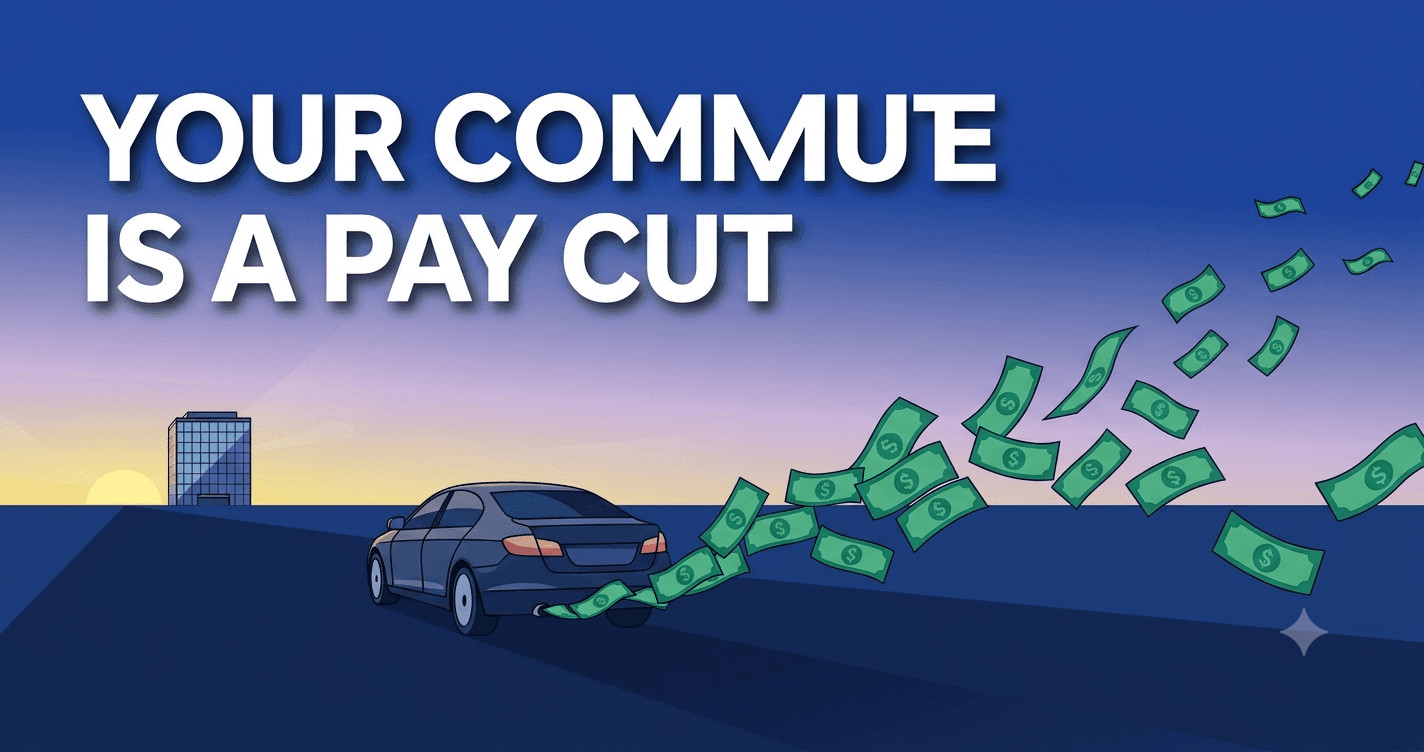
On a Tuesday in June, our VP dropped a message in the company Slack that opened with "some exciting news about how we work together." Anytime a corporate message starts with the word exciting, brace yourself. It's about to cost you something.
The news was a soft three-days-a-week return-to-office push, starting in the fall. My first reaction was the one you'd expect: a low, tired annoyance. My second reaction, about ten minutes later, was to close Slack and open a blank spreadsheet, because I didn't want to argue the principle. I wanted the actual return to office cost, in dollars, before I let myself have a feeling about it.
That's the whole pitch of this article. Not "RTO bad." Put a number on it first. A cost you can't see is one you can't negotiate, offset, or invest around, and almost every take I read on this is either ragebait or quietly wrong about the math.
Here's what my spreadsheet found, and why the yearly number wasn't the part that got me. The 30-year number did.
The Monday the mandate actually became real
Some context so you know I'm not writing this from an ivory tower. I drive a used VW Golf, my wife and I run a stupidly high savings rate because we're chasing the freedom to choose our own schedule by 40, and I already wrote once that one of my dreams is a remote job instead of losing hours a day to a car. So yeah, I walked into this spreadsheet biased. I knew it.
Which is exactly why I made myself do it honestly instead of building the scariest possible number.
The framing I kept coming back to is one the Federal Reserve put into plain economics: when a company pushes a remote or hybrid worker back into the office full time, those workers become as likely to quit as if you'd cut their pay 2 to 3 percent. Not "as if you'd inconvenienced them." As if you'd cut their pay. The mandate isn't a neutral policy with a commute attached. Economically it behaves like a pay cut that never shows up on the pay stub.
So I set out to find mine.
What return-to-office cost actually looks like in 2026
Start with the raw studies, because they're the number everyone quotes and stops at.
Owl Labs pegs a typical in-office day at roughly $55 out of pocket once you add it up: about $15 for the commute, $9 for parking, $13 for breakfast and coffee, $18 for lunch. A work-from-home day, by contrast, runs about $18. Stretch $55 a day across a full in-office year and you land near the headline figures floating around 2026: the highest-cost states clock in around $9,600 a year, with Hawaii at $9,651 and Nevada at $9,398.
 Data: Owl Labs 2025 via Black Enterprise.
Now here's the part the viral versions skip, and the reason most of them are wrong.
That $9,600 is not $9,600 of brand-new spending. A big chunk of it is food you'd eat anyway. In the Hawaii number, over $7,000 of the $9,651 is out-of-home food. You still eat lunch on a work-from-home day. If you quote the gross figure as pure new cost, you've just inflated your own outrage by a couple grand.
So I did the boring subtraction. The lunch line isn't $18 in new money, it's $18 minus the maybe $5 I'd have spent feeding myself at home. The coffee isn't $5, it's $5 minus the fifty cents a pod costs me in my own kitchen. The honest marginal cost of an office day, for me, came out around $38, not $55.
Then it got large again anyway.
Three days a week, call it 48 working weeks, is 144 office days. At $38 a pop that's about $5,500 a year. And half the Fortune 100 now demands five days, up from 5 percent back in 2021, so "three days" has a way of creeping to five. At five days my number marches straight toward that $9,600 headline. The scary figure turned out to be real. It just needed an honest floor under it first.
The pay cut nobody puts in writing
Here's where the spreadsheet stopped being an annoyance and started being a problem.
Those are after-tax dollars. Every one of them. I pay for parking and sad desk salads with money that already had income tax taken out of it. So to compare the commute honestly against my salary, I have to gross it back up.
Divide $9,600 by (1 minus your marginal tax rate). At a 30 percent rate, that $9,600 out of pocket is about $13,700 of pre-tax salary I now spend just to keep the exact same job I had while working from my kitchen. Nobody handed me a memo docking my pay by fourteen grand. The effect on what actually reaches my bank account is identical.
Then there's the tax the spreadsheet couldn't even price: time.
The average American one-way commute is 27 minutes, so 54 minutes a day round trip. Over a full in-office year that's north of 200 hours. Five forty-hour weeks. More than a month of your life, unpaid, spent watching brake lights, every single year. My own drive is a bit under that, and I still didn't love multiplying it out.
And before you think what I thought, no, you can't deduct any of it. I actually checked, because my brain went "surely the commute is a write-off." It is not. W-2 employees lost the ability to deduct unreimbursed job expenses under the 2017 tax law, and the 2025 bill made that permanent, with no scheduled return. Commuting from home to a regular workplace was never deductible to begin with. The one lever left is a pre-tax commuter benefit, and I'll get to how small that sliver is.
The number that made me close the laptop
Up to here I was mildly irritated. This is the cell that made me actually stop.
I do a thing with money that I do with everything: I automate it and let it compound. Same boring world ETF, same autoinvest every month, the engine I've written about a dozen times. So I typed the annual commute cost into that same engine, just to see. Not as an expense. As a contribution I wasn't making.
Nine thousand six hundred dollars a year, invested at a 7 percent real return, is not $9,600. Give it ten years and it's about $133,000. Twenty years, roughly $394,000. Thirty years, close to $907,000.
 Data: YourTango and Wealthvieu (modeled projection).
I sat there and looked at nine hundred grand for a while.
That's not a commute anymore. That's a house. That's a decade shaved off the freedom-at-40 plan my wife and I have been grinding toward since before our kid was born. The daily cost was a mosquito. The compounded cost was the thing that had been quietly biting me for years without me pricing it.
This is the part almost nobody writing about RTO shows you, and it's the whole reason I care about the topic. Everyone treats the commute as an annual line item, a nuisance you renew each year like a parking pass. It isn't. Every dollar you feed the commute is a dollar that can't compound, and the ones you skip in your thirties are the expensive ones. I made this exact argument about small daily spending in The Latte Factor, Run Honestly, and the commute is the same beast in a lanyard. A latte-factor problem that clocks in at nine.
If you want to see why these early shovelled-in dollars matter so disproportionately, it's the same math I walked through in Why the First $100k Is the Hardest. In the accumulation phase you basically are the compound interest. Diverting your fuel into a parking garage at that stage hurts more than the raw number suggests.
Run your own return-to-office cost in ten minutes
You don't need my spreadsheet. You need yours, because your commute, your food habits, and your tax bracket are not mine. Here's the whole method.
- Add up one honest in-office day. Fuel or transit, parking, and any coffee or lunch you buy because you're out of the house.
- Subtract what you'd spend at home anyway. This is the step that keeps you credible. You still eat. Only count the premium the office adds.
- Multiply by your real office days. Days per week times about 48 weeks. Be honest about mandate creep.
- Gross it up. Divide by (1 minus your marginal tax rate) to see the pre-tax salary it actually equals.
- Drop the annual figure into a compound-growth estimate. Seven percent real, over however many years you've got left before your own finish line.
That last step is the one that changes behavior, and it's exactly what a net-worth projection does automatically when you add a recurring expense. Cutting an unavoidable cost is the cleanest possible bump to your savings rate, which, if you've read Savings Rate vs Investment Returns, you already know is the lever you actually control. You can't make the market return more. You can absolutely stop shipping it $9,600 a year of parking money.
The mandate wave, by the way, is why this stopped being a niche worry and became something worth ten minutes of your evening.
 Data: FounderReports 2026 and Fortune.
Clawing the money back without quitting
Rage-quitting is not a financial plan, and I'm not going to pretend otherwise. Most of us are going to keep the job and try to make the mandate cost less. So, in rough order of how much they actually move the needle:
Pack the lunch. Boring, unglamorous, and it's the single fattest line you control. The office food premium is where most of the honest marginal cost lives. Kill it and you've clawed back half the number before touching anything else.
Grab the pre-tax commuter benefit. If your employer offers it, you can set aside up to $340 a month for transit and $340 for parking in 2026, both pre-tax. That's the only tax-advantaged lever left standing after the deduction rules got gutted. It covers nothing for food, but for a driver it's real money off the top.
Negotiate the offset with data, not a vibe. One guaranteed remote day cuts the annual cost by roughly 20 percent instantly. A commuter stipend or parking cash-out is a normal ask. Bring a costed proposal, ideally right after a win, the same way you'd approach any raise. I laid out how to do that without flailing in Salary Negotiation, Data-Driven. "The commute is expensive" is weak. "Here is the $9,600 figure and here's the one-day fix" is a conversation.
Change the mode or batch the days. Transit, a carpool, or a bike can undercut the per-mile cost of driving, and clustering your office days into fewer trips does the same thing. Small, but it's yours.
Then invest whatever you clawed back. This is the step everyone forgets. Money you save on the commute does not compound if it leaks straight into a nicer version of your normal life. Route it into the same autoinvest as everything else, automatically, before you can spend it. Otherwise you did all that math to buy yourself a marginally fancier dinner.
When the math actually says walk
Sometimes the answer really is to leave. But I want you to reach that from arithmetic, not from a Sunday-night mood.
Here's the honest counterweight, because I'd be a hypocrite to skip it. Remote isn't free either. Home offices, higher utilities, the slow poison of proximity bias at promotion time, all of it is real and none of it shows up in a commute spreadsheet. And for someone early in a high-earning trajectory, in-person visibility can be worth more than $9,600, because a single promotion swamps a commute line item. Presence can be an investment, not only a cost. Steelman it before you quit.
Now the number that tells you when walking is rational. Researchers put the value workers place on remote work at roughly 8 percent of salary on average, higher for parents. Around 40 percent of workers say they'd take a 5 percent pay cut to keep it. So here's the test: when your RTO cost plus the value of your lost time exceeds the raise you could realistically negotiate somewhere else, net of the risk of a job search in a market where remote roles are scarcer and often pay a little less, then leaving is a money decision, not a tantrum. Below that line, staying and clawing back is the smarter play.
And if the whole thing pushes you toward moving somewhere cheaper while keeping the paycheck, that's a legitimate branch of this same tree. It's the flip side of the coin, and I mapped it out in Geographic Salary Arbitrage.
So here's what I'm actually doing
I didn't quit. I want to be clear about that, because the internet would prefer I storm out and film it.
I asked for one protected remote day and got it, which knocked my three-day number down to two. I already brew my own coffee like a cheapskate, so that battle was won years ago, and now I pack a lunch on office days instead of donating to the salad place downtown. The rest, the honest few thousand a year I couldn't claw back, I stopped pretending was invisible. It's a line in my projection now, right next to everything else, doing its slow damage where I can finally see it.
That's the entire point of putting the return to office cost in a spreadsheet. Not to win an argument on Slack. To turn a vague, grinding annoyance into a number I can actually do something about, and then to decide on purpose instead of by mood.
Your number will be different from mine. Run it anyway. Ten minutes, one honest subtraction, one gross-up, one look at what it does over thirty years. Then negotiate, offset, invest the difference, and only walk if the math tells you to.
The commute was always costing you. The spreadsheet just makes it stop being a secret.
Stay Updated
Get notified about new articles and MFFT build-in-public updates.
Ready to Apply This?
Start tracking your finances today and put these tips into practice.
- Import bank statements in seconds
- AI-powered categorization
- Beautiful visualizations
- Set and track financial goals
Related posts
 Master Your Money
Your Job Is the Biggest Position in Your Portfolio. I Diversified Everything Except the Thing That Pays for It.
My world ETF is spread across an entire developed-market index, and every euro that buys it comes from one employer, one country, one currency. Your job is the biggest undiversified position you own. Here is what actually reduces the risk, and why seven income streams does not.
 Master Your Money
How to Stop Arguing About Money With Your Partner: Our Money Date Is Twenty Boring Minutes Because Nothing Is Left to Decide
Our monthly money date takes twenty minutes and it's deeply boring, and for years I thought that was because we're good at talking about money. It isn't. Half of couples avoid the conversation on purpose to keep the peace, and every article tells them to talk more. Here's the opposite case.
 Master Your Money
One Spouse Manages All the Finances in Our House. It's Me, and That's a Design Flaw.
In our house, one spouse manages all the finances, and it's me. I built the tool, I buy the ETF, I read the numbers out loud while my wife listens. That's a bus factor of one. Here's the 30-minute quarterly drill we run instead of a password folder, and why documents rot.
 Master Your Money
How to Calculate Net Worth (Formula + Worked Example)
Net worth is assets minus liabilities. What counts on each side, how to handle the house, pension and car, a worked example, and why monthly beats once.
 Master Your Money
How to Calculate Your FIRE Number (Formula + Examples)
Your FIRE number is annual retirement spending × 25, from the 4% rule. Three steps, a spending-to-target table, a worked example, and when 25× is wrong.