Robo-Advisor vs DIY Investing 2026: I Almost Paid 0.25%

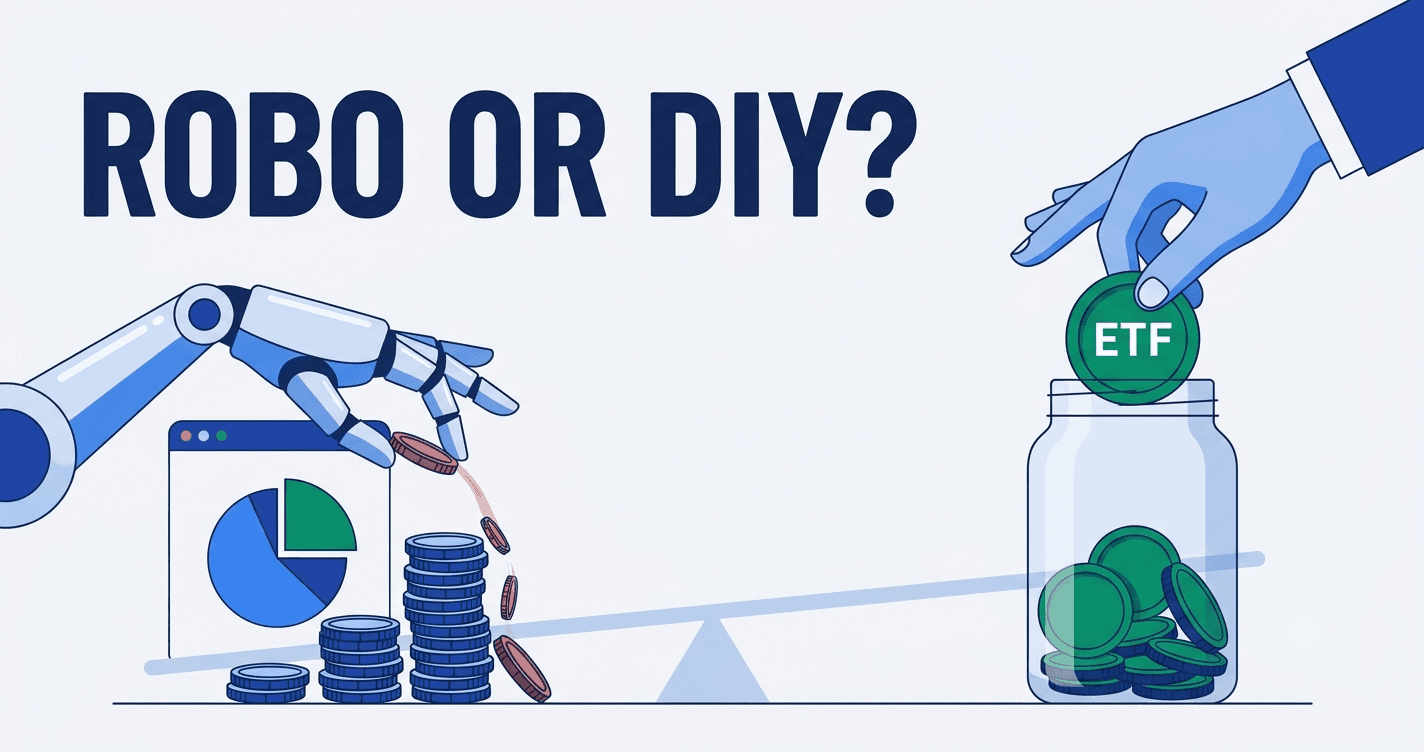
A couple of years ago I sat with my mouse hovering over a big, friendly "Start investing" button.
The robo-advisor had already done the hard part for me. It asked me eleven questions, gave me a risk score, and built a tidy portfolio: nine ETFs, a clean little pie chart, a projected balance at 60 that made me feel warm inside. All I had to do was move about $15,000 in and agree to pay 0.25% a year. Forever.
I almost clicked. Then I did the one thing every honest robo advisor vs DIY investing comparison should start with, the thing the onboarding screen really doesn't want you to do. I opened a spreadsheet.
That spreadsheet is the whole robo-versus-DIY question in a single line. Do you hand someone a slice of everything you own, every single year, to do something you could mostly do yourself in about ten minutes a month? For some people the answer is a confident yes, and I'll defend that answer later. But most of the advice you'll read on this never actually runs the numbers, because most of it is written to earn a sign-up commission. So let's run them.
What a robo-advisor actually does, once you strip the app
Underneath the smooth interface, a robo-advisor does four things.
It asks you some questions and turns your answers into a risk score. It uses that score to buy a basket of cheap, boring index ETFs. It rebalances that basket automatically when the mix drifts. And on some accounts it does tax-loss harvesting, which means selling positions that are down to book a tax deduction, then buying something similar back so you stay invested.
That's the whole product. Betterment, Wealthfront, Schwab's Intelligent Portfolios, the newer AI-branded ones, they all dress it differently, but that's the machine under the hood. The rest is design, push notifications, and a very good marketing team.
None of this is bad. It's a genuinely sensible way to invest, and it beats the two things most people actually do instead: nothing at all, or buying whatever their loudest friend is hyping this month. But look closely at what you're paying for. Portfolio construction that you only need to do once. Rebalancing that you need to do once a year. You're not renting an ongoing service so much as renting a decision you already made.
The fee that doesn't feel like a fee
Here's the part that made me close the tab.
A robo fee, usually 0.25% to 0.50% and up to 0.65% on the "premium" tiers in 2026, isn't charged on your gains. It's charged on your whole balance. Every year. It's there when the market is up, and it's still there when the market is down and your account is bleeding. You never write a check for it, because it's skimmed quietly in the background, so your brain files it under "basically nothing."
It is not basically nothing.
Start small. On a $100,000 portfolio, 0.25% is $250 a year, and 0.50% is $500. Annoying, but survivable. The problem is that the fee grows as your money grows, and it compounds against you the entire time, quietly eating a share of every year's returns before they ever get to snowball.
Run it all the way forward. Take a $500,000 portfolio, let it grow for 30 years at 8% a year, and put a plain 0.07% DIY ETF side by side with the robo tiers. By year 30 the quarter-percent robo has quietly cost you about $240,000 versus doing it yourself. Half a percent costs roughly $560,000. The 0.65% premium tier runs past $730,000. Same portfolio, same market, the only difference is the slice skimmed off every single year.
 Data: MFFT compound model ($500K, 30 years, 8%/yr); 2026 robo fee levels via CNBC/Forbes.
Most articles wave this away. "A quarter percent, who even notices." That shrug is the con. A 0.25% fee sounds like a rounding error and behaves like a small mortgage you took out against your own future self. Any time someone tells you a recurring percentage-of-everything fee is trivial, it's worth asking who gets paid the moment you agree with them.
Where robos genuinely earn it, and I'm not going to pretend otherwise
Now let me argue against myself, because the honest version of this matters more than a tidy story.
There's a reason the average investor does worse than the market they're invested in, and it isn't fees. It's behavior. The long-running DALBAR study found that over the 20 years to the end of 2024, the average U.S. equity investor earned about 9.24% a year while the S&P 500 did 10.35%. That's close to a full percentage point handed back every year, not to Wall Street, but to plain human panic. In the ugly stretch of 2024 the gap blew out to 848 basis points, the investor earning 16.54% while the index did 25.02%. People buy high, get scared, sell low, and wander back in late.
I've watched it happen up close. A friend of mine moved everything to cash during a sharp drop a few years back, told me with total conviction he'd "get back in once things calmed down," and climbed back in about 20% higher than where he sold. He didn't have a fee problem. He had a him problem, and it cost him far more than any advisory fee ever would.
A robo-advisor is very good at solving the him problem. It auto-invests before you can talk yourself out of it. It rebalances without consulting your mood. It puts a calm, boring machine between you and your worst instincts. If an app quietly doing its thing is what keeps you from blowing up your own plan, that alone can be worth more than the fee. There's a tax angle on top for some people. Wealthfront says its typical client's tax-loss harvesting has worked out to a median of roughly 4.7 times its 0.25% fee. That's the vendor's own figure, it only applies to taxable accounts, and it swings hard with your tax bracket, but it isn't imaginary either.
So if you know, hand on heart, that you will panic-sell in the next crash, or that you'll never once get around to rebalancing, then a robo is not a rip-off for you. It's insurance. Paying 0.25% to stop yourself making a 20% mistake is one of the better trades you'll ever make. Go sign up, and don't feel clever for a second about the fee.
The DIY setup that does ~90% of it for almost nothing
Still here? Good. Then here is what I actually do instead.
I buy one broad, all-world ETF. That's the core of the entire thing, thousands of companies across the planet inside a single ticker, running about a 0.07% expense ratio with no advisory fee stacked on top. I set up an automatic monthly purchase so the buying happens on schedule whether I'm paying attention or not. Once a year I spend twenty minutes rebalancing, which for a one or two fund setup barely qualifies as a chore.
That's the whole job. It's the same boring passive core I've been writing about since the very first article on this blog, and it captures the large majority of what a robo does. The difference is the price. Look at what each option charges once you line them up honestly.
 Data: CNBC / Forbes robo-advisor roundups, 2026.
Notice Schwab's 0% headline. Nothing is free. It runs that model by parking a bigger slice of your portfolio in cash, which earns you less over time, so you pay in drag instead of in an obvious line item. The fee didn't disappear, it just put on a disguise.
When I ran my own version of this, the gap stopped being abstract. On the balance I'm building toward over the next couple of decades, the difference between paying 0.07% and paying 0.25% wasn't a few dollars. Compounded across my whole horizon it was comfortably into five figures, and quietly heading for six. That's not a coffee. That's a used car, or a year of my future freedom, handed over for a service I'd mostly be performing myself anyway.
The one real thing a robo gives me that my setup doesn't is that automation, and automation matters, because friction is exactly where good intentions go to die. So I close the gap from the other side. Instead of automating the buying, I make the tracking effortless. I can open my portfolio breakdown and see precisely what I own in a few seconds, which quietly kills the most common excuse people give for paying a robo: "at least then somebody's watching it." You can watch it yourself, for free, in less time than it takes to read the robo's monthly email.
Robo money is exploding, and that's not proof it's right for you
You'll hear constantly that robo-advisors are the future, and the growth numbers do back that up. Global assets under management sat around $5.33 trillion at the end of 2021 and are forecast to reach roughly $11.12 trillion in 2026. That's a real, enormous change in how ordinary people invest, and I don't want to hand-wave it away.
 Data: S&P Global via robo-advisory market roundups / Statista.
But popularity and fit are two different questions. A big chunk of that money belongs to people who genuinely need the guardrails, and honestly, good for them, they're invested and staying invested. Another chunk belongs to disciplined index investors who never once ran the fee math and are leaking a quarter percent a year out of pure inertia. And the industry keeps nudging fees in the direction that helps the industry: "premium" tiers creeping up to 0.65%, cash-heavy 0% products, add-ons and upsells. A number getting bigger fast tells you the product is winning. It doesn't tell you it's winning for you.
2026's twist is the wave of "AI-powered" advisors promising smarter, more personal portfolios. Some of it is real, most of it is a chatbot bolted onto the same basket of index ETFs everyone else sells. Before you pay extra for intelligence, ask what the AI is actually changing about your holdings. If the answer is a slightly different tilt you could copy for free, you're paying for the word, not the work.
How to decide between a robo-advisor and DIY in ten minutes
Forget the feature comparisons and the star ratings. Here's the only test that's ever actually mattered to me. Call it the Crash Test.
Picture your portfolio down 30% next month. Rent is still due, the headlines are apocalyptic, your account is a wall of red numbers. Now be genuinely honest about what you do next.
If the honest answer is "I sell, or I lie awake refreshing the app at 2am," then a robo-advisor is probably worth 0.25% to you. It's insurance against the single most expensive thing you will ever do to your own money, which is act on that feeling. Buy the insurance and don't look back.
If the honest answer is "nothing, I keep buying, maybe I even buy a little more while it's cheap," then you don't have the problem the fee is priced to solve. You'd be paying a guaranteed, compounding cost to hedge a risk you simply don't carry.
That's the entire robo advisor vs DIY investing decision. It was never really about fees or tax-loss harvesting or which app has the prettier charts. It's one question about your own temperament, and you're the only person who knows the true answer.
I ran my own Crash Test that night with the spreadsheet still open. I'd sat through drops before without flinching, kept buying the whole way down, slept fine every time. So I closed the robo tab, kept my ten minutes a month and my 0.07%, and moved the $15,000 into the same unglamorous fund I already owned.
I'd rather own my discipline than rent it. But if renting it is what keeps you in your seat through the next storm, that is money genuinely well spent, and there's no shame at all in knowing yourself well enough to pay for it.
Stay Updated
Get notified about new articles and MFFT build-in-public updates.
Ready to Apply This?
Start tracking your finances today and put these tips into practice.
- Import bank statements in seconds
- AI-powered categorization
- Beautiful visualizations
- Set and track financial goals
Related posts
 Learn To Invest
AI Investing Advice Sells Conviction, Not an Edge. I Build a Money Tool and I Still Buy One Boring Fund.
Four in five young UK investors use AI for investing. Nearly three in four know it can be wrong. They do it anyway. AI didn't make anyone a better analyst, it made conviction free — and conviction was always the expensive part. Here's the test I use instead.
 Learn To Invest
Investing at All-Time Highs: I Bought Again This Month. The Number I Changed Was in My Plan, Not My Standing Order.
I bought my usual world ETF at a Shiller CAPE of 41, a level the market has only ever hit in 1999 and 2000. I still didn't touch the standing order. Valuation explains 25.8% of the next decade and 3.9% of the next year, so it belongs in your plan, not your bank instruction.
 Learn To Invest
How Does Compound Interest Work? (Formula + Examples)
Compound interest means growth earns growth. The formula in words, a year-by-year table, the rule of 72, and how the same math runs against you on debt.
 Learn To Invest
The Investor Return Gap: Your Fund Made 9.9%, You Made 8.7%
Morningstar: the average dollar earned 8.7% a year while its funds earned 9.9%. I was that investor return gap once. The fix is fewer decisions, not discipline.
 Learn To Invest
Lump Sum vs Dollar-Cost Averaging: My Windfall in 2026
I froze for six weeks with a lump sum at a record high. What the data says about lump sum vs dollar-cost averaging, and why pressing the button matters more.