Lifestyle Creep After a Baby: I Had Every Excuse to Upgrade. I Still Drive the Same Golf.

Two weeks ago I had a pro list, and it was a good one.
Our daughter had arrived, the car seat was in, and I somehow had four browser tabs open on three-to-six-year-old family SUVs. A RAV4 for the reliability extreme. A Santa Fe because it's enormous and depreciates like a normal object rather than a luxury one. Good cars, all of them. Every line on the list was true, too: more boot space, easier to load a pram one-handed in the rain, safer in the abstract way that everyone means and nobody defines.
That list is what lifestyle creep actually looks like from the inside. It never shows up as greed. It shows up as arithmetic.
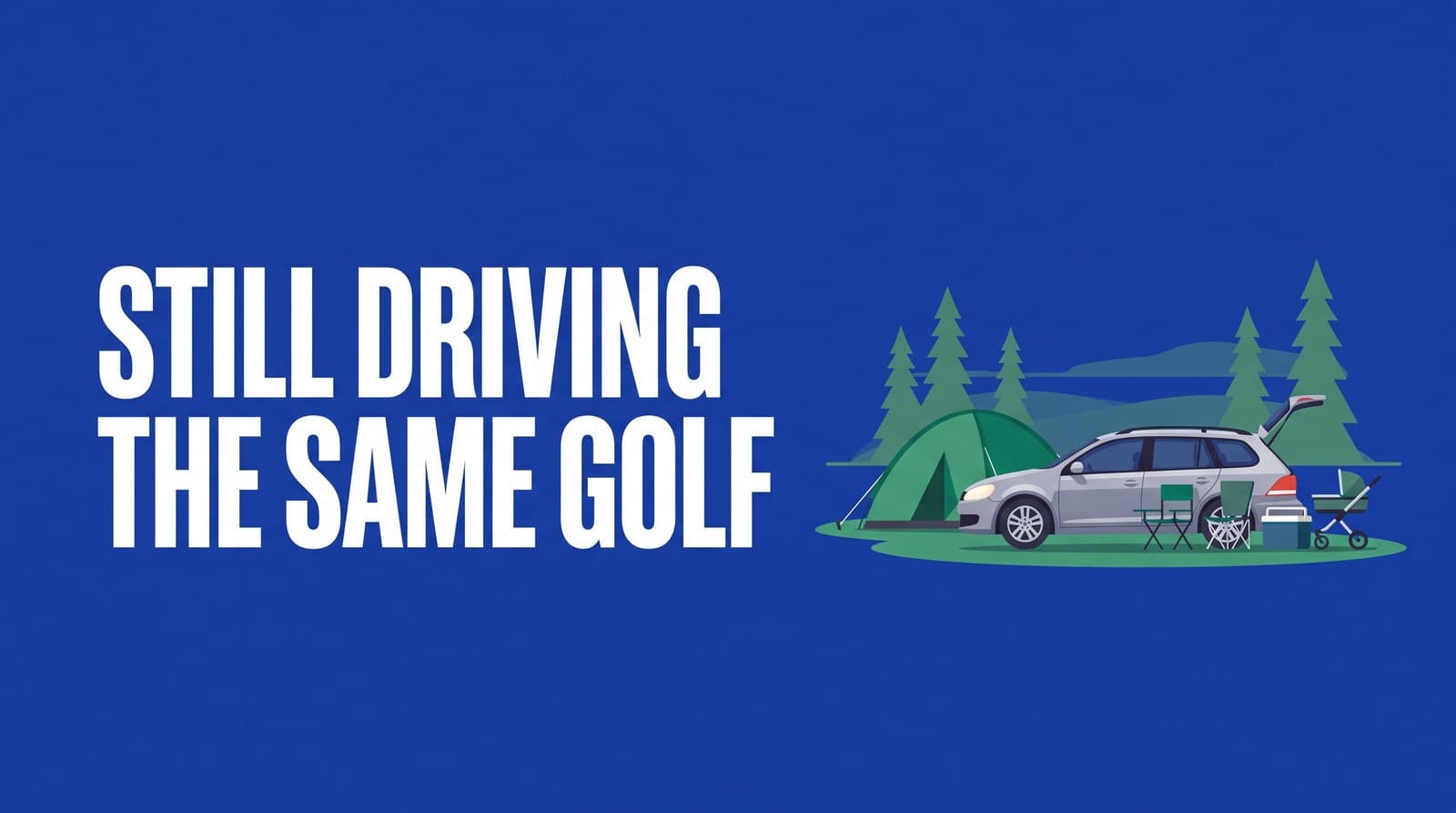
Two weeks later I'm still driving the Golf mk7 estate I bought about four years ago. We're still car camping. Almost all of the baby gear came second-hand off Vinted and Bazoš. Our savings rate did drop, from around 60% of household income to around 50%, and we modelled that before it happened rather than discovering it in a bank statement in March.
None of that was because we couldn't afford the SUV. That's the part I want to be precise about, because the frugal-dad version of this story is boring and also not true.
Lifestyle creep is not a willpower problem
The entire 2026 argument about lifestyle creep is being had between two camps who agree on more than they think. One camp says creep is the goal — you earned it, enjoy it, the whole point of a raise is that your life gets better. The other publishes cancel-and-cap scorecards where you audit your subscriptions and pledge to hold your spending flat for a year.
Both camps are arguing about how much. Almost nobody is arguing about when.
Which is a shame, because the how-much question was settled a while ago and the answer is unflattering. Blundell, Pistaferri and Preston went through two decades of US household panel data and found that a 10% permanent income increase produces a 6.4% permanent increase in consumption. Not a moral failing, not the weak-willed minority. That's the average household, and it's roughly what you'd expect from a species that adapts to everything.
So creep is the default setting. Fighting it head-on with discipline is a losing strategy, because you're not fighting a habit, you're fighting arithmetic that most people never notice performing itself.
The timing question is the interesting one, and there's actually research on it. The most famous study in this whole field is Brickman's 1978 lottery paper, and it gets quoted wrong constantly. People remember it as "winners weren't happier." What it actually found is stranger and more useful: winners' rated happiness wasn't meaningfully different from the control group's, but they rated seven ordinary everyday pleasures significantly lower — 3.33 against the controls' 3.82 on a five-point scale. Breakfast. Talking to a friend. Buying clothes.
The upgrade doesn't fail to make you happy. It makes the thing you already own feel worse.
That's my whole argument, and it's also why "spend more" and "spend less" both miss. Dunn, Gilbert and Wilson wrote eight principles for spending money in ways that actually work, and the fifth one is just delay consumption. Not cancel it. Delay it. The waiting is where a large chunk of the value lives, and buying immediately is the one guaranteed way to throw that part away.
Savour first. Upgrade last. Every upgrade I've regretted, I bought before I'd finished enjoying the thing it replaced.
We were about to buy a car for twelve days a year
Here's the moment the SUV plan died, and it wasn't noble.
My wife and I sat down and counted how often we actually drive somewhere far, for a long time, with the car genuinely full. Not "could imagine doing." Actually did, last year. The answer was about once a month. Call it twelve days.
The other three hundred and something days, that car is me, alone, going to work. And once you've said out loud that you were about to buy a two-tonne family vehicle so that one adult can commute in it by himself, the pro list stops sounding like arithmetic.
We're not weird here. Eurostat's mobility data puts average car occupancy across the surveyed member states somewhere between 1.2 and 1.9 people on urban trips. In vehicles with five seats.
Meanwhile SUVs took 54% of new car registrations in Europe in 2024, a record. So more than half of Europe is buying a vehicle sized for a use case that shows up twelve days a year, and mostly commuting in it alone. I was two weeks from being a data point.
The money is the least interesting part of it, honestly, but it's not nothing and it's recurring.
 Data: ADAC Autokosten, spring/summer 2026.
ADAC's cost tables have a Golf Variant and a Tiguan running the identical 110 kW 1.5 eTSI engine at €773 and €805 a month over five years. Thirty-two euros. Move to the 2.0 TDI and the same pair sits at €817 and €879. In AUTO ZEITUNG's head-to-head on the petrol engine, the Tiguan drank 7.8 l/100 km against the Golf's 6.5, carried 179 kg more, and lost about €383 more per year in value.
Nobody's life is ruined by sixty euros a month. But it's a direct debit you sign for eight years, in exchange for twelve days.
The rule we wrote down before we needed it
I should admit something that makes the above sound less principled than it was. I love cars. I don't think there's a person alive consuming more car content than me. Left to instinct, I'd change car annually and call it research.
So we wrote a rule down, back when nothing was at stake, which is the only time rules are worth writing:
Ten years. Or five years plus a raise of 25% or more. Whichever comes first, per car, and we alternate between the two.
It's blunt on purpose. Ten years sounds absurd when you're already buying used, and that's the feature, not the bug — it quietly forces us toward cars that can actually do ten years. It doesn't mean everything has to be a Corolla. It does keep us away from the tempting end of the premium market, the generation of a certain German powertrain that sits suspiciously inside your budget. There's usually a reason it's in your budget.
The alternation matters as much as the interval. It means there's always a "next one," which turns out to be most of what the wanting was after anyway. I'm not saying no to a nicer car. I'm saying not this one, not now, and here's the date.
For what it's worth, keeping a car a decade isn't eccentric in Europe. The average passenger car on EU roads is 12.7 years old, and in Czechia, where I live, it's 16.5. What's eccentric is deciding it in advance instead of when the pro list turns up.
And the Golf? Four years in, I still enjoy driving it. It's a station wagon you can throw into a corner and it does something fun, and then it swallows a pram and does 6.5 litres on the motorway. I don't think there are many cars that tick that many boxes for a father at once. The reason I'm still enjoying it is not discipline. It's that I haven't spent the last four years reading about its replacement.
The tent isn't the sacrifice. It's the best holiday we've had.
Second thing the baby was supposed to end: car camping.
The socially approved upgrade path here is obvious. You had a kid, you can't do a tent now, book the hotel, get the flights, do it properly. And we did look, because a night that involves someone else making breakfast has genuine appeal at 3am.
 Data: dwif study for CIVD (2024).
The German tourism institute dwif priced an identical fourteen-day family holiday to the Italian coast five different ways. Driving with a caravan came out at €2,749. Flying and staying in a four-star beach hotel came out at €12,130. Same fortnight, same beach, same family. And the gap gets wider the more people you bring, which is the opposite of how most family spending works.
I'm not going to pretend I chose the tent because of a German cost study. I chose it because the best holidays we've had were the ones where we drove somewhere with the boot full and no plan, and I hadn't finished enjoying that before someone told me I'd outgrown it.
Europe seems to agree, quietly. Eurostat's accommodation numbers have EU campsite nights running about 20% above 2019, while hotel nights are up roughly 4%. In Czechia, where I live, camping nights actually rose in 2020, the year hotel nights fell by half. That's not a frugality trend. That's people finding out they like it.
The baby gear went the same way, and this one had a better reason than money. Used kit tends to run about a third cheaper than new, according to a classifieds-platform price analysis, which is fine. But when a marketplace actually asked over a thousand parents why they buy second-hand, the top answer wasn't the price. It was that baby things get used for about eleven minutes before the child outgrows them. Buying a brand-new object with a four-month service life is a category error, not a splurge.
The upgrades that did stick
We're not running a monastery. We've bought plenty of things over the last two years, and looking at them there's an obvious pattern: they land in exactly three buckets.
Health. Safety. Things that save money or time for years.
That's it. That's the whole filter. It's not a rule we invented so much as one I noticed we'd been following, and the upgrades in those buckets are the only ones I can't remember regretting. Nobody has ever felt buyer's remorse about the thing that made them sleep better.
The mirror image is the boring maintenance work that funds all of it. One Sunday last year we went through every subscription and utility contract in the house and freed up over 4,000 Kč a month, which is genuinely embarrassing and also completely normal. None of that money was buying anyone joy. It was buying inertia.
And there's a deliberately unoptimised piece too: we each keep a fun-money pile, hers deliberately bigger than mine, that nobody has to justify to anybody. A 50% savings rate held on pure discipline lasts about eighteen months. Held with a small ring-fenced amount of not-optimising in it, it lasts years.
The honest case for letting lifestyle creep happen
Now the part where I argue against myself, because the opposing case here is better than the internet version of it.
The strongest argument isn't "you deserve nice things." It's economics. Under the standard life-cycle model, if your income is going to rise over your career, the optimal path has a young family with small children spending more than it earns and saving very little, then catching up later. Kotlikoff's arithmetic puts the theoretically correct first-year saving rate for a young household at around 2.1%, against the 15% to 24% the financial industry recommends. By that model, we're not being prudent. We're mis-timing our own consumption and shifting enjoyment from the years our daughter is small to years when she'll have left. That's a real cost and I don't have a clean rebuttal to it, only a preference. Dying with zero has the same problem in reverse.
The safety argument is more interesting than I expected, and it doesn't go where SUV brochures want it to. IIHS's driver death rates put midsize station wagons at 4 deaths per million registered vehicle years — the lowest of any car category they publish, with the Golf itself at zero. So "we need something safer for the baby" doesn't lead to a big SUV.
It does lead somewhere, though. Monash's 2025 analysis of 9.5 million vehicles found 2023 models carry 43% lower risk of death or serious injury than 2001 models, and Euro NCAP's own position is that a rating expires after six years and you should buy the most recent test you can afford. Which means the honest version of the safety case is "buy a newer estate," not "buy a taller car." A four-year-old Golf is comfortably inside that window. A sixteen-year-old anything, which is the Czech average, is not — and if you're driving one, this article is not for you and you should go buy a newer car.
Savour first, upgrade last
The rule isn't spend less. I'd have written a much duller article if it were.
The rule is that an upgrade only counts once you've finished with the thing you already have. Not once you can afford it, not once it's socially expected, and definitely not once you've built the pro list — the pro list is a symptom, not evidence. Lifestyle creep on a timer is just called having a nicer life. Lifestyle creep on autopilot is ego with a direct debit attached.
Our daughter arrived with permission to spend on almost everything, and we mostly declined, and I'm not remotely proud of that as an act of restraint because it didn't cost anything. The tent is fun. The Golf is fun. Nothing was sacrificed.
Ask me in six years, when the car hits ten and my turn comes round in the alternation. I'll have a pro list ready by then. The difference is that I'll have earned it by using the thing up first, and I'll enjoy the new one about ten times more than I would have this September.
That's the whole trick, and it costs nothing but patience.
Stay Updated
Get notified about new articles and MFFT build-in-public updates.
Ready to Apply This?
Start tracking your finances today and put these tips into practice.
- Import bank statements in seconds
- AI-powered categorization
- Beautiful visualizations
- Set and track financial goals
Related posts
 My Journey
Buying Back Your Time: We Save Half Our Income and Have Never Once Paid Anyone to Do Our Work
We save around half our income and have never once paid anyone to do our work. So I priced the refusal. The same €400 a month costs 2.3 years of financial independence if it becomes permanent, and 1.2 if it stays a decision you review in January.
 My Journey
One Lucky Tesla Pick Made Me Feel Like a Genius. Crypto Sent Me the Invoice.
At twenty I put everything into Tesla and it worked. The money was never the expensive part — the belief was. Here's the invoice crypto sent me, and why I buy one boring fund now.
 My Journey
My Wife's Fun Money Is Bigger Than Mine. I Set It Up That Way.
We pool all of our household income, then split fun money roughly two thirds to her and one third to me. Equal fun money is fairness theatre — here's the research on why the unequal version is what keeps a 50% savings rate alive.
 My Journey
My Emergency Fund Is Too Big on Purpose. It's What Lets Me Be Honest at Work.
My emergency fund is too big on purpose: 12 months of essentials in a plain savings account, costing me ~3.5 percentage points a year. Here's what that actually buys.
 My Journey
Is Rental Property Passive Income? Mine Is a Part-Time Job
Is rental property passive income? I own a second house, so no. Landlord-hour estimates run 3 a month to 31 — here's the division almost nobody does.