Direct Indexing vs ETF: I Ran It. The Boring Fund Won.

Last Tuesday my brokerage app tried to sell me something. Not a fund, not a bond. An upgrade.
There was a little banner sitting on top of my one boring index position. "Turn this into a personalized index and harvest tax losses automatically." Underneath, a number: an estimated $1,240 in tax savings for the year. Big friendly button. Two taps and I'd be, apparently, a more sophisticated investor.
I'm the guy who tells everyone to buy one fund and go make dinner. The whole direct indexing vs ETF question? I figured I'd settled that years ago. And yet, for about an evening, that banner had me. It made me feel like the boring index guy was quietly leaving money on the floor while the smart people vacuumed it up.
So I did what I always do with a direct indexing vs ETF pitch. I opened a spreadsheet.
What follows is what fell out of it. Short version: the fancy version is real. It's just not for me, and it's probably not for you either, and the number of people it actually helps is way smaller than the marketing suggests.
What direct indexing actually is, minus the jargon
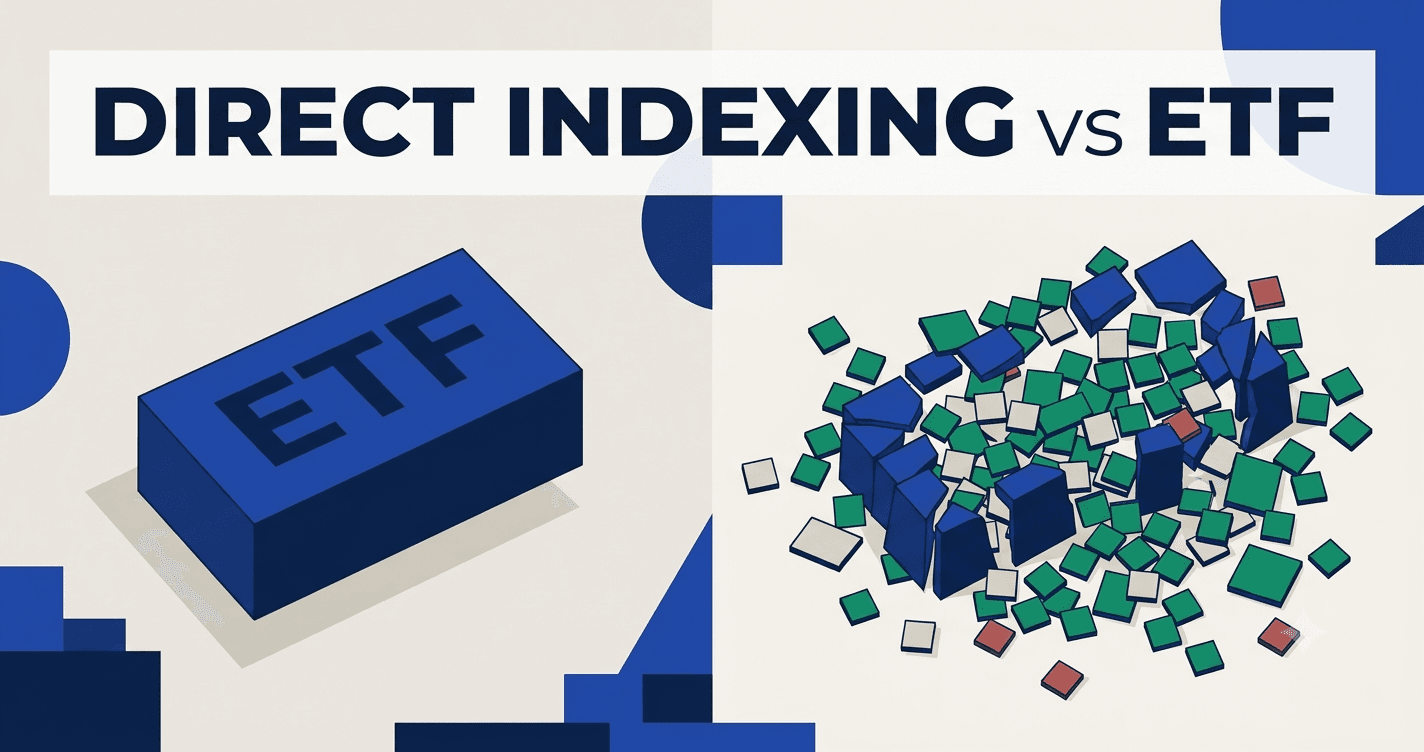
Right now, when I autoinvest on the 1st, I buy one thing. A share of a fund that holds the whole index. One line on my statement. Clean.
Direct indexing tears that line into pieces. Instead of owning one fund that holds the 500 companies, you own the 500 companies. Directly, in your own account, in roughly the same weights as the index. A computer runs it for you and keeps it tracking the benchmark.
Why would anyone want 500 line items instead of one? One reason, mostly: taxes.
When you own the stocks individually, the manager can sell the specific ones that happen to be down, book that loss on paper, and immediately buy something similar to keep your exposure intact. That booked loss lowers your tax bill. Do it automatically, all year, on hundreds of positions, and you get what the brochures call "tax alpha."
That's it. That's the whole trick. Everything else is decoration.
If you've read my piece on the best boring world ETFs, direct indexing is being sold as the sequel. The premium tier. And to understand why it can even work, you have to remember something I only really internalized recently: an index is not one smooth blob, it's a pile of individual stocks with wildly different fates. Some are up 60% while the index is up 12%. Some are down 30% in the same year. Direct indexing lives in that gap.
The one thing it genuinely does better than my ETF
Here's the part that had me nodding along at 11pm.
The S&P 500 can finish a year up double digits and still have 100-plus of its members red on the year. Every year. Even good ones. My ETF can't do anything with that. It holds everything in one wrapper, so when one stock inside it drops, that loss is invisible to my tax return. It just gets averaged away.
Direct indexing sees each loser individually. It sells the ones that are down, banks the loss, buys something close enough to keep tracking, and hands you a tax deduction you didn't have to do anything to earn.
Those losses aren't fake money. You can use them to cancel out capital gains elsewhere, and if you've got leftover losses, knock up to $3,000 a year off your ordinary income, with the rest carried forward to future years.
I want to be fair here, because I went in wanting to hate it. This is a real edge. It's not astrology, it's not a sales gimmick built on nothing. The most rigorous study on it, a peer-reviewed paper out of MIT and AQR, measured the benefit at about 1.08% a year. That's genuine.
Now watch what happens to that number when you keep reading.
The direct indexing vs ETF math, and who tax alpha is really for
That 1.08% has a footnote most ads skip. The same study re-ran it with the wash-sale rule properly enforced (the IRS rule that stops you from selling something and rebuying the identical thing within 30 days just to claim a loss). With that switched on, the benefit dropped to 0.82% a year.
Vanguard's own research lands in the same neighborhood. Depending on your tax rates and state, they put the annual benefit somewhere between 0.47% and 1.27%. The headline "1% to 2%" you see in the brochures only shows up for a very specific customer: someone paying the top capital-gains rate who regularly has big gains to offset.
 Data: Chaudhuri, Burnham & Lo (Financial Analysts Journal, 2020); Vanguard (2024).
Let me make it concrete, because that's the only way I could get it straight in my own head.
Picture a founder who just sold a chunk of her company. She's got seven figures in a taxable account and, every single year, big capital gains rolling in from vesting stock she's selling down. For her, harvested losses are worth 20% plus a 3.8% surcharge on real, six-figure gains. One percent of after-tax alpha on a few million dollars is tens of thousands of dollars. Every year. Direct indexing is basically printing money for her. She should absolutely do it.
Now picture me. Or, honestly, most people reading this.
Most of my money that matters is in tax-advantaged accounts, where tax-loss harvesting does precisely nothing, because there's no tax to harvest against in the first place. My taxable account is real but modest. And in a normal year I don't have a pile of capital gains sitting around begging to be offset, because I don't sell. I buy on the 1st and I sit there.
So what would my harvested losses actually cancel? Nothing, mostly. They'd hit that $3,000-a-year ceiling against ordinary income and stop. The rest would pile up as a carryforward I might use someday, maybe, if I ever sell.
Here's the position the brochures will never take, so I'll take it: almost everything written about direct indexing vs ETF gets the emphasis backwards. It leads with the tax alpha and buries the one question that decides everything. The question isn't "how much can it harvest." It's "do you even have gains to offset." For most households the honest answer is no, and once it's no, the whole thing deflates.
The edge fades, and the ad forgets to mention that too
There's a second problem, and it's baked into how the strategy works.
To harvest a loss, you need a loser. In year one you've got plenty. You just bought 500 stocks, the market wobbles, a big handful go red, the computer sells them, books losses, easy pickings. Great first year.
But your positions appreciate. That's the whole point of investing. And as they climb, fewer and fewer of them are underwater, so there's less and less to harvest. The machine runs out of losers.
Vanguard actually published the shape of this, and it's blunt. The benefit starts around 3.1% in year one and drifts down to about 1.2% by year ten.
 Data: Vanguard, "Tax-loss harvesting: why a personalized approach is important" (2024).
Read that as a curve, not a yield. It's front-loaded. You get most of the value early, and then the strategy slowly becomes a very expensive way to own the index. Nobody puts a decaying line on a marketing banner. They quote you "up to 2%" like it's a dividend that shows up forever. It isn't.
The costs the tax story quietly hides
Okay. So the benefit is real, modest, front-loaded, and only fully lands for high earners with gains to spare. Now the other side of the ledger, which the tax story tends to whisper.
Fees first. My boring ETF costs 0.03% a year. Three dollars per ten grand. Direct indexing runs anywhere from 0.09% for a bare-bones S&P 500 version up to 0.40% at Fidelity or Schwab, and past 1% if there's an advisor bolted on top.
 Data: Frec provider comparison (2026); Forbes/Vanguard.
The 0.09% headline is genuinely competitive, and I'll give the newer providers credit for it. But read the fine print: that price is for the plain S&P 500 sleeve. Want the actual whole market? The fee climbs to 0.25% or more. Want a human involved? Now you're at real money.
And fees are sneaky because they compound against you the same way returns compound for you. Frec ran the arithmetic on their own site: $100,000, 8% a year, 30 years. At a 0.09% fee you end with about $978,000. At 0.40% you end with about $900,000. That 0.31% gap you barely noticed on the signup screen quietly cost you $78,425.
 Data: Frec worked example (2026).
That's the visible cost. The invisible one is worse, and it's the thing that actually made me close the laptop.
Think about where you are five or six years in. You started with one clean fund. Now you own 300-odd individual stocks, most of them bought low, most of them now sitting on fat gains you deferred instead of eliminated. The harvesting has mostly dried up. You look at this sprawling pile and think, fine, I'm done, let's go back to one boring fund.
You can't. Not cleanly.
Selling those 300 low-basis positions to simplify means realizing every gain you spent years carefully deferring. The tax bill you dodged doesn't vanish, it just waits for you at the exit. Want to switch providers because a cheaper one launched? Same wall. Want to hand it to your kids, move states, retire early and restructure? The pile follows you around.
The pitch is "personalized, flexible, your index, your rules." What you actually build is a room you can't easily leave without paying at the door. Elm Wealth, who are the sharpest skeptics on this whole thing, made the point that stuck with me: after a few years you're paying an ongoing fee on a drifting pile of stocks that's mostly stopped doing the one useful thing it was hired for. The flexibility becomes a cage.
Direct indexing vs ETF: when the boring one still wins
So who should skip this entirely? Run yourself through five questions. If you flunk any of them, direct indexing is not your move.
What's your capital-gains rate? If you're in the 0% or 15% bracket, harvested losses are worth very little to you. The math mainly comes alive at the top 20% rate plus the 3.8% surcharge, which starts north of $500,000 of income.
Where does your money actually live? Tax-loss harvesting does nothing inside a 401(k), IRA, or Roth. If most of your net worth is tax-sheltered, this whole conversation is irrelevant to you. It needs a big taxable balance to bite.
Do you have gains to offset every year? No recurring gains means your losses cap out at $3,000 a year against income. This is the gate almost everyone fails, and it's the one the ads never mention.
Do you want to be able to hold one thing forever? If yes, weigh the lock-in hard. Simplicity later has real value, and direct indexing taxes you for wanting it.
Do you have a genuine need an ETF can't meet? Unwinding a giant concentrated stock position, screening out companies on principle, gifting your highest-gain shares to charity. These are legitimate reasons that have nothing to do with the tax-alpha headline.
That's the honest map. And notice what it describes: a wealthy person with a fat taxable account, a high bracket, gains rolling in, and a specific problem. Not the default investor. For everyone else, the plain fund keeps winning, for the same unglamorous reason the target-date fund your 401(k) dumped you into keeps quietly beating the clever alternatives. Simple survives contact with real life. Clever usually doesn't.
What I did, and how to check your own case
I closed the banner. I'm still in my one boring fund. Same autoinvest on the 1st, same not-looking-at-it, same going to make dinner.
Not because I can't do the sophisticated thing. Because I actually modeled it and it isn't for me, and I'd rather write that down honestly than keep the option open for ego reasons. "I own one boring fund" is a feature. It was never a gap in my education.
If that banner ever shows up on your screen, here's the ten-minute version before you tap anything.
Find your marginal capital-gains bracket. Look at how much of your money sits in taxable accounts versus retirement accounts. Ask yourself, truthfully, whether you have real capital gains showing up year after year that need offsetting. If you're in a middling bracket, mostly tax-sheltered, and you don't sell, you already have your answer, and it's the cheaper one.
And before you pay anyone a cent to "personalize" your index, go look at what you already own. Half the time the "upgrade" is solving a problem you don't have, and you can see that for free. I ran mine through the portfolio X-ray tool to check my real exposure before deciding, and it took less time than reading the fee disclosure would have.
If you're earlier on and you don't even own an index fund yet, ignore all of this. Seriously. Go read how to actually start instead. A tax overlay on a portfolio you don't have yet is like buying a roof rack before the car. The order matters.
The thing the marketing never says out loud is that boring was always the sophisticated move. Direct indexing is a real tool for a real, narrow job. I just don't have that job. And for one evening this week, a little banner almost convinced me I did.
Stay Updated
Get notified about new articles and MFFT build-in-public updates.
Ready to Apply This?
Start tracking your finances today and put these tips into practice.
- Import bank statements in seconds
- AI-powered categorization
- Beautiful visualizations
- Set and track financial goals
Related posts
 Invest Smart
VT vs VTI vs VOO: Whole World, All US, or S&P 500?
VOO is the S&P 500, VTI all of the US, VT the whole world. The real choice is how much non-US stock you want. Here's what each one holds, by the numbers.
 Invest Smart
Private Markets for Retail Investors: I Build Products for a Living, and "Democratized" Means They Ran Out of Institutions.
Private markets went retail on both sides of the Atlantic in 2026. I read the launch the way I read any launch at work: the institutional money got hard to raise first, and then I got invited.
 Invest Smart
Is Your House Part of Your Asset Allocation? I Call Myself a 100% Stock Investor and Own Two Houses
I hold 100% stocks, have never owned a bond, and own two houses I had never once put on the same page as the portfolio. The euro-area main residence is 47% of household assets. Here is what the real mix says, why it argues for more equities and not fewer, and the paper that says I am wrong.
 Invest Smart
Holding Leveraged ETFs Long Term: The Maths vs the Behaviour
The issuer's own document says these funds are built for one day. The maths is arguable, the behaviour isn't. How to contain one if you hold it anyway.
 Invest Smart
Investing as a Couple With Different Risk Tolerance
Research finds household portfolios weight the husband's risk preference 0.6 to the wife's 0.4. Three ways couples agree on one allocation, and the cost.