Target-Date Funds: An Honest Look at the 401(k) Default

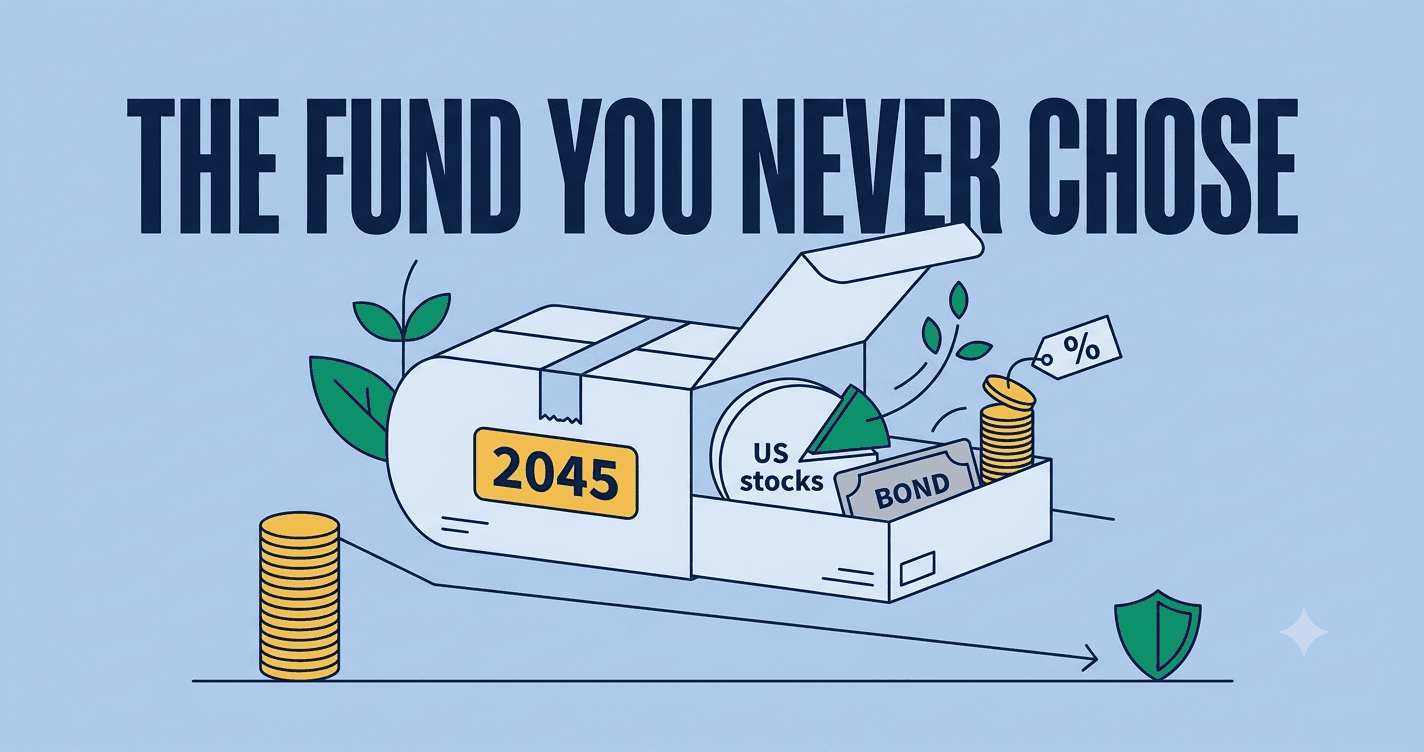
The first real paycheck from my first real job came with a stack of onboarding forms, and somewhere in that stack I ticked a box I didn't really understand. A few weeks later my retirement money started landing in a fund with a year stamped on the end of its name. I looked at it exactly once, decided that meant "retirement: handled," and didn't open it again for years.
That fund was a target-date fund. If you have a 401(k), there's a strong chance one is quietly running most of your retirement too. Target-date funds are now the default that a huge share of American savers never actually chose, and almost none of us ever look inside.
Here's my honest position before we go any further, because most writing on this topic is useless. Half of it says "set it and forget it, you're done." The other half says "they're bleeding you dry with hidden fees." Both are lazy. The real answer is calmer and more annoying: for most people a cheap target-date fund left alone is a genuinely good deal, probably better than whatever they'd cook up on their own. But "default" is not the same thing as "chosen for you," and "set and forget" has a nasty habit of rotting into "own and ignore."
So let's open the hood once. Then you can decide.
What a target-date fund actually is (and why you probably own one)
Strip away the jargon and it's simple. A target-date fund is one fund that holds a mix of other funds, some stocks and some bonds, and automatically shifts that mix to get more conservative as it approaches the year in its name. Pick the one closest to when you'll retire (2050, 2055, whatever), and in theory you never touch it again. It rebalances itself and slowly dials down the risk as you age.
You probably own one because a law made it the path of least resistance. Target-date funds have existed since 1994, but they were a rounding error until the Pension Protection Act of 2006 blessed them as a "qualified default investment alternative." Translated: if your employer auto-enrolls you and you pick nothing, they can drop your money into a target-date fund and be legally covered. Auto-enrollment did the rest. It went from 10% of Vanguard plans in 2006 to 61% by 2024.
The scale is genuinely hard to picture.
- U.S. target-date funds held about $4.8 trillion at the end of 2025, up roughly 20% in a single year. Add custom strategies and it's north of $5 trillion.
- At Vanguard, plan participation hit a record 86%, and about 70% of participants now sit in a professionally managed option, mostly a single target-date fund.
- Around 96% of Vanguard plans offer them, roughly 84% of participants use one when it's on the menu, and about 73% of those hold a single target-date fund as their entire account.
- Five firms run 81% of all this money. Vanguard alone runs about 37% of it.
Sit with that last group of numbers. The single most-owned investment in America is one that most owners were defaulted into, have never inspected, and hold as their whole retirement. That's not a scandal. It's just a strange thing to be true about the account your future depends on.
The glide path is the part nobody reads
The "automatically gets safer over time" bit has a name: the glide path. It's just the schedule for how the stock-to-bond mix steps down as the target year gets closer. Early on you're heavy in stocks. As retirement nears, bonds creep in to cushion the ride.
Fine in theory. Here's the part nobody tells you: two funds wearing the same year on the box can hold wildly different amounts of stock right now.
The big fork is whether a fund glides "to" retirement or "through" it. A "to" fund reaches its most conservative mix at the target year and stops. A "through" fund keeps cutting stocks for years, sometimes decades, past the date. Vanguard's series, for instance, doesn't reach its final and most conservative mix (around 30% stocks) until roughly age 72. BlackRock's LifePath, a "to" design, lands near 40% stocks at the date and holds flat from there.
That difference isn't academic. It decides how exposed you are at the single most fragile moment of your financial life: the years right around retirement, when a bad crash can do permanent damage because you're pulling money out instead of putting it in. That risk is the whole reason the glide path exists in the first place — and I wrote about it in sequence of returns risk.
Look at what "the responsible thing" actually buys two coworkers who both picked a fund for the same retirement year:
 Data: Young and the Invested (equity allocation at age 65, 2025-dated funds, May 2026).
Same label. A 12-point spread in how much stock-market risk you're carrying at 65 — decided entirely by which provider your employer happened to sign with. Neither coworker chose it. That's the whole problem in one chart.
What I actually found when I opened the hood
Years after that first job, I was building a portfolio X-ray for my own tracker, a tool that breaks any fund down into what it really holds. Naturally I pointed it at my own accounts first. When I finally decomposed that old target-date fund, I found three things I never would have picked on purpose.
First, a big home-country tilt. The stock slice leaned heavily toward U.S. companies, which sounds fine until you remember that "U.S. stocks" now means an enormous bet on a handful of giant tech names. I never signed up to concentrate there; the fund just did it for me. If you also own an S&P 500 fund somewhere, you're doubling down on the exact same names without realizing it, which is a trap I picked apart in your "diversified" index fund.
Second, a bond slug I didn't want. I was in my early 30s with a 30-year runway, and the fund was already parking a slice in bonds "for safety." For where I actually was, that wasn't safety. It was drag.
Neither of those is wrong. A home tilt and a few bonds are perfectly defensible. They just weren't my choices, and that's the entire point.
And the tilt isn't only theoretical. In the first quarter of 2026, plain U.S.-heavy target-date funds actually lost more than 1%, while more globally diversified glide paths came out ahead, and spreading beyond U.S. stocks and bonds added more than 3% for the quarter. If you ever typed "why did my target-date fund lose money in 2026" into Google, that's your answer. It wasn't broken. It was concentrated — in a way you never agreed to.
The fees: an 8x spread for the exact same idea
Every target-date fund sells the same basic promise: a hands-off, age-appropriate portfolio. So you'd expect them all to cost about the same.
They don't. Not even close.
 Data: Young and the Invested and fund providers (expense ratios, May 2026).
The cheap index versions run about 0.08% a year. The priciest mainstream active series run about 0.68%. That's an 8.5x gap for what is, functionally, the same age-based idea. The industry average has been dropping (asset-weighted, it's now about 0.27%), which is great, but averages hide the funds quietly charging several times the cheapest option.
Half a percent a year sounds like nothing. Over a career it is very much not nothing.
 Data: Young and the Invested (fees); 7% gross-return model assumption.
Same $100,000, same assumed 7% return, same strategy. The only difference is the fee, and after 30 years the expensive version has quietly cost you roughly $116,000 in lost growth. That's not a fee. That's a wing of a house.
One wrinkle makes this harder than it should be. A lot of 401(k) target-date funds aren't mutual funds at all, they're "collective investment trusts." A CIT has no ticker and no public prospectus, so you often can't just look it up online. The fee lives on your plan's fee-disclosure paperwork instead. Annoying, but findable. If you're stuck, ask HR or your recordkeeper for the "404a-5" notice.
Cheap index target-date funds are boring in the best possible way. The expensive active ones bleed you slowly, in a currency you don't feel until decades later.
Three ways people mess up a perfectly good target-date fund
The fund itself is usually fine. The mistakes are almost always in how people use it.
| The mistake | Why it hurts | The one-line fix |
|---|---|---|
| Stacking other funds on top | You break the glide path and pile up hidden overlap | The target-date fund is the whole meal, not a side |
| Owning the wrong date | The year is a risk dial, not your birthday | Pick the date that matches your risk, not your age |
| Holding one in a taxable account | Auto-rebalancing triggers tax bills you don't control | Keep target-date funds in a 401(k) or IRA |
The first one is the most common, and about 1 in 4 target-date owners do it. They hold the fund and bolt an S&P 500 fund and "a little international" on top. The problem is you can no longer see what you actually own. Your careful glide path is now silently overweight U.S. tech and nobody is steering. This is exactly the mess a portfolio breakdown is built for. Decompose everything into its real holdings and the double-counting jumps straight out at you.
The second one trips up people who think the year is a rule. It isn't. It's a suggestion. Cautious? Pick an earlier year and get more bonds sooner. Aggressive and young? Pick a later year and stay in stocks longer. You're allowed. The date on the box is the one dial they hand you, so actually use it.
The third one is the sneaky-expensive one, and it comes with a perfect cautionary tale.
At the end of 2021, people who held certain Vanguard target-date funds in taxable accounts got a nasty surprise: capital-gains distributions running anywhere from 3% to 15% of the fund's value, depending on the vintage. What happened? Vanguard had cut the minimum on its cheaper institutional version, big plans stampeded out of the retail fund into it, and the retail fund had to sell appreciated holdings to fund the exodus, dumping the tax bill on everyone who stayed put. About 99% of holders were in tax-deferred accounts and never felt a thing. The 1% in taxable accounts got hit. The SEC came knocking, and Vanguard settled for $106 million in January 2025.
The lesson isn't "Vanguard bad." It's that a target-date fund's automatic machinery, which is a gift inside a 401(k), turns into a liability inside a taxable brokerage account. Keep them where they belong.
The honest case for just leaving it alone
Now the part a skeptic like me has to say out loud, because the data leaves no room to wiggle.
Every year Morningstar runs a study called Mind the Gap that measures the difference between what funds returned and what investors in those funds actually earned. The gap is real, and it's usually ugly. Over the decade ending in 2024, the average dollar earned 7.0% a year while the funds themselves returned 8.2%. That 1.2-point gap is the cost of human behavior: buying high, panic-selling low, chasing last year's winner.
Guess which category had the smallest gap of all? Allocation funds. The target-date family. About 0.1 points. Basically nothing.
Read that again, because it's the strongest argument against my own skeptical instinct. People who own one target-date fund and leave it alone capture almost exactly what the fund earns, because there's nothing to tinker with and no obvious lever to yank at the worst possible moment. During 2025's volatility, only 5% of Vanguard participants traded at all. The one-fund default is a big reason the other 95% didn't panic-sell the bottom.
The counterfactual matters here. For most people the alternative to a mediocre target-date fund isn't a beautifully optimized portfolio. It's cash sitting in a "stable value" fund earning nothing, or a pile of company stock, or never enrolling at all. Auto-enrollment plus a default fund dragged participation from 65% up to that record 86%. A "good enough" fund you actually stick with beats a "perfect" one you bail on in the first crash. That's just true.
So no, this isn't a hit piece. If you own one low-cost target-date fund, in a 401(k), and you leave it alone, you're already doing better than most of the people reading this. Genuinely.
When it's worth taking the wheel
All of that granted, there are real reasons to steer yourself instead.
Maybe you want a different stock-and-bond split than the glide path dictates. Maybe you want to control that home-country tilt yourself instead of accepting whatever the provider baked in. Maybe you're staring at a 0.68% active series in your plan and you'd rather not lose $116,000 to it over a career. Or maybe your money is scattered across a 401(k), an IRA, and a taxable account, and no single target-date fund can see across all three. It optimizes its own little sleeve while blind to everything else you own.
There's a middle option people reach for at exactly this fork: hand the wheel to a robo-advisor for around 0.25% a year. I nearly did, then sat down and worked out what that quarter-point actually buys versus doing it myself.
For what it's worth, that last one is why I eventually took the wheel myself. I'm an autoinvest person by temperament. I want one transparent lever I fully understand, so I moved the bulk of my money into a single global ETF and set it on automatic. I like seeing exactly what I hold, down to the last percent. I laid out how I think about that in the best world ETFs.
But I want to be dead clear: that's a preference, not a verdict. I didn't leave because target-date funds are bad. I left because I'm the kind of person who opens the hood and then can't resist holding the wrench. If you're not, that's completely fine, and it honestly might make you a calmer investor than me. And if all of this is brand new and you're not sure where to even start, don't judge your default fund until you've got the basics down. Investing made simple is where I'd point a friend first.
Your 15-minute hood check
You don't have to change a single thing today. You do have to look. Block off fifteen minutes and run down this list for the target-date fund you already own:
- Find it. Get the exact fund name, its ticker (or its CIT fact sheet if there's no ticker), and the target year.
- Check the mix. What's the stock-to-bond split today, and is it a "to" or a "through" glide path? Does that risk level actually match yours?
- Check the fee. Under about 0.15% is cheap and fine. Anything over about 0.5% is an active series worth a hard look.
- Check for double-ups. Are you holding other funds on top of it and quietly breaking the plan?
- Check the account. It should live in a 401(k) or IRA, not a taxable brokerage.
- Decide. Keep it, shift to a different date, or take the wheel. All three are fine answers. Doing it on purpose is the only part that matters.
That's the whole exercise. The default really is fine for most people, maybe even great. But "I got auto-enrolled and never looked" was never a strategy. It was just inertia wearing a strategy’s clothes. Fifteen minutes turns the fund you were handed into the fund you actually chose.
Mine took about ten minutes to decode once I had the tool built. If you want to see what's hiding across all your accounts at once, that's exactly what the portfolio X-ray is for.
Go open the hood. Then go live your life.
Own a target-date fund you've never actually looked at? Tell me what you find at dennis.vymer@myfinancialfreedomtracker.com.
Stay Updated
Get notified about new articles and MFFT build-in-public updates.
Ready to Apply This?
Start tracking your finances today and put these tips into practice.
- Import bank statements in seconds
- AI-powered categorization
- Beautiful visualizations
- Set and track financial goals
Related posts
 Invest Smart
VT vs VTI vs VOO: Whole World, All US, or S&P 500?
VOO is the S&P 500, VTI all of the US, VT the whole world. The real choice is how much non-US stock you want. Here's what each one holds, by the numbers.
 Invest Smart
Private Markets for Retail Investors: I Build Products for a Living, and "Democratized" Means They Ran Out of Institutions.
Private markets went retail on both sides of the Atlantic in 2026. I read the launch the way I read any launch at work: the institutional money got hard to raise first, and then I got invited.
 Invest Smart
Is Your House Part of Your Asset Allocation? I Call Myself a 100% Stock Investor and Own Two Houses
I hold 100% stocks, have never owned a bond, and own two houses I had never once put on the same page as the portfolio. The euro-area main residence is 47% of household assets. Here is what the real mix says, why it argues for more equities and not fewer, and the paper that says I am wrong.
 Invest Smart
Holding Leveraged ETFs Long Term: The Maths vs the Behaviour
The issuer's own document says these funds are built for one day. The maths is arguable, the behaviour isn't. How to contain one if you hold it anyway.
 Invest Smart
Investing as a Couple With Different Risk Tolerance
Research finds household portfolios weight the husband's risk preference 0.6 to the wife's 0.4. Three ways couples agree on one allocation, and the cost.