Side Hustle vs Career Growth: I Paid for a Coach Instead

I have never had a side hustle. Not a shop, not a channel, not one weekend spent driving strangers across town.
For most of my twenties that felt like something I should apologise for. Everyone had a thing, and when someone asked what mine was I changed the subject.
So here's my side hustle vs career growth take. For most employed people a side hustle is a second job wearing better branding, and the unglamorous lever, being worth more between nine and five, is the one that actually moves a financial independence date. What I did instead was pay a coach out of my own pocket, for work nobody at my company had asked me to do.
I've had exactly one lucky pick in my life. I held Tesla early enough to feel like a genius, and then the crypto cycle sat me down and explained that I was not one. The coach beat both.
I can't hand you a percentage for that, and I'm not going to invent one.
Almost nobody is doing this for the love of it
The story we tell about side hustles is a story about passion. Someone turns a hobby into a business, quits the job, posts a photo from Lisbon. That was the version I felt guilty for not wanting.
The data tells a different story, and it tells it in four countries at once.
 Data: Omnisend Side Hustle Economy Report 2026, surveyed by Cint in March 2026.
A quarter to a third of adults in these markets have a side hustle now: 28% in the US, 25% in the UK, 31% in Canada, 33% in Australia. And when they're asked why, between 80% and 85% in every single country say the reason is financial. Bills, debt, a savings goal, the fear that one income isn't safe anymore. Somewhere between eight and ten percent are chasing a passion.
So this isn't an entrepreneurship movement. That's not a criticism of anyone doing it, by the way. It's a criticism of how it gets sold.
676 hours, and what they cost
One number stopped me from ever starting one.
The Penny Hoarder surveyed a thousand American side hustlers in February. The average one works 13 extra hours a week. That's 676 hours a year, or in the unit that actually lands: 17 extra 40-hour working weeks, every year, on top of the job you already have.
The median take is $1,275 a month. Do the division (median pay against average hours, so treat it as a ballpark rather than a payslip) and you get a bit under $23 an hour, before tax and before whatever the hustle costs to run.
Twenty-three dollars an hour, for seventeen weeks of your life a year.
And it comes with a tax that doesn't show up on any invoice. Sixty-five percent of those side hustlers report burnout at least sometimes. Only one in ten never feel it. Only 44% feel even somewhat financially secure, which is a devastating sentence when you remember these are the people who took the extra work specifically to feel safer.
The bit I find hardest to shrug off is arithmetic. A standard week plus 13 hours is a 53-hour week. The WHO and ILO put the danger line at 55 hours, where the risk of stroke runs about 35% higher and the risk of dying from heart disease about 17% higher than at 35 to 40 hours. The average side hustler is parked two hours short of that line, and a quarter of them have been doing it for more than five years.
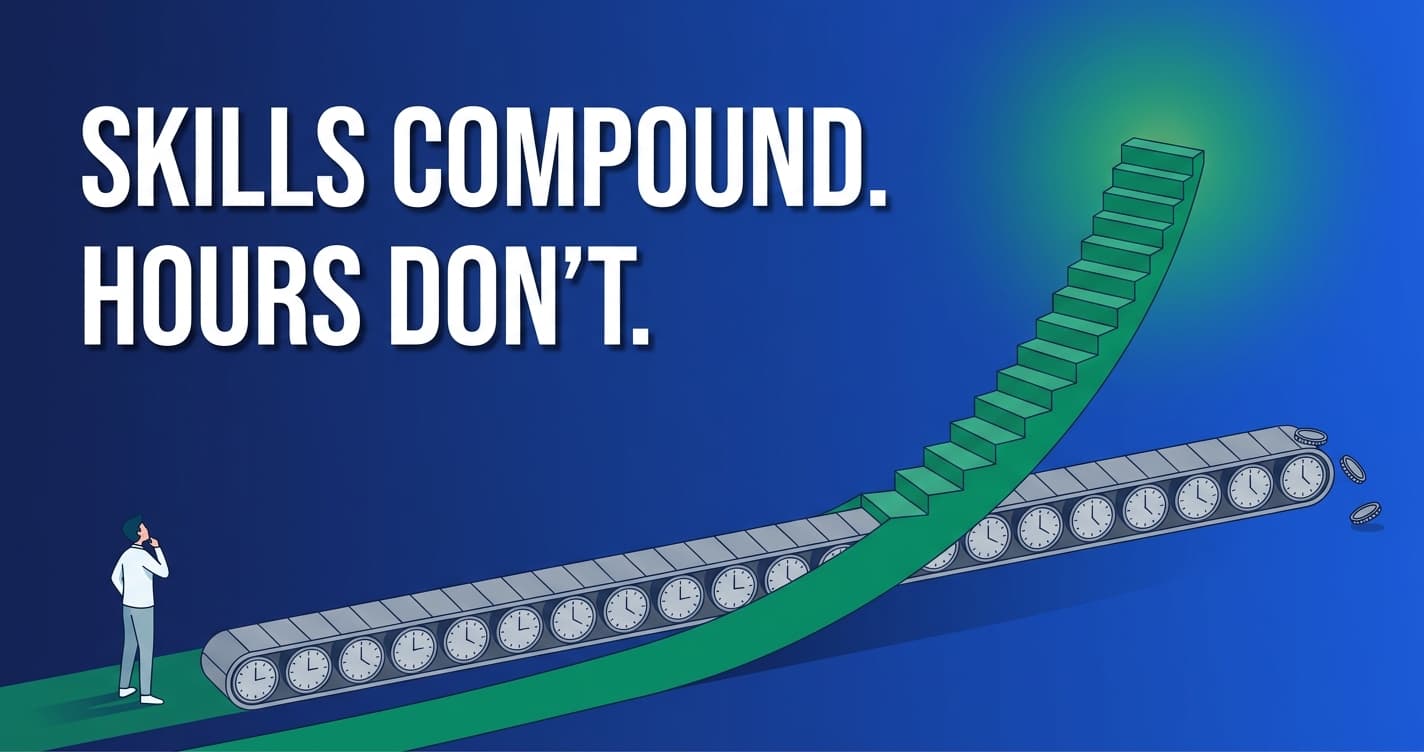
I keep saying on this blog that health and skills compound the same way money does, and this is the version where the compounding runs the wrong way.
What I bought instead
The coach was not a career coach in the LinkedIn sense. We worked on soft skills, on the long game, and mostly on learning to look at a product from every angle at once. It ran for months, and I paid for all of it myself, which is its own kind of motivation when you've already transferred the money.
I went in convinced my problem was that I needed to build better things. The question that kept coming back at me, in one form or another, was who was going to sell the thing I'd just built, and to whom, and why that would make the company any money. I didn't have answers. I had opinions about architecture.
That reframing is the whole product of those months. Building the thing is a small slice of the actual job. Someone has to sell it, it has to fit the business model, it has to be profitable, and it has to serve where the company says it's going — the vision and mission most people treat as poster material. Before that I was an engineer who thought good work spoke for itself. It doesn't. It needs a translator, and I'd been refusing to be one.
Did it take a lot of work? Yes. Slow, uncomfortable, ego-bruising work. What came out of it was a raise or a promotion roughly every year since.
What I didn't expect was how far it leaked. It made me a better husband and a better father, which is an absurd thing to claim about a work coach until you see the actual lesson underneath. You need a why, a what, and a how, in that order, for anything you're serious about.
The why has to be strong enough to survive a Tuesday. Ours is family time now and options later, and it's the only reason we can say no to the hundred small distractions every week throws at us. The what is knowing what you're really choosing between, because income and investments and time don't pay out the same way. And the how is a written plan rather than a vibe. Plans go stale the minute you write them, which is fine. You review, you adjust, and the goal stays put.
That's the same shape as our money. It's why the path we're on is boring on purpose and hasn't changed in years.
The problems nobody wants
The other half of it was tactical, and it's the advice I'd give a twenty-five-year-old over any list of gigs.
Take the problems nobody wants. In every company there are one or two projects with a pessimistic outlook, a long history, and enough stress attached that people find reasons to be busy elsewhere. Nobody touches them until they turn green — and then everybody remembers being involved.
Those problems are the fastest education I've ever had. You learn like it's a crash course, because it is one, and it usually ends up counting for you personally even when the project stays a mess. Three US patents came out of that habit. So did a move into SaaS, which happened faster than I expected once I'd worked out what I actually needed to learn first.
I'll be honest about the cost too. I burned out somewhere in there. Not spectacularly, and I came back quickly, but it happened. I'm more careful now. I still go after the big ugly problems, because they're the fun ones, but I've stopped treating my own capacity as infinite.
Side hustle vs career growth, over twenty years
Now the part where the math turns on me for a while. It does, and I'd rather show you than let you find it yourself.
 My own model, not a citation. A $62,000 starting salary (US median for full-time workers, BLS), pay growing 6.6% a year instead of 4.4% (ADP Pay Insights, April 2026), against a side hustle held flat at $15,300 a year. Pre-tax. Holding the higher rate for two decades means moving or being promoted over and over, which is the load-bearing assumption here.
ADP's payroll data has people who stay put getting 4.4% a year right now, and people who move getting 6.6%. Hold that higher number for twenty years, through moves, promotions, being the one who took the ugly project, and you end up around half a million dollars ahead of the version of you who stayed still. For zero extra hours.
Against that, the median side hustle pays about $15,300 a year and costs 676 hours. Over twenty years: roughly $306,000, and 13,520 hours of your life.
The hustle stays ahead until year fifteen. That's not a rounding error, and if your problem is this year's rent, my twenty-year chart is useless to you.
But look at the shape. One line bends. The other is a straight diagonal, because it has to be. It's hours multiplied by a rate, and there are only so many hours. The raise doesn't just pay you this year. It resets the base for every raise after it, and it's the number the next employer anchors on. Stop hustling and the hustle line stops dead the same month. Stop studying and the career line keeps paying for a decade out of sheer momentum.
Which is the same argument I make about savings rate versus returns, pointed at the income side of the equation instead of the spending side.
"But you built a product on the side"
Yes. I did. I'm building the tracker this blog belongs to, on evenings and weekends, while writing an article about how side hustles are overrated. Go ahead.
Two honest answers.
First, it has cost us money, not made it. It has slowed our financial independence date down, not sped it up. Anyone telling you their side project accelerated their FIRE plan in year one is selling a course.
Second, and this is why I'd still do it: it's the most expensive and most effective training I've ever bought. Setting up a legal entity. Pricing. Support. Owning a product end to end with nobody to escalate to. I've learned more from it than from the previous couple of years at work, which isn't a slight against my job. I like my job.
The test is whether the skills come back. They do, every single day, in the nine-to-five that actually pays us. Which makes it a skills lab that happens to have a payment button, not a side hustle. If it ever becomes a real income stream, great. That's not the reason it exists.
When I'd tell you to hustle anyway
The same survey that gave me my best argument hands the other side its best one: 53% of those side hustlers say they'd struggle to cover essentials without the money. If that's you, none of my compounding curves matter. Take the work, take the cash, and be furious at the arithmetic of the last few years rather than at yourself.
I'd also say yes to a hustle that teaches you something your employer will pay more for later, or one with a ceiling above your own hours. This blog has ranked the common ones by what they actually return, in a piece considerably friendlier to the idea than I am. Both can be useful.
What I'd push back on is the default, the assumption that the way to more money is a second job when the first one has a lever on it most people have never tried pulling — which is the whole side hustle vs career growth question, and almost nobody prices out the second half of it.
Forty percent of side hustlers say they wouldn't quit even if their main employer handed them a 20% raise. I understand the instinct. One income feels fragile. But read it the other way and it's bleak: a fifth more money, for none of the hours, and they'd keep the 676 anyway.
My daughter is two months old. Somewhere in the next few years I want a four-day week and free Wednesdays, and eventually a classroom where I get to teach math and physics badly at first. None of that gets bought with 676 hours a year. It gets bought by being worth enough between nine and five that I can ask for the Wednesday and mean it.
The coach cost me a few uncomfortable months and a real invoice. I still think it's the best thing I've ever bought.
Stay Updated
Get notified about new articles and MFFT build-in-public updates.
Ready to Apply This?
Start tracking your finances today and put these tips into practice.
- Import bank statements in seconds
- AI-powered categorization
- Beautiful visualizations
- Set and track financial goals
Related posts
 My Journey
Coast FIRE Isn't a Permission Slip. For Us It's a Deadline — and We Won't Downshift When We Hit It.
Our coast FIRE number lands around 40 and I haven't crossed it yet. The internet treats that day as permission to quit and go part-time. I pulled 150 years of returns and ran the numbers: buying a four-day week costs one year of full FI, stopping costs sixteen.
 My Journey
We Bought Almost Everything for Our Daughter Second-Hand. The Money Was the Smallest Part.
The stroller, the cot, the chairs and most of her clothes came from someone else. The money we saved was small enough to be embarrassing. We bought second-hand baby gear anyway, because new is what the baby industry charges for reassurance.
 My Journey
When the Market Drops, I Do Nothing. Not Because I'm Disciplined — Because I Deleted the Decision.
The market fell in September and I did nothing. Not out of discipline — there was no decision left to make. Why I think buying the dip is panic selling with better manners, and the one exception I allow.
 My Journey
When the Market Drops, I Do Nothing. Not Because I'm Disciplined, But Because I Deleted the Decision.
I found out about the June sell-off on the Monday, from a colleague at lunch who wanted to know if I was alright. My answer to what to do when the market drops is nothing, and it isn't discipline. I once put a third of my net worth into Cardano, and I still hold the wreckage as a reminder.
 My Journey
Health Is the One Asset in Our FIRE Plan I Can't Buy Back at 40 — and This Year I've Been Quietly Spending It
Health and skills compound like the ETF does, and they're the only assets in our FIRE plan I can't buy back at 40 with a bigger number. This year, the first baby year, is the first time I've run a real deficit on one of them. No morning routine at the end.