Side Hustles Ranked by Real ROI: What Actually Pays in 2026

New to personal finance and investing?
If you're just getting started, I recommend checking these out first:
- How to Build Wealth From Zero — the equation that explains wealth multiplication
- The Complete Guide to FIRE — financial independence, explained
- How to Start a Budget — the first step to visibility
It's 2026. You're working full-time. Your salary is decent. You're meeting deadlines, staying productive, doing everything right.
But there's a gnawing feeling: it's not enough.
You're not broke. But you're not getting ahead either. The gap between your income and your financial goals feels impossibly wide.
And you're not alone. 72% of US workers now rely on secondary income to make their money work harder. That's not a side gig anymore. That's the new normal.
This article is about the paradox: side hustles have become essential financial infrastructure, but they're also burning people out at alarming rates. I'm going to show you why 45% of the US workforce now has one, how to evaluate opportunities by actual return on your time, and which side hustles compound over a decade instead of leaving you exhausted and broke.
The truth is, side hustles aren't optional anymore. But if you approach them wrong, they'll destroy your finances faster than they help them.
The Shift: Why Secondary Income Became Non-Negotiable
Let me be direct about what's happening: the single-income model is dead.
Not because people are greedy or impatient. Because the economics fundamentally changed.
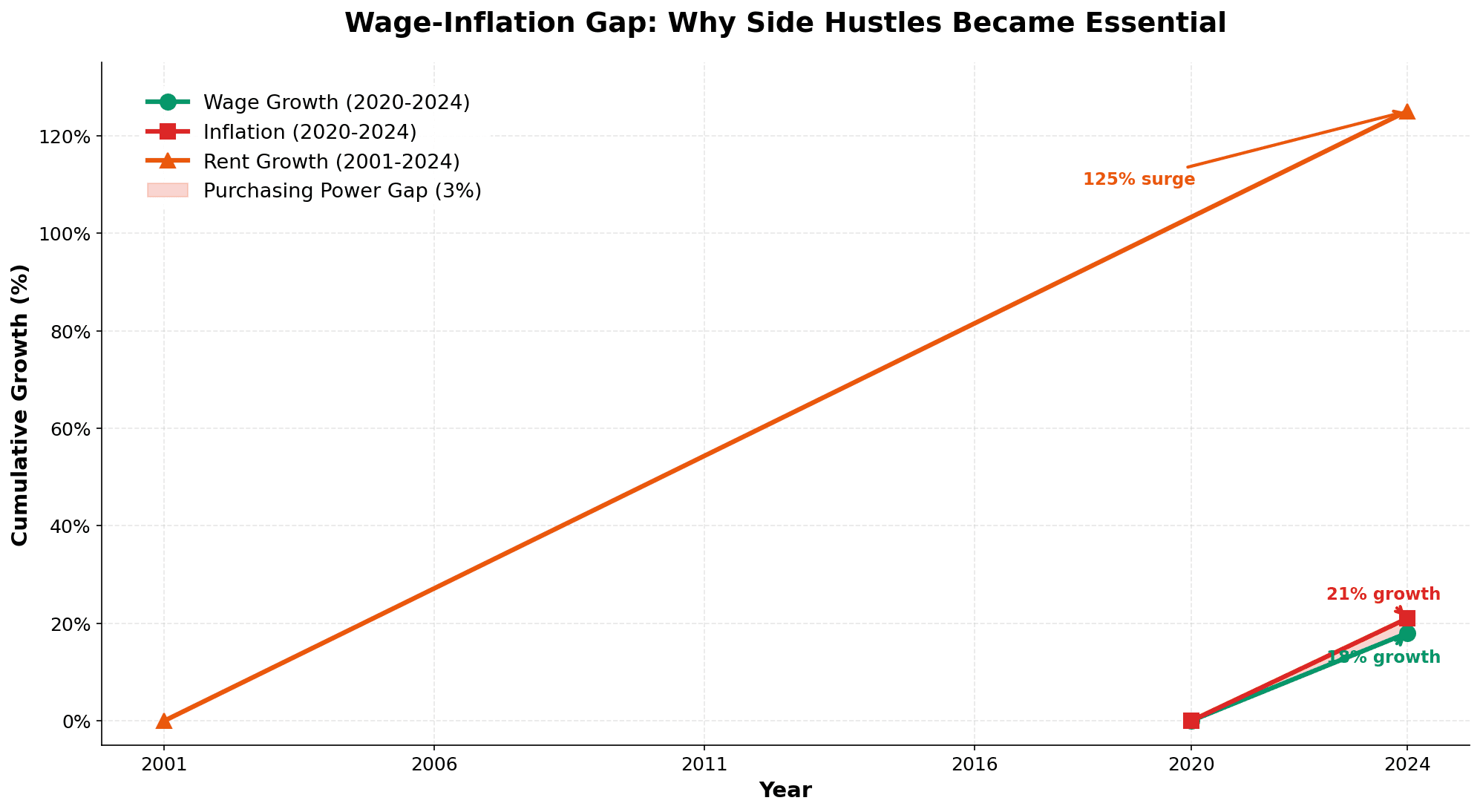
From 2020 to 2024, American wages rose 18%. Inflation rose 21%. That's a 3-percentage-point gap that seems small until you compound it over years. You're making more money while losing purchasing power.
Rent has been even worse. Since 2001, rent has climbed 125% while median wages stayed flat. If you earned $40,000 in 2001, you'd need $48,000 today just to match wage growth. But your rent likely jumped from $800/month to $1,800+/month.
The math doesn't work anymore.
Enter the side hustle. Not as ambition. As survival.
Here's what the data shows:
- 72% of US workers now use secondary income, according to MyPerfectResume's 2026 survey
- 48.5% of the workforce is in the gig economy, up from 34% five years ago
- Average side hustle earnings: $530 per month, though this masks a huge distribution where median is only $200
- 10.5% of hustlers earn over $1,000/month, meaning 90% are making modest amounts
The adoption rate tells you something important: this isn't trend-following. This is economic necessity meeting opportunity.
The Side Hustle Trap: Most People Get This Wrong
Here's where I need to be honest about something uncomfortable.
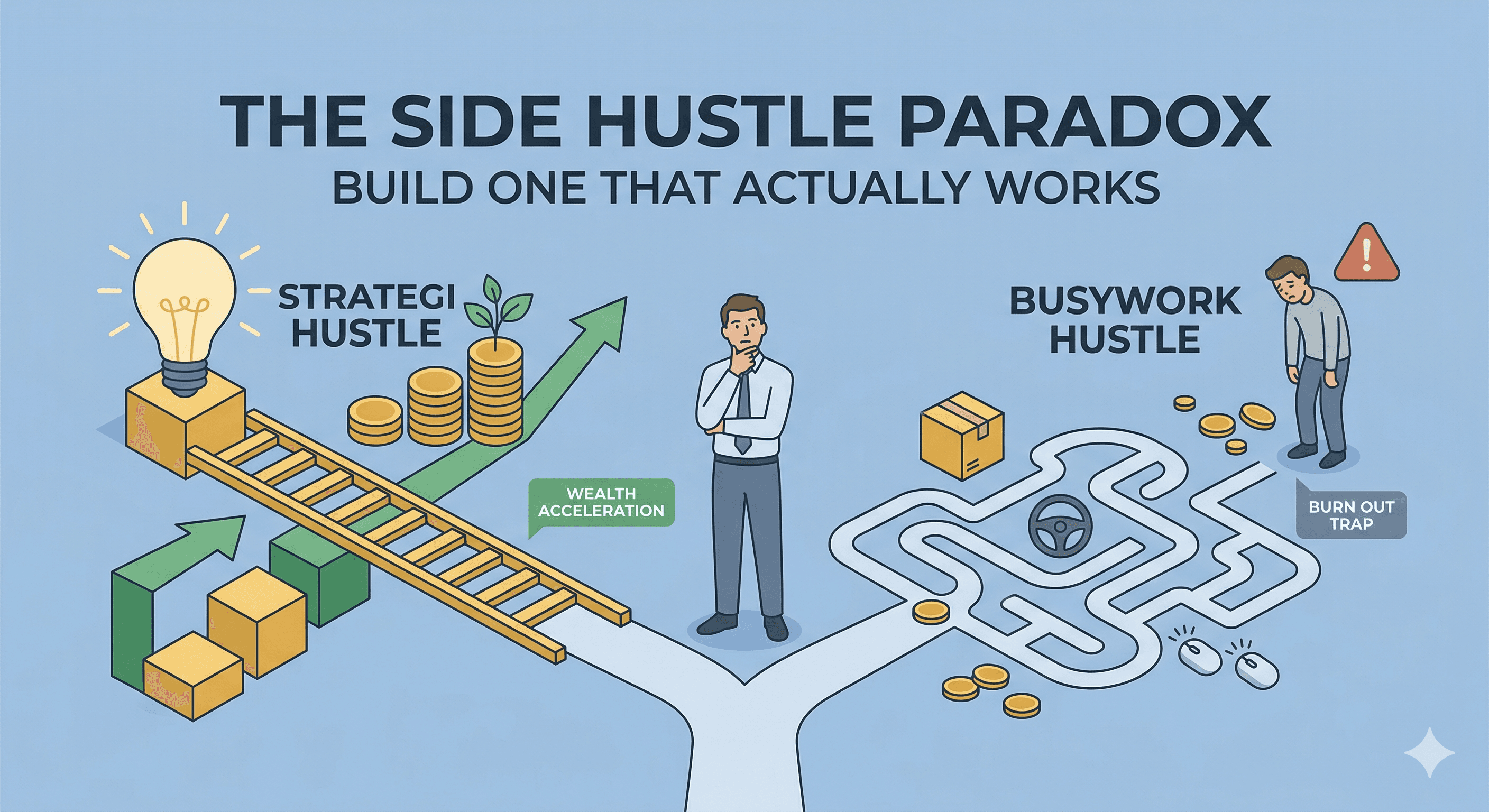
Most side hustles fail not because the idea is bad. They fail because people mistake busy for strategic.
Busy side hustles = trading time for money at low rates ($15-25/hour). You're grinding 12-15 hours a week and making $400/month. That's $6-8 per hour after taxes. It's worse than minimum wage.
Strategic side hustles = compounding income that doesn't require proportional time increases. You build once, earn continuously.
The difference matters because time is your scarcest resource.
Let me introduce Marcus and Keisha, two real case studies from my network:
Marcus (Data Analyst, Age 32): Instead of freelancing hourly, he positioned himself as a "data storytelling consultant" for startups pitching to VCs. His rate: $150/hour. Time: 6-8 hours/week, project-based. Monthly income: $3,200-4,300. After two years, his referral pipeline is so strong he charges 25% more without pitching.
Keisha (Marketing Manager, Age 29): Took a social media management side gig at $18/hour for 20 hours/week. Nominally $1,440/month. But after 8 months: sleep deprivation, missed promotion due to exhaustion, relationship strain. The $1,440/month cost her a $15,000 promotion bonus. She quit realizing her true hourly rate was negative when accounting for opportunity costs.
The lesson: a side hustle that replaces sleep or career development is economically destructive, even if the nominal income looks good.
High-ROI Side Hustle Categories (Ranked by Automation Potential)
Not all side hustles are created equal. Let me break them down by income model and what they actually deliver.
Hourly Gigs (Low ROI, High Burnout)
Examples: Rideshare, freelancing, tutoring, virtual assistant work
- Median income: $400/month
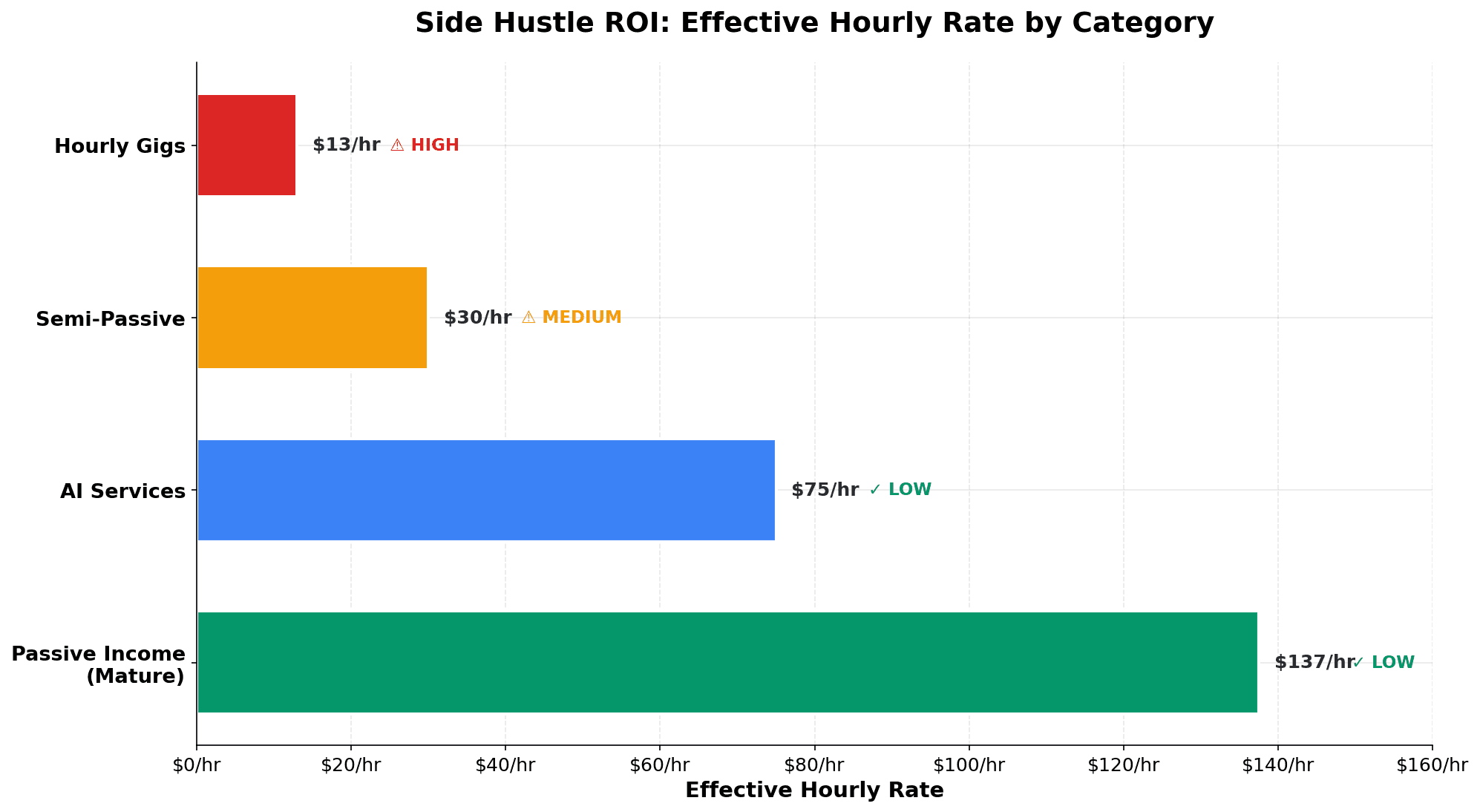
- Effective hourly rate: $13/hour (after taxes, expenses, platform fees)
- Scalability: None—your time is the product
- Burnout risk: HIGH (67% report burnout by 8 weeks)
- Time investment: 12-16 hours/week
Verdict: Avoid unless you have zero alternative. This is exchanging your worst hours (evenings, weekends) for below-minimum-wage income.
Semi-Passive Income (Medium ROI)
Examples: Content writing, specialized freelancing, social media management, basic digital products
- Median income: $600-1,500/month after you establish reputation
- Effective hourly rate: $20-40/hour (once established)
- Scalability: Medium—requires ongoing effort but compounds with niche specialization
- Burnout risk: MEDIUM (especially in early months)
- Time investment: 10-14 hours/week initially, declining as you specialize
Real example: Alex started freelance writing at $0.10/word ($400/month). Over two years, she specialized into B2B SaaS niches, now at $0.50/word ($2,500/month), then healthcare content at $0.80/word ($3,500/month). Her income velocity increased 875% through specialization, not volume.
Passive Income Models (High ROI If You Start Early)
Examples: Digital products (courses, templates), content with affiliate income, niche content sites, rental income
- Median income: $250-500/month once established (varies wildly)
- Top 10% income: $3,000-5,000+/month
- Effective hourly rate: Terrible initially ($0-5/hour), excellent long-term ($75-200+/hour)
- Scalability: VERY HIGH—operations don't require proportional time increases
- Burnout risk: LOW once established, but brutal in setup phase (50-100+ hours upfront)
- Time investment: 50-100 hours to launch, then 2-5 hours/month maintenance
Reality check: Jordan, a 26-year-old engineer, created a Python automation course over 24 hours. Year 1: $240/month in sales. Year 2: $580/month (after investing in ads). Year 5: $2,100/month passive. Over five years at 7% compound growth, that $2,100/month becomes $126,000 in additional wealth—from an initial 24-hour time investment.
The catch? He saw $0 income for three months while building.
AI & Specialized Services (Highest Hourly Rates)
Examples: AI workflow automation, specialized consulting, fintech development
- Median income: $1,500/month
- Effective hourly rate: $50-100+/hour (if you have the skills)
- Scalability: Medium-High
- Burnout risk: LOW if you set boundaries
- Time investment: 6-10 hours/week
The premium here is real: AI-related side hustles on Upwork earn 44% more than the platform average. Specialized consultants ($150-200/hour) command premium rates because their expertise is rare.
The requirement? You need skills that aren't commodified yet. AI is still in that window. It won't last.
The Math: How Strategic Side Hustles Accelerate Your FIRE Timeline
This is where it gets powerful.
Most people think side hustle income is just "extra money." It's not. When you invest it strategically, it fundamentally changes your FIRE date.
Here's the math:
Assume:
- Base FIRE number: $1M (using the 25x rule)
- Base savings rate before side hustle: 20%
- Investment returns: 7% annually (market average)
- Side hustle income: $500/month invested
What does $500/month actually deliver?
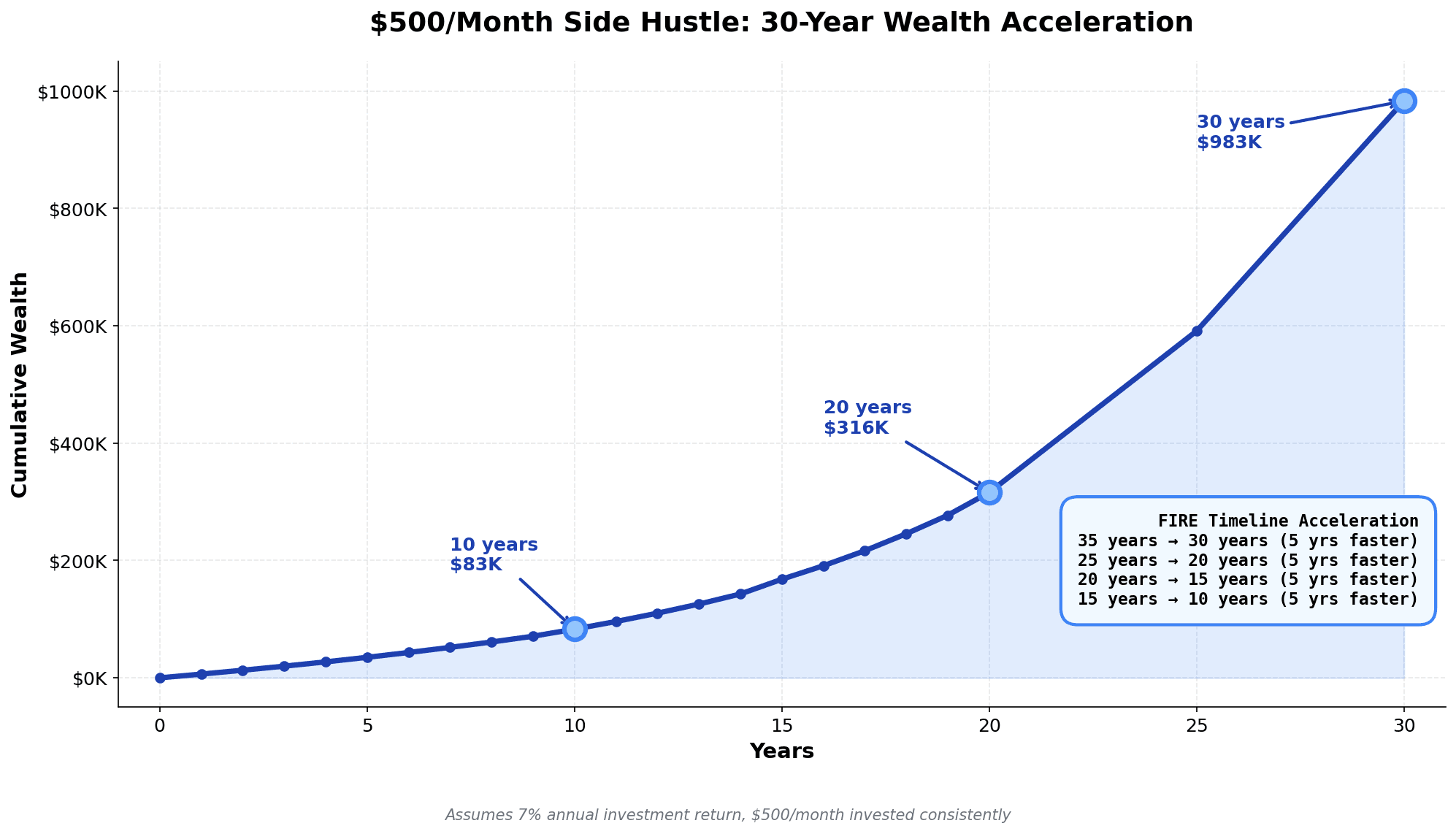
After 10 years at 7% returns: $83,400 After 20 years: $316,000 After 30 years: $983,000
That $500/month side hustle delivers nearly a million dollars in wealth if reinvested over 30 years.
Now let's look at FIRE timeline acceleration:
| Initial Timeline | With $500/mo Side Hustle Invested | Acceleration |
|---|---|---|
| 35 years | 30 years | 5 years faster |
| 25 years | 20 years | 5 years faster |
| 20 years | 15 years | 5 years faster |
| 15 years | 10 years | 5 years faster |
A modest $500/month side hustle shaves 5 years off your FIRE timeline. That's not small. That's the difference between retiring at 45 instead of 50.
This assumes you actually invest the money instead of spending it. That's the critical part. The wealth-building equation requires three factors: income × discipline × time. The side hustle provides the income. Discipline requires tracking where it goes.
Building Your First Side Hustle: 6 Steps From Idea to Sustainable Income
Okay, you're convinced that strategic secondary income matters. Here's how to actually build one without burning out.
Step 1: Start With Skills You Already Have
Don't invent skills. Don't take a course first. Use what you know.
What do you do at your day job that people pay for? Writing? Design? Analysis? Teaching? Project management?
Marcus didn't invent "data storytelling." He used his existing 8-year career as a data analyst and reframed it for a different market (startups vs. enterprises).
Your existing skills have a 5-year head start on learning something from scratch.
Step 2: Test With $20-50 of Your Own Money
Don't overthink the launch. Pick one platform, one idea, one offering. Spend $20-50 to validate demand.
Examples:
- Create one Fiverr gig and wait for inquiries (cost: $0, just takes time)
- Write one article on Medium's Partner Program (cost: $0)
- Create one simple digital product template and list it on Gumroad (cost: $0)
- Run a small Upwork project and test rates (cost: $0-30 in profile optimization)
The goal isn't profit. It's learning what people actually want vs. what you think they want.
Step 3: Find Your Effective Hourly Rate
Before you commit, calculate the truth.
If you're considering a freelance gig:
- Job pays: $500
- Time required: 20 hours
- Taxes (25%): -$125
- Platform fees (5-20%): -$50
- Net hourly rate: $17.50/hour
Is $17.50/hour better than your best alternative use of time? Probably not. But what if you specialize and move to $50/hour? Then it's worth 10 hours a week.
Step 4: Set Hard Time Boundaries
This is non-negotiable.
The research is clear: burnout accelerates after 8 hours/week. 67% of side hustlers report burnout. The severity increases exponentially at 15+ hours/week.
Cap your side hustle at 8-12 hours per week maximum. Batch the work—Tuesday and Thursday evenings, 2-3 hour blocks. Protect sleep above all else.
A side hustle that costs you sleep is a wealth-destruction machine.
Step 5: Track Income With Obsessive Precision
Use a simple spreadsheet or tool like MFFT to track:
- Gross income
- Platform fees/costs
- Taxes withheld (or estimated)
- Time invested
- Effective hourly rate
The reason: You need to see immediately if something isn't working. If your $500/month gig suddenly requires 30 hours a week, you'll know to cut it.
Step 6: Reinvest, Don't Spend
This is where discipline lives.
Set up an automatic transfer:
- 70-90% of net side hustle income → Index funds (tax-advantaged accounts first)
- 10-30% → Reinvest in scaling the hustle (tools, ads, education)
- Budget 20-30% for taxes upfront
Don't let side hustle income become lifestyle inflation. The person who treats $500/month as "extra spending money" never reaches FIRE.
Red Flags: Side Hustles That Will Burn You Out (And What to Avoid)
Not all side hustles are created equal. Some are wealth-builders. Some are wealth-destroyers.
Here's what to avoid:
1. MLMs and Network Marketing (99% Lose Money)
If the business model depends on recruitment, run.
The FTC has published this extensively: 99% of MLM participants either lose money or make below minimum wage. The profits come from recruiting other hustlers, not from product sales.
Red flags:
- Upfront inventory requirement
- Emphasis on recruiting vs. selling
- Income primarily from recruits, not customers
- Unrealistic income promises
- Pressure to join quickly
Verdict: AVOID entirely. The math is engineered against you.
2. Dropshipping and E-Commerce Without Edge
The brutal reality: 80-90% of dropshipping stores fail within year one. Most earn $0 after accounting for ad spend.
The survivors are people who:
- Already have a brand/audience
- Solve a specific problem competitors miss
- Have capital to sustain 12+ months of losses
- Understand digital marketing deeply
Without those advantages, you're competing on price in a saturated market. Not recommended for beginners.
3. Time Sinks Without Scaling Potential
Examples: hourly freelancing, gig delivery work, customer service.
These are legitimate income sources, but they don't accelerate FIRE. You can work 40 hours at your job and 15 hours on a gig job. The gig job won't scale. You're trading health for modest income.
Better path: Find something with scaling potential or higher hourly rates ($50+).
4. Anything Requiring Unpredictable Hours
Side gigs that demand you be available 24/7 (emergency response work, on-call roles) will destroy your sleep and recovery.
Burnout from side hustles is often worse than day-job burnout because it comes after you're already tired. Your cognitive resources are depleted.
Protect recovery time above all else.
5. Businesses With High Ongoing Costs
Digital products that require expensive tools, inventory-based businesses, anything with recurring fees without proportional revenue.
Calculate your actual profit margin. If your "profitable" business costs $200/month in tools and software and earns $300/month, your real net is $100/month. That's not worth 10 hours/week.
Beyond Side Hustle: When (And How) to Scale Into a Real Business
Some side hustles become businesses. Not all should.
Here are the signals it's time to invest more:
- Revenue consistency: You've earned $500+ per month for 6+ consecutive months
- Demand signal: You have a waitlist or people asking if you're available
- Margin improvement: Your hourly rate is climbing ($40+/hour) or your passive income is scaling
- Repeat customers: 50%+ of income comes from repeat clients or recurring revenue
- Documented systems: You could train someone else to deliver 80% of the work
When three of those are true, you can consider:
- Hiring help (freelancer to handle delivery, freeing you for sales)
- Investing in ads (if you have product-market fit)
- Building productized services (scaling from hourly to package pricing)
- Moving to part-time in your day job to focus on growth
The key question: Can this realistically replace your income in 18-24 months? If yes, it's worth scaling. If no, keep it as a lifestyle business.
Gen Z is already pioneering this phased approach—starting side projects early, scaling the ones that work, and using the freedom to negotiate better employment or exit earlier.
Tax Reality: The Boring But Critical Part
I need to talk about taxes because most side hustlers get this wrong and face nasty surprises.
The math:
- Federal income tax: 12-22% (depending on bracket)
- Self-employment tax: 15.3% (both employer and employee portions)
- Total tax rate: 25-30% on side hustle income
If you earn $500/month from a side hustle, plan on paying $125-150 in taxes each month.
Key tax rules:
- Quarterly estimated taxes: If you owe more than $1,000 in taxes, you must pay quarterly (April 15, June 15, September 15, January 15)
- Deductible expenses: Home office, internet, software, equipment, professional development—track everything
- 1099 threshold: If a client pays you more than $600, they'll send a 1099-NEC
- Accounting software: Wave (free), FreshBooks, or Expensify make tracking painless
The real cost: A $500/month side hustle nets about $350 after taxes. Plan accordingly. (If you're an hourly W-2 worker, compare that against simply picking up extra shifts — the new 2026 overtime tax deduction can make overtime hours beat gig income after tax.)
And yes, your MFFT budget tool can track side hustle income separately, making tax time much easier. Categorizing all your business expenses in real-time saves hours in April.
Your Action Plan: Launch This Week
You don't need to wait. You can start this week.
Here's the decision tree:
Do you have 6+ hours available per week?
- YES: Move to Step 2
- NO: Focus on increasing income at your day job first, or adjust life schedule
Do you have a skill you could package (writing, design, analysis, teaching)?
- YES: Start freelancing on Upwork, Fiverr, or directly approaching clients
- NO: Learn an AI-related skill (AI prompt optimization, workflow automation, content generation) in the next 4 weeks, then start
Are you willing to invest 50-100 hours upfront for future passive income, OR do you need cash now?
- Need cash now: Choose semi-passive (specialized freelancing, consulting)
- Can wait 3-6 months: Choose passive (digital products, content sites)
Which appeals more: project-based work or creating once and earning repeatedly?
- Project-based: Freelancing, consulting, services ($25-100+/hour)
- Create once: Digital products, courses, content, templates ($0-$5000+/month mature)
Quick Launch Checklist:
- Choose one side hustle model (don't overthink—pick something this week)
- Set up basic tracking (spreadsheet with income/hours/expenses)
- Launch a test version (Upwork gig, Medium article, Gumroad product—something with $0-20 cost)
- Set hard time boundaries (maximum 10 hours/week, specific days/times)
- Commit to tracking taxes (or using Wave/Expensify from day one)
- Plan to reinvest 70%+ of earnings (set up automatic transfer to investment account)
Conclusion: Side Hustles Are Infrastructure Now, Not Optional
Here's the reality we're living in: side hustles aren't trendy anymore. They're essential.
72% of workers have them. The wage-inflation gap is widening. Remote work has made geographic arbitrage possible. AI has created new opportunities faster than old jobs disappeared.
But here's what separates people who win from people who burn out:
Winners think strategically. They ask: "What's my effective hourly rate?" "Can this scale?" "Is this worth my sleep?"
Burnout victims think hopefully. They say: "This could turn into something" while working 15-hour weeks and wondering why they're exhausted.
The winners understand the math. A modest $500/month side hustle invested consistently cuts 5 years off your FIRE timeline. A poorly designed $1,000/month gig that costs you sleep and energy costs you money through missed promotions and health impacts.
Choose strategically. Set boundaries ruthlessly. Invest relentlessly.
The side hustlers who accelerate their FIRE date aren't grinding harder. They're working smarter on things with scaling potential, protecting their recovery time, and treating side income as wealth-building infrastructure, not extra spending money.
You have the option now. 45% of the US workforce is using it. The question is: will you build a side hustle that actually works, or spin your wheels on something that looks busy?
Ready to track your side hustle income and see how it accelerates your path to financial independence? My Financial Freedom Tracker makes it easy to separate multiple income streams, calculate your real after-tax earnings, and visualize your FIRE timeline with secondary income included.
Questions? Email me at dennis.vymer@myfinancialfreedomtracker.com. I love hearing about side hustles that actually work.
Stay Updated
Get notified about new articles and MFFT build-in-public updates.
Ready to Apply This?
Start tracking your finances today and put these tips into practice.
- Import bank statements in seconds
- AI-powered categorization
- Beautiful visualizations
- Set and track financial goals
Related posts
 Master Your Money
Your Job Is the Biggest Position in Your Portfolio. I Diversified Everything Except the Thing That Pays for It.
My world ETF is spread across an entire developed-market index, and every euro that buys it comes from one employer, one country, one currency. Your job is the biggest undiversified position you own. Here is what actually reduces the risk, and why seven income streams does not.
 Master Your Money
How to Stop Arguing About Money With Your Partner: Our Money Date Is Twenty Boring Minutes Because Nothing Is Left to Decide
Our monthly money date takes twenty minutes and it's deeply boring, and for years I thought that was because we're good at talking about money. It isn't. Half of couples avoid the conversation on purpose to keep the peace, and every article tells them to talk more. Here's the opposite case.
 Master Your Money
One Spouse Manages All the Finances in Our House. It's Me, and That's a Design Flaw.
In our house, one spouse manages all the finances, and it's me. I built the tool, I buy the ETF, I read the numbers out loud while my wife listens. That's a bus factor of one. Here's the 30-minute quarterly drill we run instead of a password folder, and why documents rot.
 Master Your Money
How to Calculate Net Worth (Formula + Worked Example)
Net worth is assets minus liabilities. What counts on each side, how to handle the house, pension and car, a worked example, and why monthly beats once.
 Master Your Money
How to Calculate Your FIRE Number (Formula + Examples)
Your FIRE number is annual retirement spending × 25, from the 4% rule. Three steps, a spending-to-target table, a worked example, and when 25× is wrong.