Stablecoin Savings Accounts: Is 8% Yield Worth It in 2026?

The number that got me was 7.2%.
It showed up on my phone on a Thursday evening in July, tucked between a food-delivery ad and a notification that my "high-yield" savings account had quietly slid to 2.4%. A clean little euro app, one green button: earn 7.2% on your euros, no lock-up, withdraw anytime. And there I was, the guy who tells everyone he meets to keep their money aggressively boring, thumb hovering over "Get started."
I'll be honest about that, because most write-ups on a stablecoin savings account in 2026 are written by people pretending they were never tempted. I was tempted. My insured account pays me roughly a third of what that app was waving around, and on real money that gap is not a rounding error. So instead of tapping the button or closing the app in a huff, I did the annoying thing. I opened it, read every screen, and traced where that 7.2% actually comes from.
This is what I found, and why my emergency fund is still sitting exactly where it was.
What a stablecoin savings account actually is in 2026
Let's kill the marketing first. A stablecoin savings account is not a bank account. It looks like one on purpose, but the plumbing underneath is nothing alike.
Here's the actual chain of events. You deposit euros or dollars. Behind the scenes the app swaps them into a stablecoin, a token that's supposed to be worth exactly one dollar or one euro, forever. USDC, USDT, PayPal's PYUSD, Circle's euro coin EURC, that family. Then the app takes that token and puts it to work somewhere that pays: an on-chain lending market like Aave or Morpho, or a tokenized pile of US Treasury bills. Whatever yield that generates, the app keeps a slice and passes the rest to you as a "reward."
That word "reward" is not a coincidence, and it's the first thing that made me sit up. In 2025 the US passed the GENIUS Act and Europe finished rolling out MiCA, and both of them flat-out ban the company that issues a stablecoin from paying you interest on it. So the apps route around it. They don't pay "interest," a third party pays you a "reward." Same money, different word, and the different word exists specifically so the thing is legal. When a product renames itself to dodge a rule, I want to know what the rule was protecting me from.
The stablecoin itself is also just a promise. It's worth a dollar because a company says it's holding a dollar (or a Treasury bill) for every token, and because everyone agrees to keep trading it at a dollar. That promise has been broken before, and we'll get to the bodies later.
Where a stablecoin savings account gets its yield
This is the question the banner ad never answers, so I'll answer it. There are basically three floors of the building, and they get less safe as you go up.
The ground floor is Treasury bills. A big chunk of the honest yield in this whole space is just US government interest, passed through a token. Products like Ondo's USDY pay around 4.65% because they're literally holding short-term Treasuries, the same ones the government pays a hair under 4% on right now. That part isn't magic. It's a T-bill wearing a hoodie.
The second floor is lending. When you supply USDC to Aave or Morpho, over-collateralized borrowers pay to borrow it, and that's a genuine economic transaction, not fairy dust. It pays somewhere in the 4 to 7% range depending on how badly people want to borrow that week. Real, but variable, and it can dry up fast.
The top floor is where I get nervous. Anything materially above the roughly 4% you'd earn on a boring Treasury bill is the market paying you to take a risk. Smart-contract risk, counterparty risk, the chance the "reward" gets switched off, or a straight promotional subsidy to buy your signup. Coinbase booked 1.35 billion dollars in stablecoin revenue in 2025, a lot of it spent handing rewards to customers. That's not generosity. That's customer acquisition, and a marketing budget can be cut on a Tuesday.
 Data: BitGo, Spark, eco.com.
My rule of thumb, and I built a version of this into how I think about every yield offer: if you can't explain in one sentence where the money comes from, you are where the money comes from. On a normal savings account the source is obvious and boring. The bank lends your deposit, the ECB pays it interest, and a government insurance scheme has its back. Try writing that same clean sentence for a 9% euro-stablecoin app. You can't, and the fact that you can't is the answer. This is the same trap I wrote about in the cash sweep trap: platforms are very good at making money off your idle cash while making it feel like they're the ones doing you the favor.
The stablecoin savings account risks nobody puts in the ad
Start with the one that matters most, because it's the one the ad works hardest to hide: there is no deposit insurance. None. The FDIC said it plainly in 2026, stablecoin holders are not covered, and issuers aren't even allowed to imply they are. In Europe there's no FSCS, no national deposit guarantee. If the app fails, if the issuer fails, if the lending protocol gets drained, you are an unsecured creditor standing at the back of a very long line.
We know exactly what that line looks like, because people have stood in it. When Celsius went bankrupt in 2022, customers who thought they had a "high-yield savings account" lost around 5 billion dollars and are still, years later, fighting to get pennies back. That same year TerraUSD, a stablecoin paying about 20% through a product called Anchor, went from a 17.5 billion dollar market cap to essentially zero over a single weekend, and helped erase something like 60 billion dollars of value on the way down. Twenty percent felt completely normal right up until the Friday it didn't.
And it's not only the sketchy ones. In March 2023, USDC, one of the two blue-chip stablecoins, the one your regulated app probably uses, dropped to 87 cents. Not because it did anything wrong, but because Circle had 3.3 billion dollars of its reserves stuck in Silicon Valley Bank, and SVB collapsed. It re-pegged in two days once the US government backstopped the bank. But if your rent was due that weekend and you needed to sell, you ate a 13% loss on money you thought was a stable dollar.
 Data: Kraken, Decrypt, MEXC depeg history.
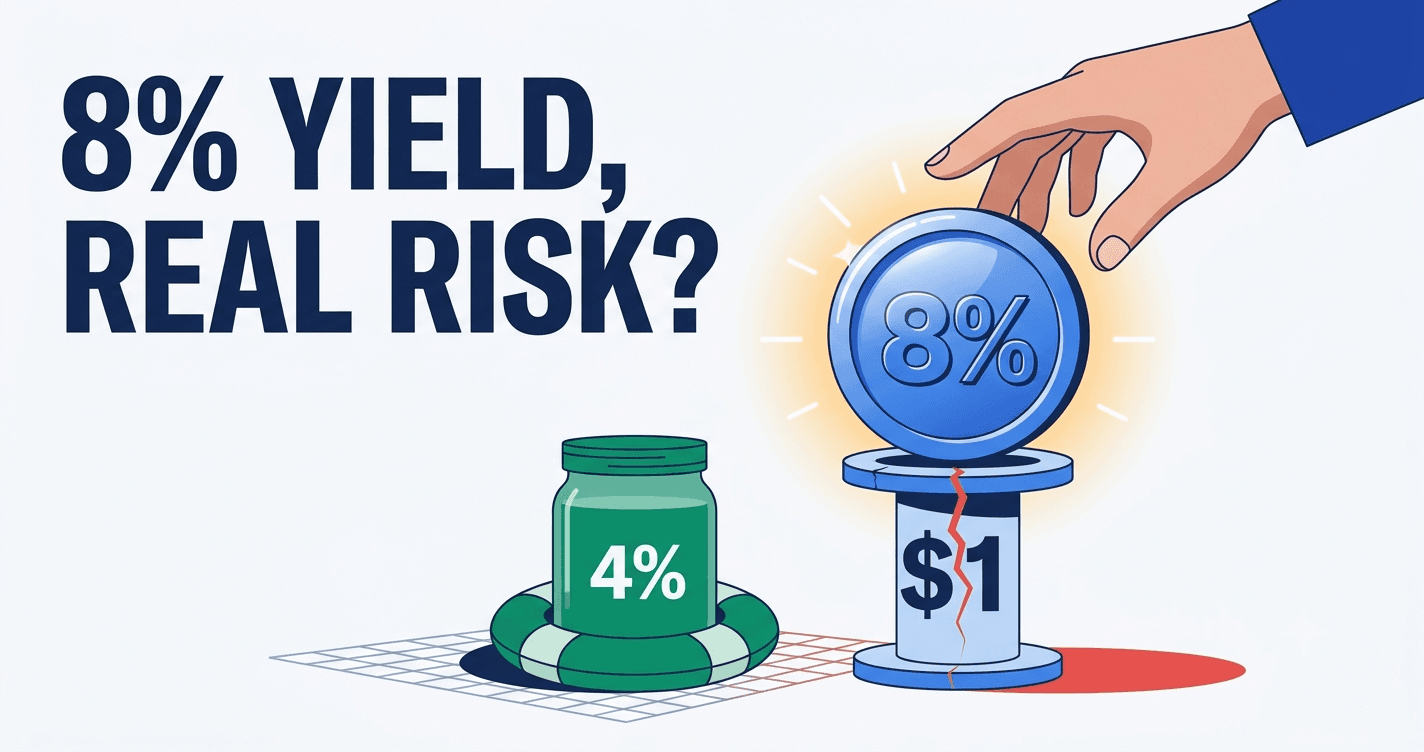
Here's the reframe I keep coming back to. When one thing pays 4% and another pays 8%, the 8% is not a smarter version of the 4%. The market is not stupid. That extra four points is the price of a real, non-zero chance you lose a chunk, or all, of it. You're not beating the system. You're getting paid to hold a risk the 4% account doesn't carry. Sometimes that trade is fine. On your emergency fund, the money you need most on your worst day, it is exactly backwards. That's the whole argument I made in the 2026 emergency fund crisis, and stablecoins don't change it, they just dress it up in a nicer app.
Why the stablecoin savings account pitch is louder in Europe right now
I kept wondering why these ads hit my European phone so much harder than they hit my American friends. Then I looked at the rates and it clicked.
An American saver can still walk into an insured, boring, government-backed high-yield account and get about 4.2%. The gap between that and a stablecoin app isn't nothing, but it's small enough that a sensible person shrugs and stays insured. Over here it's a different picture. The ECB deposit rate sits at 2.0%, and the best cash rates my broker offers hover around 2.2 to 3.0%. So when an app dangles 7%, the euro gap it's advertising against is twice as wide. The temptation is engineered by the rate environment, and the rate environment in the eurozone makes the bait look a lot juicier.
 Data: EU Personal Finance, Bankrate, NerdWallet, Nexo, Coinbase.
The fair thing to say, and I want to be fair, is that the European gap is partly legitimate. MiCA now forces euro stablecoins to hold 100% reserves, get audited, and redeem at par. The plumbing genuinely got sturdier. A euro saver routing into tokenized US Treasuries really can earn more than their local bank pays, and there's nothing fraudulent about that specific slice. But "more than my bank" and "safe as my bank" are two completely different sentences, and the ads are betting you'll read the first one and hear the second.
I almost moved my emergency fund. Here's the math that stopped me.
So I did what I always do when I'm tempted. I opened my own tracker and ran the numbers instead of the vibes.
Take a 10,000 euro emergency fund, the kind of buffer a normal person actually keeps. In my insured account at 2%, it earns 200 euros a year. In the 8% app it earns 800 euros, gross, no insurance. So the prize for taking the leap is 600 euros a year. Real money. I'm not going to pretend 600 euros is nothing, because when your savings rate is falling it feels like a lot.
Now the other side of the ledger. If a USDC-style depeg hits like it did in 2023, that's a 13% haircut, minus 1,300 euros, on the exact day you might need to spend it. And if the thing behind your app turns out to be a Celsius or an Anchor, the loss isn't a haircut, it's a decapitation. Minus 100%. Ten thousand euros, gone, with you standing at the back of the creditor line.
 Data: ECB, stablecoininsider, CNBC, coincentral.
Line those up next to each other and the trade gets obvious. You're risking a 13-to-100% loss to chase a 6% gain, on the one pool of money whose entire job is to be there, in full, on your worst day. That's not an investment decision. That's writing an insurance policy to the app, where you take all the downside and they keep your premium. I closed the tab. The 8% number still nags at me, I won't lie, some part of my brain refuses to fully let go of it. But nagging isn't the same as being right.
The one case where I think it's defensible
I don't want to be the guy who just says "crypto bad" and walks off, because that's lazy and it's not quite true. There's one version of this I can actually defend.
If you have money you have genuinely, truly written off, a small play sleeve you could set on fire without it changing your life, then putting it into the most transparent tokenized-Treasury product and pocketing the 4.65% is a coherent thing to do. Note what I'm not saying. Not the 14% offer. Not the emergency fund. Not the long-term core. A tiny, clearly-labeled satellite, treated as speculation that happens to pay a yield, capped at an amount whose total loss you'd shrug at.
That's the same box I keep any crypto exposure in, and it's why I get twitchy watching people bolt it onto the parts of their life that are supposed to be safe, which is exactly what I argued about putting Bitcoin in your 401k. Speculation is fine in the speculation drawer. The problem is always when it sneaks into the safety drawer wearing a savings-account costume.
What I actually do with money I can't afford to lose
Nothing clever. That's sort of the point.
The buffer stays in a boring insured account, earning its boring 2 to 4%, fully guaranteed, available the instant I need it. For cash I've got earmarked for something twelve to twenty-four months out, I'd rather lock in a real government-backed yield while rates are still falling, which is what buying Treasury bills in 2026 is for. And the money that's actually meant to grow, the retire-someday money, goes where it's always gone, into a plain all-world ETF on autopilot, doing the slow compounding thing I've bet my whole plan on.
The market cap of stablecoins is around 316 billion dollars now, up from 27 billion five years ago, so this isn't a fad that's going away. Some of it is real, useful financial machinery, and euro stablecoins backed by actual Treasuries will probably keep getting safer. I'm not anti-innovation. I'm anti putting my fire extinguisher inside the fireplace.
So here's my honest verdict on the whole stablecoin savings account in 2026, from a guy who genuinely almost signed up: the legit part of the yield tops out around what a Treasury bill pays, and everything above that is you getting paid to take a risk the ad forgot to mention. For play money you've already written off, fine, eyes open. For the money that has to catch you when you fall, no chance. The extra few hundred euros a year is a bad price for a buffer that might not be there when you reach for it.
The falling savings rate is annoying. I feel it every month, same as you. But an emergency fund that's fully there when the roof leaks is doing its job perfectly, even at a lazy 2%. Boring isn't the price I pay for safety. Boring is the safety. And the day I forget that, remind me I wrote it down.
Stay Updated
Get notified about new articles and MFFT build-in-public updates.
Ready to Apply This?
Start tracking your finances today and put these tips into practice.
- Import bank statements in seconds
- AI-powered categorization
- Beautiful visualizations
- Set and track financial goals
Related posts
 Master Your Money
How to Stop Arguing About Money With Your Partner: Our Money Date Is Twenty Boring Minutes Because Nothing Is Left to Decide
Our monthly money date takes twenty minutes and it's deeply boring, and for years I thought that was because we're good at talking about money. It isn't. Half of couples avoid the conversation on purpose to keep the peace, and every article tells them to talk more. Here's the opposite case.
 Master Your Money
One Spouse Manages All the Finances in Our House. It's Me, and That's a Design Flaw.
In our house, one spouse manages all the finances, and it's me. I built the tool, I buy the ETF, I read the numbers out loud while my wife listens. That's a bus factor of one. Here's the 30-minute quarterly drill we run instead of a password folder, and why documents rot.
 Master Your Money
How to Calculate Net Worth (Formula + Worked Example)
Net worth is assets minus liabilities. What counts on each side, how to handle the house, pension and car, a worked example, and why monthly beats once.
 Master Your Money
How to Calculate Your FIRE Number (Formula + Examples)
Your FIRE number is annual retirement spending × 25, from the 4% rule. Three steps, a spending-to-target table, a worked example, and when 25× is wrong.
 Master Your Money
Job Hopping vs Staying in 2026: Both Camps Time the Market
Job hopping vs staying is market timing with a résumé: the switching premium hit a record low in January, then widened by July. I've made that mistake before.