The Cash-Sweep Trap: Your Broker Pays 0.01% on Idle Cash

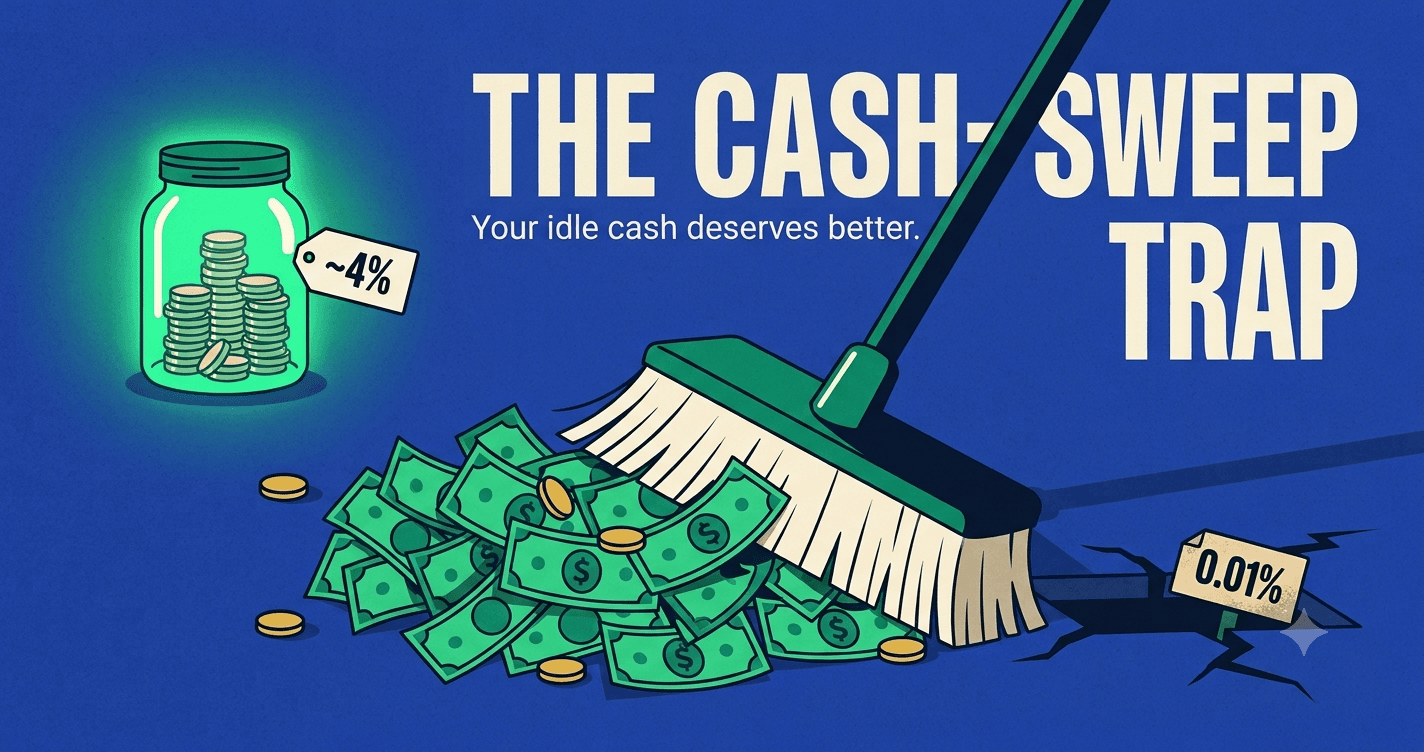
Last quarter I was adding up our accounts by hand, the way I do every three months, and one line stopped me cold. Sitting in a brokerage cash sweep account was a chunk of money earning 0.01%. One line down, the same account offered a money-market fund paying north of 3.5%. Same broker. Same login. Same day. One was paying me roughly three hundred and sixty times more than the other, and I had somehow ended up in the wrong one without ever choosing it.
I did the math in my head. The sweep cash was earning me a few dollars a year. A few. If I moved it, it would earn well over a thousand.
That is when it clicked for me: the thing quietly costing me money wasn't a bad investment. It was cash I assumed was working and wasn't.
The moment I found dead money in my own accounts
Here's the part I'm slightly embarrassed about. I build a net-worth tracker for a living. I preach "know where every dollar is." And I still missed this for months, because the broker's app rounds interest down to a number so small you scroll right past it.
The only reason I caught it is that I don't trust dashboards. I total everything myself, in my own tracker that doesn't link to my bank, specifically because I want to see the ugly line items the pretty apps hide. And there it was. A "sweep" balance next to a "money fund" balance, one paying basically nothing, the other paying real money, and me not having clicked a single button to end up split between them.
If you set up your account once, turned on autoinvest, and never looked again, I'd bet money you're in the same spot right now. Not because you did anything wrong. Because the default was chosen for you, and the default is bad.
What a cash sweep actually is (and why the default costs you)
A cash sweep is the plumbing under your brokerage account. Any cash that isn't invested, whether from a deposit, a dividend, or a sale, gets "swept" somewhere overnight so it isn't just sitting there. Fine. The question nobody asks is: swept where, and paying what?
There are two flavors. A bank sweep moves your uninvested cash into a bank, often one the broker owns, and pays you whatever rate the broker feels like. A money-market fund sweep moves it into an actual money fund that pays close to the going short-term rate. Guess which one most of the big firms make the default.
The broker sets the rate you get and keeps the difference between what your cash earns and what they hand back to you. That spread is not small change to them. Charles Schwab reported around $399 billion in client sweep cash back in March 2024, and in 2023 pulled nearly half of its $18.8 billion in revenue from net interest income. The pennies rounded off your statement are somebody else's billion-dollar line item.
 Data: SEC.gov, PR Newswire, Reuters, Crane Data.
And here's how I know I'm not just a cranky guy with a spreadsheet: the regulators and the courts have already had this fight. In January 2025 the SEC settled with two Wells Fargo entities and Merrill Lynch for $60 million total over how they handled sweep cash. In February 2026 a federal judge let the breach-of-contract claims against J.P. Morgan Securities move forward, while the fiduciary-duty claims got tossed, so it's a split decision, not a bloodbath. Two months later, in April 2026, Oppenheimer agreed to a $70 million settlement to make its own sweep case go away. More than a dozen suits have landed across the industry against at least eight firms. This is not a fringe complaint. This is the industry getting caught doing the same thing at scale.
One nuance that matters, because I refuse to fearmonger: this trap is firm-specific. If you're at Fidelity or Vanguard and never touched the settings, your default cash is probably already in a money fund (SPAXX or VMFXX), and you're mostly fine. The trap is worst at the wirehouses and bank-owned brokers, meaning Merrill, Morgan Stanley and its E*TRADE arm, J.P. Morgan self-directed, and Schwab's bank sweep. J.P. Morgan's self-directed sweep, for what it's worth, sat frozen at 0.01% from June 2020 straight through the years the Fed pushed rates past 5%. The number just never moved.
The real math: what 0.01% vs 3.8% costs you
Let me kill the vague version of this argument. People say "you're leaving money on the table" and your brain hears "eh, a few bucks." So here are actual numbers.
At 0.01%, ten thousand dollars earns you one dollar a year. I didn't invent that number to be dramatic. It's E*TRADE's own published tier, which even spells it out as a dollar of interest per ten grand. At the alternatives available right now, that same ten grand earns a couple hundred.
 Data: Brokerage-Review, Bankrate, Vanguard, Fidelity/Morningstar (2026 rates).
Now scale it to real balances. Say you keep an emergency buffer plus a little slack. Here's the annual gap between a 0.01% sweep and roughly 3.8%, which is about the middle of what a government money fund (VMFXX at 3.56%) or a top HYSA (around 4%) pays as I write this in mid-2026.
 Data: Computed from quoted 2026 rates (VMFXX 3.56% / HYSA ~4%).
A thirty-thousand-dollar buffer earns about three dollars a year in the sweep and about eleven hundred and forty in a money fund. That's not a rounding error. That's a nice weekend, every single year, that you're gifting to a bank because a settings page was pre-filled for you.
And it compounds, which is where it gets genuinely annoying. Leave that same $30k in a 0.05% sweep for a decade instead of ~3.8%, and you don't lose a thousand bucks. You lose something like thirteen thousand four hundred.
 Data: Computed, compounded annually at flat 0.05% vs 3.8%; illustrative.
Now, honesty check, because I'd want one. Two years ago money funds paid closer to 5% and this gap was even fatter. Rates have come down since; the Fed has been holding around 3.50 to 3.75%. So the alternative isn't as juicy as the 2024 headlines screamed. But "less juicy" still means 60 to 360 times your sweep. The gap shrank. It did not close.
There's also a second failure mode, and I'll come back to it: holding too much cash. Fixing a 0.01% sweep is easy money. Parking your entire future in cash at 4% because the market feels scary is a slower, quieter mistake. Both are cash drag. One just hurts over 30 years instead of one.
How much cash should actually be sitting in cash
Before you go yield-chasing, sort your cash into buckets. This is the boring step everyone skips, and it's the one that keeps you from doing something dumb like locking your rent money in a one-year CD.
Spending money is what you'll touch this month. Rent, groceries, the card bill. This lives in checking. Its job is to be there instantly. It is not supposed to earn anything, so stop optimizing it.
Your emergency buffer is three to six months of expenses, sized to how risky your income is. A dual-income household where both people have stable jobs needs less runway than a one-income freelancer. I've written a whole piece on why the emergency fund math changed in 2026, so I won't relitigate it here, but this is the bucket where the sweep problem usually bites, because it's a real pile of cash you rarely move.
Sinking-fund cash is money for the known-but-not-yet expenses. The next used car, the roof, the trip. Ours sits in named savings buckets.
Then there's a fourth bucket that a lot of people mislabel: money that is genuinely long-term and has no business sitting in cash at all. If you won't touch it for ten-plus years, cash isn't safety, it's slow erosion. That money belongs invested, and I'll point you at how I think about keeping investing boring and simple rather than repeating myself.
Get the buckets right first. Then, and only then, optimize where each one lives.
The cash cascade: where each bucket lives in 2026
Here's the flow I actually use. Think of it as cash falling down a set of shelves, each one a little less liquid and a little higher-yielding than the last.
Instant-access spending stays in checking. Done.
The emergency buffer goes to one of two places, and honestly either is defensible. A high-yield savings account pays around 4.00 to 4.20% right now, it's FDIC-insured, and transfers are usually same-day, which is great if you want your safety money government-guaranteed and sitting somewhere you won't accidentally invest it. Or a Treasury or government money-market fund bought inside your brokerage (VMFXX, SPAXX, or your broker's version), which pays roughly 3.3 to 3.6%, is SIPC-covered rather than FDIC-insured, and settles the next day when you sell. I like the money fund for cash I want to keep at the broker and deploy fast. I like the HYSA for the buffer I want walled off.
Cash you won't need for one to five years can reach for a bit more by giving up liquidity. A CD ladder or short Treasuries locks in the ~4.1% on offer today for money you're confident you won't touch. If falling rates have you wanting to nail down a yield before it drops further, I laid out how to build a CD ladder when rates are sliding, and it's the natural home for this shelf.
The long-term bucket doesn't belong on this cascade at all. It belongs invested.
Now the trade-offs, because there's no free lunch and I hate advice that pretends there is. FDIC insurance (the bank sweep, the HYSA) protects your principal up to the limit even if the bank fails. A money-market fund carries no FDIC coverage. SIPC protects you if the broker collapses, up to $500,000 with a $250,000 cash sublimit, but not against the fund itself losing value. Can a money fund lose value? Rarely, but yes. In 2008 the Reserve Primary Fund "broke the buck" and fell below a dollar per share, and it set off a run. Government money funds like VMFXX and SPAXX are far sturdier than that 2008 prime fund, but "not insured" is true and worth saying out loud. There's also tax: that extra interest is ordinary income, so on a small balance the after-tax, after-effort payoff is real but modest. Weigh it honestly. Then pick.
Your two-minute quarterly cash-sweep audit
This is the whole fix, and it takes less time than reheating coffee.
One. Log in and find your cash. Look for "cash management," "sweep," "cash features," or "sweep rates." Your monthly statement lists it too. Read the actual APY on your uninvested cash. If it starts with 0.0, you're in a low-yield default.
Two. Compare it to the alternative in the same place. Nine times out of ten your broker offers a government money fund you can buy in about four clicks. Pull up its current yield.
Three. Move it. Either flip the "cash feature" setting where the broker lets you, or just buy the money-market fund manually with your idle cash. It's a normal trade, same as buying any fund. If your broker only offers a stingy bank sweep and won't budge, move the buffer to an outside HYSA instead.
Four. Set a recurring reminder. Every quarter, two minutes, check the sweep yield against the alternative. Rates move, and the gap can quietly reopen.
That's it. The reason I harp on the reminder is that the autoinvest crowd, me very much included, is the most exposed group here. We're proud of our set-and-forget systems. We automate the buying, feel responsible, and never look at the cash line again. The automation is the whole vulnerability.
The mindset: track it yourself or the default wins
If there's one thing to take from this, it's that the risk in your cash isn't drama. It's boredom. Nobody blows up their finances on a cash sweep account. They just leak a little every month, for years, on a line item designed to be un-noticeable.
I only caught mine because I distrust the dashboard and total my accounts by hand. The government, weirdly, agrees with me. The SEC's own investor bulletin tells you flat out that you can move your uninvested cash for a better rate even if your firm auto-enrolled you in its default. That's the regulator saying the quiet part: the default is not on your side.
So here's my actual takeaway, the same one I'd give a friend over a beer. Automate the investing. Never automate the cash. Read the fine print on the word "cash" wherever it appears in your accounts, because it can mean 0.01% or it can mean 3.8%, and the app will never make the difference feel urgent. Do the boring two-minute check. Then go live your life.
I moved mine in about ten minutes. Next quarter I'll spend two minutes making sure it stayed moved. That's the entire strategy, and it's worth more than most of the clever ones.
Stay Updated
Get notified about new articles and MFFT build-in-public updates.
Ready to Apply This?
Start tracking your finances today and put these tips into practice.
- Import bank statements in seconds
- AI-powered categorization
- Beautiful visualizations
- Set and track financial goals
Related posts
 Master Your Money
Your Job Is the Biggest Position in Your Portfolio. I Diversified Everything Except the Thing That Pays for It.
My world ETF is spread across an entire developed-market index, and every euro that buys it comes from one employer, one country, one currency. Your job is the biggest undiversified position you own. Here is what actually reduces the risk, and why seven income streams does not.
 Master Your Money
How to Stop Arguing About Money With Your Partner: Our Money Date Is Twenty Boring Minutes Because Nothing Is Left to Decide
Our monthly money date takes twenty minutes and it's deeply boring, and for years I thought that was because we're good at talking about money. It isn't. Half of couples avoid the conversation on purpose to keep the peace, and every article tells them to talk more. Here's the opposite case.
 Master Your Money
One Spouse Manages All the Finances in Our House. It's Me, and That's a Design Flaw.
In our house, one spouse manages all the finances, and it's me. I built the tool, I buy the ETF, I read the numbers out loud while my wife listens. That's a bus factor of one. Here's the 30-minute quarterly drill we run instead of a password folder, and why documents rot.
 Master Your Money
How to Calculate Net Worth (Formula + Worked Example)
Net worth is assets minus liabilities. What counts on each side, how to handle the house, pension and car, a worked example, and why monthly beats once.
 Master Your Money
How to Calculate Your FIRE Number (Formula + Examples)
Your FIRE number is annual retirement spending × 25, from the 4% rule. Three steps, a spending-to-target table, a worked example, and when 25× is wrong.