Buying Back Your Time: We Save Half Our Income and Have Never Once Paid Anyone to Do Our Work

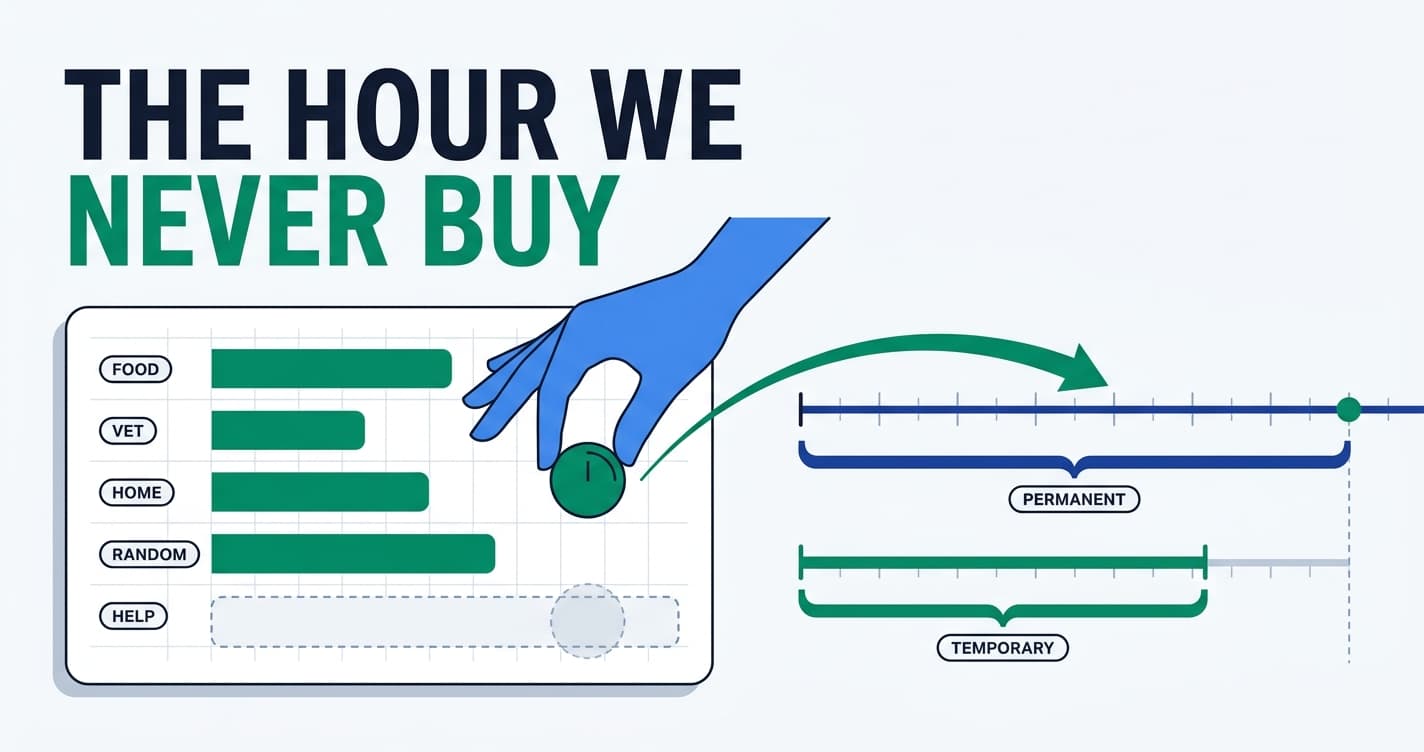
We have a budget category for the vet. We have one called random stuff, which exists purely so my sinking funds stop lying to me. And in years of running this budget there has never been a single line for paying another person to do a job that currently belongs to us. Not a cleaner. Not a delivery. Not a man with a van, not a gardener, not one hour of anybody's labour.
Zero. Every month. For years.
Buying back your time is the one purchase this household has never made, and I've come round to thinking it's the most expensive habit in the house.
That gap isn't an oversight. A household that names its categories out loud doesn't forget one.
Two weeks ago I published a piece arguing that my second house is a part-time job I never applied for, that the honest move is to price the job and then professionalise it or sell it, and I signed off promising to run my own numbers this autumn. I'm a fortnight into logging the hours and I can already see the shape of it. It is nowhere near the three hours a month the rental brokerages quote. It's a couple of Saturdays, most of them the kind that start at nine and are somehow gone.
And I have already decided to do nothing about it. That's the real subject here.
The arrangement this refusal sits inside
Here's how we run money, so you know what you're arguing with.
One pot. All income lands in one account, investments go out first on payday before anything gets a vote, and we each keep a personal fun-money pile that the other one never comments on — hers is roughly twice the size of mine, and I set it up that way. We save around half of what we make. We sit down once a month with a coffee and the statement for ten minutes, and once a year in January for the long version.
Right now our daughter isn't quite three months old, my wife is home with her, and I'm doing the outside jobs at whatever hour they fit into. The second house has a boiler, gutters, insurance that renews itself with a step function, and a slow list of small repairs that never gets shorter.
I've been telling myself that doing all of it myself is discipline. The case against me is better than I'd like.
Why buying back your time looks so expensive when you save half your income
Every euro of new recurring spending hits a high-savings household twice. It comes out of what you invest, and it raises the pile you need, because the target is a multiple of what you spend. That double hit is why an hour feels so much more expensive to us than to a normal household, and it's the same mechanism that makes the savings rate dominate everything else in the plan.
So I did the arithmetic on a clean round household, because I wasn't going to publish ours.
 My own projection, not a survey. A household with 100,000 a year of net income — the currency doesn't matter, the ratios do — saving 50% of it, starting from zero, 5% real return, financial independence defined as 25× annual spending. In the permanent scenario the spend is added to annual spending and to the target. In the temporary scenario it reduces savings but the target stays at 25 × 50,000, because the purchase ends before retirement. Taxes on returns, wage growth and sequence risk are not modelled. The 5% comes from the long-run worldwide-equity real return of 5.2% (1900–2024, Dimson, Marsh and Staunton in the UBS Global Investment Returns Yearbook), rounded down.
At €400 a month of household help, baked in permanently as a feature of the life I'm retiring into, the model pushes financial independence out by 2.3 years. On a fifteen-year plan that's fifteen percent of the runway. I'm not going to pretend that's small.
Now the number that changed my mind. Price exactly the same €400 as a temporary purchase, something with an end date rather than a permanent feature of that life, and the same model says 1.2 years. Same money, same market, half the damage.
The gap between those two bars is the whole article.
It isn't about how much you spend. It's about whether the spending quietly becomes who you are, and we already proved that to ourselves once. Our savings rate went from around 60% to around 50% when our daughter arrived, and that moved our date by about six months rather than six years, for exactly this reason: a temporary dip only costs you the contributions you missed, while a permanent one moves the finish line away from you while you run at it.
One caveat I owe you, because it makes every bar in that chart taller: 25× assumes 4% is safe, and 4% is contested. Morningstar's base case for a 2026 retiree is 3.9% over thirty years.
Everything written about buying back your time assumes you can sell hour forty-one
Search the phrase and you get one book and about forty summaries of it. The mechanic everyone quotes is the buyback rate: annual salary divided by two thousand hours. The promotional example uses a founder taking home a million a year, which produces five hundred dollars an hour, which makes any purchase on earth look like a bargain.
That number is nonsense for a salaried household, for two reasons nobody on that first page mentions. It uses gross pay. And it assumes you can sell that forty-first hour. I can't. My employer does not buy extra hours from me at my average rate, and neither does yours.
Run it honestly and it's uncomfortable rather than flattering. Take the EU average net annual earnings for a single worker without children, €29,573 in 2024 per Eurostat, and divide by the OECD average of 1,683 hours actually worked, and you get €17.57 an hour. Now add the commute: roughly 209 hours a year, from a 27-minute average one-way trip over about 230 days. That is the American figure, and the EU-27 average of 25 minutes is close enough that it doesn't change the answer. Your hour drops to €15.63. Set that beside the US median wage for a housekeeping cleaner, $17.07 an hour in the BLS occupational data for May 2025, and the trade is roughly one for one. Not free. Not the ninety-percent discount the productivity genre implies.
But here's where I think most advice on this optimises entirely the wrong thing. That whole genre ends its loop by refilling the freed hour with higher-leverage work. Buy the hour, put it back into the business, scale. For a founder that might be the point. For a household it's the definition of failure, and I'll show you the research that says so in a minute.
The question was never what your hour would earn. It's what the hour is being converted into.
The research is real. It is also small, and two of six samples found nothing.
The canonical study is Whillans, Dunn, Smeets, Bekkers and Norton in PNAS, 2017. Six thousand two hundred and seventy-one people across the US, Canada, Denmark and the Netherlands, which is the rare piece of evidence that works on both sides of the Atlantic without translation. People who spent money on time-saving services reported higher life satisfaction. Across the six directly comparable samples, 4,469 people, 28% had made a purchase like that in a typical month, spending an average of $148.
The effect size is d = 0.24. That is small. Four of the six correlational samples reached significance and two didn't. The only causal experiment in the paper is sixty people in Vancouver over two weekends with forty dollars each. Anyone selling you a transformation off that paper is overselling it.
The finding I actually care about isn't the happiness boost. It's the buffer. Among people who didn't buy time, feeling time-poor predicted lower life satisfaction. Among people who did, that link came out at p = 0.144, which is a statistician's way of saying it wasn't there. You're not buying happiness. You're buying insulation.
And there's a 2022 replication in PLOS One from some of the same authors that I have to put in, because it points straight at me. Spending money on other people held up across every demographic they tested. Buying time didn't. It was only marginally significant for men, and non-significant within each individual income bracket. Worse, the benefit sat mostly with people who value money over time. The group that already treats time as the scarce thing got no measurable lift, and that is precisely the group reading this.
I'm making my argument anyway, and now you know how thin the plank is.
 Data: Whillans, Dunn, Smeets, Bekkers & Norton, PNAS (2017), Table 1. n = 6,271. The US Qualtrics sample used a broader definition of a time-saving purchase than the other six and is not strictly comparable.
Look at the bottom bar and then look at the top one. That sample of Dutch millionaires had a median household net worth of $879,000, and roughly four hundred of the eight hundred and eighteen of them spent nothing at all on outsourcing tasks they disliked. Not a reduced amount. Nothing.
So "we'll do it when we can afford it" has an expiry date that never arrives. In a separate study in the same paper, ninety-eight working adults were asked what they'd do with forty dollars landing next week. Two percent thought of buying time. Ask your partner that question this weekend and see if either of you says "four hours back."
The hour you buy goes straight back to work
This is the part the cheerleaders drop, and it's the part I believe most.
Cassie Mogilner ran experiments back in 2010 showing that priming people with the concept of money makes them work more and socialise less, while priming them with time does the reverse. A household that opens a savings-rate dashboard every month is running a permanent money prime on itself.
Then the natural experiment. Whillans has pointed out that American workers freed up something like 89 million work days by not commuting, and substituted that time almost completely with more work, about an extra hour a day. That figure is US and pandemic-vintage, so treat it as a behaviour pattern rather than a European statistic.
Hsee and colleagues supply the mechanism: people are averse to idleness and will accept even a flimsy justification to be busy rather than sit with unstructured time. If you don't name what the hour is for, something will name it for you. In my house that something has a boiler and gutters.
And the couples research now closes the loop. Whillans and co-authors published a seven-study paper in 2025, including an eleven-year British panel of 98,062 observations from 33,456 people. Time-saving purchases do predict relationship satisfaction. But the direct effect barely clears significance at β = .08, which is another way of saying almost nothing. The route that runs through quality time spent together is B = .40, an order of magnitude bigger.
Read that as an operating rule rather than a finding. The invoice does nothing. The evening you actually spend together does all of it. Somebody comes on a Thursday, I drive to the second house anyway, she spends the freed hour on the laundry pile, and we have paid real money for a result that measures as zero.
Whose hours are you actually buying
Household work is almost never divided the way household money is, which means an outsourcing decision made by one person quietly buys back the hours of whoever already had more of them.
The European numbers are blunt about the direction. Across 23 European countries in the OECD time-use data, women average 262 minutes a day of unpaid work against 141 for men. That's a two-hour gap, every day. It runs from 29% in Sweden to 349% in Turkey, with Germany at 61% and Italy at 134%.
 Data: OECD Time Use Database, 23 European countries, via Euronews (September 2025). "Unpaid work" here includes care and shopping, which is a different definition from the US time-use survey, so don't compare this to an American number you've seen elsewhere.
I'm not going to publish our household's split or put a position in my wife's mouth. What I will say is that a woman at home with a newborn and a man who disappears to a building site on Saturdays are not two people with the same amount of discretionary time, and any purchase I decided on my own would be me deciding whose Saturday matters.
So it goes on the money-date agenda in this order, and the order matters: name the task, name who currently owns it, name what the freed hour is for, and only then name the price. If nobody can answer the third one, we don't authorise the spend.
One structural rule fell out of that conversation and I'd defend it hard. A bought hour does not come out of fun money. Fun money is personal and discretionary and exists so neither of us has to justify a coffee. An hour bought back is an operating cost of the household and belongs to both of us. Take it out of the personal piles and you've turned a joint decision into one person's sacrifice, which is how a good idea becomes a resentment.
This is exactly how lifestyle creep starts, and that objection is good
Now the strongest case against me, and I want to make it properly rather than build a version I can knock over.
Every convenience purchase feels like buying time at the moment you make it. Ratchets only turn one way. The FIRE version is sharper still: the chores you'd outsource are precisely the skills that keep your burn rate low in the first place, so you'd be raising your spending and losing the competence that made low spending possible, at the same time. A household that has forgotten how to cook has a permanently higher floor.
The original paper hands the critics one more. The authors found exploratory evidence that the benefit is curvilinear and reverses at the highest spending levels, with a proposed mechanism I find completely believable: heavy outsourcing erodes your sense that you can handle your own life.
 Data: Trübner & Nisic, International Journal of Consumer Studies (2024). A German access panel of 1,479 partnered adults aged 30–60 who have never used domestic services. German data, so read it as European colour rather than a universal split.
And then there's this, which I think is the most honest chart in the piece. The biggest single group of people who have never hired help aren't broke and aren't embarrassed. Nearly a third of them are what the authors call do-it-yourself approvers: perfectly comfortable with the idea, unbothered by having someone in the house, they simply record the highest preference for looking after their own home. Another quarter are uncomfortable having a stranger clean up their own mess. That's not a market failure waiting to be corrected by a blog post. That's a preference, and it deserves the same respect as anyone else's.
Ashley Whillans, whose research this whole article leans on, doesn't outsource her own dishes. She and her partner pair them with an audiobook they'd otherwise never get to. She's also explicit that some chores are how you teach a child what maintaining a life costs, and that reframing a task beats buying it out.
So what separates a bought hour from creep? One test, and it's the same one that turns 2.3 years into 1.2. A bought hour has a named destination and a review date. Lifestyle creep has neither. If you can't say what the hour is for and when you'll check whether it worked, you're buying convenience and calling it time.
Which is the same refusal I keep writing about from the other end. The die-with-zero crowd is arguing with people who reach seventy with a portfolio they never converted into anything. Same instinct, thirty years later, with fewer hours left and every one of them worth less.
What we changed at the last money date
Small things, and I'd rather report them small than pretend I had a conversion.
We ranked our jobs on three axes instead of on price: how much we dread it, whether it can wait a week, and whether doing it ourselves builds anything. High dread, non-deferrable, builds nothing — that's the buy list, and it's shorter than I expected. The painting and the heavier jobs at the second house go on it. The ones I'd honestly rather do stay, and there are more of those than I admitted to myself. I like the hardware store. That trip is not a chore, it's my Saturday.
The line has a name in the budget, a number in the low single digits as a percentage of what we take home, and a review date in January at the long money date. Not a renewal. A review, where the default answer is that it stops. And it has a destination written next to it, which is the part I'd have skipped a year ago and which the research says is the only part that does any work: the hours bought are for the three of us, together, at home. Not for the inbox and not for the second house.
The honest limit of my own argument: I've been refusing this for years and I'm changing it in the month my life got busiest, which is exactly when everyone else makes their worst permanent decisions too. Ask me in January whether we reviewed it or renewed it. That answer is the only real test of everything above.
We're saving a decade and change to buy back all of our time at once, and refused to buy a single hour of it along the way.
Buying back your time in small, named, reviewed amounts isn't a betrayal of that plan. It's what makes the plan survivable, the same way the fun money is. I'm not saving for a beach. I'm saving for free Wednesdays. And a Wednesday I hand straight back to the boiler at thirty-nine is a Wednesday I never actually bought.
Stay Updated
Get notified about new articles and MFFT build-in-public updates.
Ready to Apply This?
Start tracking your finances today and put these tips into practice.
- Import bank statements in seconds
- AI-powered categorization
- Beautiful visualizations
- Set and track financial goals
Related posts
 My Journey
The Money Talk Before Marriage: We Did It in One Evening
Before our wedding we each put every number on one sheet: assets, debts, income, habits. Why that beat a list of questions, and why we then merged it all.
 My Journey
Accumulating vs Distributing ETF: Why Mine Pays Nothing
I buy one accumulating world ETF every month and it has never paid me a cent. Why I skip distributing funds while building, and why I'll sell shares later.
 My Journey
Coast FIRE Isn't a Permission Slip. For Us It's a Deadline — and We Won't Downshift When We Hit It.
Our coast FIRE number lands around 40 and I haven't crossed it yet. The internet treats that day as permission to quit and go part-time. I pulled 150 years of returns and ran the numbers: buying a four-day week costs one year of full FI, stopping costs sixteen.
 My Journey
We Bought Almost Everything for Our Daughter Second-Hand. The Money Was the Smallest Part.
The stroller, the cot, the chairs and most of her clothes came from someone else. The money we saved was small enough to be embarrassing. We bought second-hand baby gear anyway, because new is what the baby industry charges for reassurance.
 My Journey
When the Market Drops, I Do Nothing. Not Because I'm Disciplined — Because I Deleted the Decision.
The market fell in September and I did nothing. Not out of discipline — there was no decision left to make. Why I think buying the dip is panic selling with better manners, and the one exception I allow.