Why Did Your Mortgage Payment Go Up in 2026? Escrow Shock

A few years back my home-insurance renewal landed, and the number had quietly grown by about 40%. I'd paid roughly $940 the year before. The new quote wanted $1,310.
You're probably here for a different envelope than mine. You're staring at a mortgage statement thinking, "why did my mortgage payment go up? It's a fixed rate. I didn't refinance anything." Hold that thought, because what got me is the same machine that got you, just without a bank in the middle.
I'm the guy who built a budgeting tool, and I keep a pot of money set aside all year for that insurance bill so it never surprises me. That year it did anyway. I'd filled the pot based on the old price plus a thin bit of padding, and when the property-tax bill nudged up the same quarter, I came up about $460 short. I ended up raiding our "random stuff" fund to cover it. Annoyed doesn't quite capture it — I do this for a living.
Now the confession a returning reader will demand: I don't have a mortgage. We paid ours off and we're slowly buying a second place. I'm in Europe, so I've never had an escrow account in my life. No servicer bundles my tax and insurance into one tidy monthly number and pays it for me. I've always done that by hand, from a sinking fund I top up every month. So when those two bills jump, there's no bank absorbing the hit for a year. I feel it the day it happens.
You don't. And that is exactly why your version showed up as an ambush in the mail.
Your rate is fixed. Your payment never was.
Let me kill the myth that causes all of this, because it's baked right into the words we use.
A "fixed-rate mortgage" locks exactly one thing: your interest rate. Not your payment. The rate decides how much interest you owe, and that piece, plus the part that chips away at principal, holds steady for 30 years. That's your P&I, principal and interest, and it genuinely doesn't move.
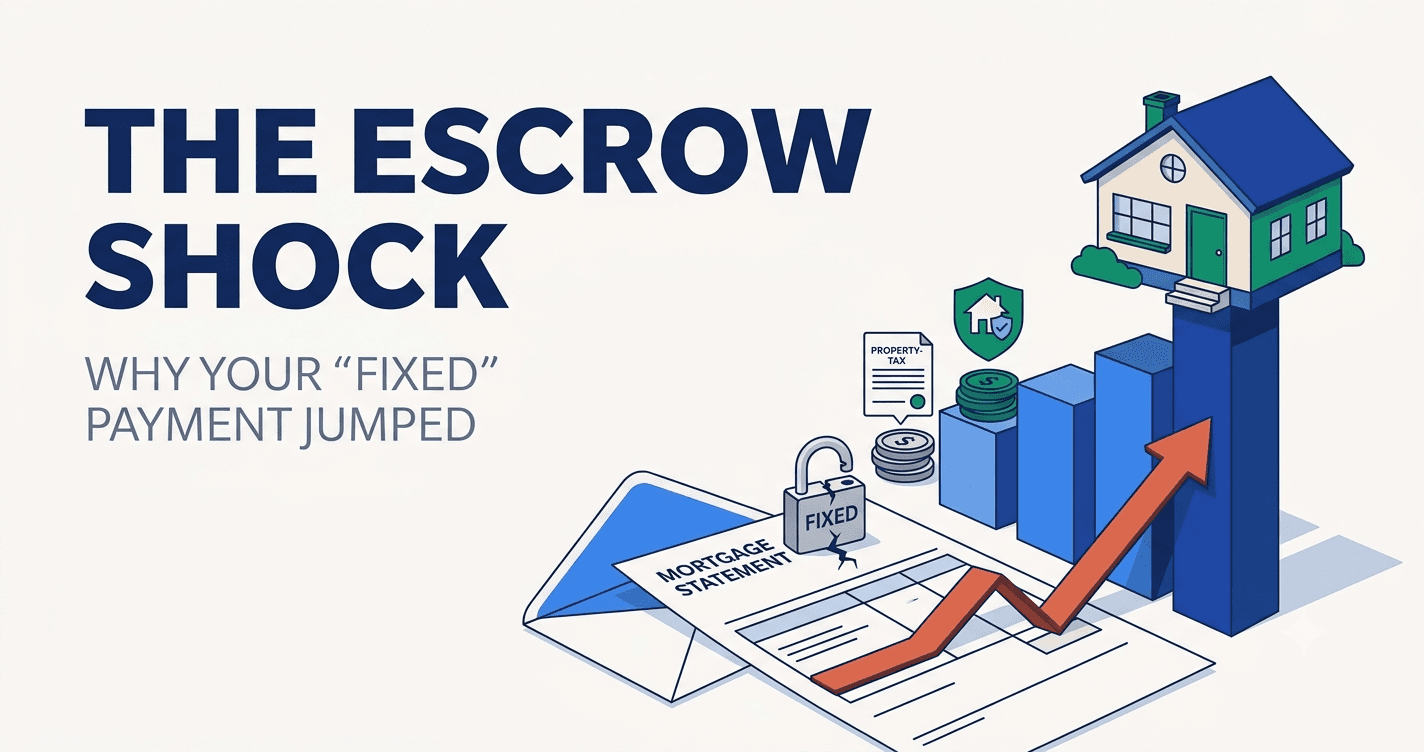
But your monthly payment isn't only P&I. Bolted onto it is escrow: an account your servicer runs to pay two bills you owe no matter what, your property tax and your homeowners insurance. Once a year it looks at what those cost, divides by twelve, and folds it into your payment. When the tax and the insurance climb, the escrow portion climbs, and your "fixed" payment climbs right along with it.
That's the entire trick. Your rate is fixed. The taxes and insurance riding shotgun next to it are not, and they never agreed to sit still.
Here's the data point that still gets me: in the big 2026 borrower survey, 39% of homeowners still believed a fixed-rate payment couldn't change if they had escrow. That's not a stupidity problem, it's a naming problem. We called the thing "fixed," so people assumed the whole payment was. It never was.
Why did your mortgage payment go up in 2026? Two costs collided
Escrow has been drifting upward for years. What made 2026 loud is that both halves spiked at once.
Start with property tax. The typical single-family tax bill rose about 27% between 2019 and 2024, to near $3,018 a year. Not because anyone hiked the rate, but because your house is "worth" more on paper and the assessor eventually catches up. There's a lag, and 2026 is a lot of counties finally catching up.
Then insurance, the uglier engine. Home-insurance rates rose roughly 47% cumulatively from 2020 through 2025, five years of increases in a row, driven by disasters that keep getting bigger and more frequent, by the rising cost of actually rebuilding a house, and by the price insurers pay for their own coverage roughly doubling.
Stack the two together, run them through the same escrow account, and you get the headline: Cotality projects about 65% of escrow accounts ran short in 2026, by an average of $2,157. Spread over the following year, that shortage alone tacks on around $180 a month. And that's before the new, higher going rate even shows up.
When homeowners who got hit were asked what drove it, 62% pointed at property taxes and 48% at insurance. Plenty caught both at once.
 Data: LERETA 2026 borrower escrow survey.
It's also one line inside a much longer bill. If your groceries and power both climbed at once, escrow creep is just the housing verse of that song. I got into the wider squeeze in the affordability crisis, and escrow shock slots neatly into it.
Your ZIP code decides how hard this hits
The part the big national articles skip: this increase is nothing like uniform.
The national average home-insurance premium is around $2,395 a year, but that "average" is close to meaningless, because the spread is enormous. It runs past $5,000 in Oklahoma and sits under $900 in Hawaii. Same coverage, wildly different bill — mostly down to disaster risk.
 Data: LendingTree State of Home Insurance 2026.
Time to argue with the panic a little. Nationally, the government's own watchdog found insurance premiums roughly tracked inflation from 2019 to 2024, and in 2025 Florida's rate barely moved. If you own in a low-risk county with a sane tax base, your escrow shock this year might be a rounding error, and the doom headlines aren't about you.
But in the wrong ZIP code it's brutal. Cotality pegs the total escrow-cost increase, tax and insurance combined, at 77% in Colorado and 70% in Florida over roughly five years, against about 45% nationally. Two identical loans, two identical houses, and the one in a wildfire or hurricane zone gets a completely different letter.
 Data: Cotality (via TheStreet).
Find out which of those two homeowners you are before you panic.
The catch-up and the new baseline are not the same number
This is the part almost every article gets lazy about, and it's the single most useful thing to understand, so stay with me.
When your payment jumps, it's really two different increases wearing one coat.
The first is the shortage catch-up. Last year your escrow account didn't hold enough, because the bills came in higher than the servicer guessed, so it went into the red and now they're clawing it back. That $2,157 average shortage, spread over twelve months, is about $180 a month. But it's a one-time repair. Once the account is topped back up, that piece disappears.
The second is the new baseline. Your taxes and insurance are simply higher now, for good, so the ongoing deposit is bigger from here on. That piece does not disappear.
The difference matters because the scary number on the letter bundles them together and makes the increase look worse than your true recurring cost. Say your payment "went up $300." Maybe $180 is the temporary catch-up and $120 is the real, permanent raise. Next year, if nothing else moves, you settle back toward that $120. Nobody spells this out, so people brace for the $300 like it's forever. Often it isn't.
That points to a choice your servicer will offer: pay the shortage as a lump sum, or spread it over twelve months. If you've got the cash, the lump sum kills the temporary bump immediately, and your next statement reflects only the real increase. This is exactly what an emergency fund is for. A $2,000 surprise bill is stressful. A $2,000 surprise bill you cover from a dedicated account without flinching is just a Tuesday.
How to read your escrow analysis without a translator
Every year your servicer mails you an escrow analysis. Most people skim the new payment figure and file it. Don't. Open it and hunt for three numbers.
One: the projected property tax for the year ahead. Two: the projected homeowners insurance. Three: the prior-year shortage. The first two are your permanent baseline; the third is the temporary catch-up. Now you know which part of the increase is staying and which part is passing through.
Then check their work. Servicers estimate, and estimates are wrong constantly. Pull your actual county tax bill and your insurance declarations page, and hold them against the servicer's numbers. If they've projected a fatter tax bill than your county assessed, or they're still using last year's premium after you re-shopped, they're over-collecting, and federal escrow rules give you the right to ask for a correction. It's rarely malice, just an estimate on autopilot that has no idea you switched insurers in March.
One more: there's a legal ceiling on the cushion they can hold, generally no more than two months of escrow payments. If yours looks plumper than that, ask why.
Five levers that actually move the number
Here's where I get skeptical, because the standard advice list is half-useless and one item on it is genuinely risky for most people. Roughly in order of how much they're worth:
Appeal your property-tax assessment. Fewer than 5% of homeowners ever do this, which is wild, because depending on whose numbers you use, 30% to 60% of the people who appeal win some reduction, averaging 10-15% off. Better still, a lower assessment carries forward, so you're not fighting for one year, you're lowering the base for every year after. Pull three to five comparable sales near you from the last six months, check the assessment for dumb errors in square footage or bed count, and mind the filing deadline. An afternoon of work for years of savings.
Re-shop your insurance, and don't just call the household names. Get at least three quotes and include smaller regional insurers, which routinely undercut the national brands. Bundling home and auto tends to shave around 18% off, sometimes as much as 25%. Easiest hour on this list.
Raise your deductible, but only to a number you can actually pay. Going from a $1,000 to a $2,500 deductible cuts your premium by roughly 9%; jumping from $500 to $2,500 can save 15-30%. The catch is obvious: if the roof goes, you're paying $2,500 before insurance lifts a finger. Only do it if that money is already sitting in savings doing nothing.
Pay the shortage as a lump sum if you possibly can, for the reason I gave above. It clears the temporary bump instead of dragging it across a year of payments.
Waive escrow entirely. And here's where I split from a lot of the advice online. With at least 20% equity, plenty of lenders will let you drop escrow, take your tax and insurance money back into your own hands, park it in a high-yield account, and pocket the interest. On a spreadsheet it looks brilliant. You capture the float and you control the timing.
I do a version of this in real life, remember. Nobody escrows anything for me. And precisely because I live it, I'll tell you what the spreadsheet crowd won't: for most people, this is a mistake. Escrow exists because when a $4,000 tax bill lands one month and a $1,300 insurance bill lands another, a lot of us have not calmly stashed the money, and now there's a tax lien or a dropped policy. I got caught $460 short and this is my job. Waiving escrow doesn't delete the bill, it just rips off the training wheels and hands you the discipline problem directly. If you're dead certain you'll fund it every single month, take the float. If you're not, the servicer smoothing it for you is a feature to be grateful for — not a fee to escape.
Why your mortgage payment went up is a budgeting problem, not a mortgage one
Here's my real thesis, the thing I'd say to a friend over a beer, not in a blog post.
The escrow shock isn't really a mortgage story. Your mortgage did exactly what it promised, the rate held. The problem is we were all taught to model housing as one flat, unchanging line, when a big chunk of it, the tax and the insurance, has been quietly inflating 5-10% a year in a lot of markets and far faster in disaster-prone ones. We treated a variable cost as fixed, then acted shocked when it varied.
That's the exact mistake I made with my own bills, minus the excuse of a servicer hiding the trend from me. I saw those bills every year and still lazily assumed next year would look like this one.
So model it honestly. Split your housing cost into two lines. One is P&I, genuinely fixed, set it and forget it. The other is tax plus insurance, and you treat that as a number that rises. When I rebuilt my own budget this way, tracking housing as an inflating line instead of a frozen one, the surprises basically stopped. That's what tracking your real cost of ownership by hand is really about, rather than trusting one number to hold still forever.
Then pre-fund it, which is where a proper sinking fund earns its keep. Instead of funding your set-aside at exactly this year's figure, pad it 5-10% above the current cost, every month, automatically. When next year's increase lands, the money is already there. The bill doesn't get smaller, but it stops being an ambush.
That's the fix I run now. I fund my tax-and-insurance pot above what the bills currently cost, on purpose, so a 40% insurance jump becomes a shrug instead of a raid on the vacation money. It took one embarrassing $460 shortfall to teach me. You get to learn it for free.
What this means if you rent, or you're about to buy
Two quick things before I go.
If you rent, you're not fully off the hook. Landlords face the same rising taxes and insurance, and roughly three in four say their ownership costs went up. Some gets passed along as higher rent. One honest caveat, though, because the "renters get hammered too" line is usually overcooked: research from the Fed suggests landlords eat most of the insurance increase, and the slice reaching the average tenant's rent has stayed tiny, a few dollars a month. Renters feel it as a slow drift, not the body blow owners take in one letter. If you want the fuller comparison of owning versus renting, I got into it in housing affordability.
If you're about to buy, don't repeat my mistake in spirit. Don't take the year-one payment the lender quotes and assume that's your payment for the next three decades. That figure is a snapshot of today's taxes and today's insurance, both of which will climb. Budget for the house you'll be paying for in year five, not the one on the closing sheet.
And it doesn't matter if you own, rent, or you're still scraping together a down payment, the lesson underneath is the same one that cost me a chunk of our "random stuff" fund. Almost nothing about your cost of living is truly fixed. The word "fixed" on a mortgage is doing a very narrow, very specific job, and nearly everyone reads it too broadly.
So the next time you're squinting at a statement wondering why your mortgage payment went up, you'll actually know. Part of it is a one-time catch-up that will fade. Part of it is the new, higher normal. And all of it was hiding in plain sight, inside a bill you thought you'd already solved.
I'd rather you see it coming than get the envelope I got. Go pad your sinking fund this month. Future you will be strangely grateful for a boring line item that never surprises them again.
Stay Updated
Get notified about new articles and MFFT build-in-public updates.
Ready to Apply This?
Start tracking your finances today and put these tips into practice.
- Import bank statements in seconds
- AI-powered categorization
- Beautiful visualizations
- Set and track financial goals
Related posts
 Master Your Money
How to Stop Arguing About Money With Your Partner: Our Money Date Is Twenty Boring Minutes Because Nothing Is Left to Decide
Our monthly money date takes twenty minutes and it's deeply boring, and for years I thought that was because we're good at talking about money. It isn't. Half of couples avoid the conversation on purpose to keep the peace, and every article tells them to talk more. Here's the opposite case.
 Master Your Money
One Spouse Manages All the Finances in Our House. It's Me, and That's a Design Flaw.
In our house, one spouse manages all the finances, and it's me. I built the tool, I buy the ETF, I read the numbers out loud while my wife listens. That's a bus factor of one. Here's the 30-minute quarterly drill we run instead of a password folder, and why documents rot.
 Master Your Money
How to Calculate Net Worth (Formula + Worked Example)
Net worth is assets minus liabilities. What counts on each side, how to handle the house, pension and car, a worked example, and why monthly beats once.
 Master Your Money
How to Calculate Your FIRE Number (Formula + Examples)
Your FIRE number is annual retirement spending × 25, from the 4% rule. Three steps, a spending-to-target table, a worked example, and when 25× is wrong.
 Master Your Money
Job Hopping vs Staying in 2026: Both Camps Time the Market
Job hopping vs staying is market timing with a résumé: the switching premium hit a record low in January, then widened by July. I've made that mistake before.