FIRE Is Not an Escape Hatch. In 2026 That Is Exactly How Most People Are Using It.

A colleague once did some rough arithmetic on a number I'd let slip about our savings rate, and then asked me, carefully, how long I was planning to stay.
Not what I was saving for. How long I was staying. He'd heard "saves more than half his income" and read it as "has one foot out the door."
He was playing the odds, to be fair. Almost every financial independence escape plan I meet is built out of a job the person has already quit in their head, and the saving is the wanting-out, converted into a monthly transfer. When I told him I like my job and I'm not going anywhere, he didn't believe me for about a week.
Motive gets treated as the soft biographical bit. You mention it once and then drop it before the arithmetic starts. I think it does more work than that: it quietly builds a different plan than the same numbers pointed at a destination, and a worse one.
Two 2026 numbers that only make sense next to each other
In July the US quits rate was 1.9%. About 3.1 million people gave notice in a month, and the year is averaging 1.96% so far, against a 2022 peak of 2.76%. That is back to where the number sat in the middle of the last decade.
Here's what makes it strange rather than just gloomy. In the same month there were 7.3 million open jobs. The doors aren't locked. People are sitting still anyway.
 Data: US Bureau of Labor Statistics, JOLTS (series JTSQUR), via FRED.
If everyone were staying because the work is good, fine, no article. Gallup's global engagement figure for 2025 is 20%, down for a second consecutive year, and not one region of the world improved. One percentage point there is about 21 million people. (US engagement specifically was 31% in 2024, a ten-year low, from a different survey year and a different continent. Same direction of travel.)
The detail I can't get out of my head is the managers. Global manager engagement fell from 31% in 2022 to 22% in 2025 while individual contributors barely moved, 20% to 19%. Whatever this is, it started at the top. The person who was supposed to be the reason you stay checked out before you did.
So: a lot of people parked in jobs they've mentally resigned from, in a market where moving feels dangerous. And in the same year, Euronews runs a piece on young Europeans turning to FIRE and lists the drivers as housing costs, stagnant wages, burnout and geopolitical instability. Not one word about designing a life.
That's a movement absorbing the people who won't walk through the open door.
The exit you're planning for is not the exit that arrives
Allianz published the number this year that I think ought to be pinned to the top of every financial independence forum, and as far as I can tell nobody in this corner of the internet has touched it.
They asked people still working why they expect to retire early. Top three answers: spend more time with family (36%), got financially ready sooner than expected (32%), reduce stress (31%).
Then they asked people who had retired early why it actually happened. Health issues that stopped them doing the job (30%). An unexpected job loss (21%). Financially ready sooner than expected (21%).
 Data: Allianz Life, “Many Americans Retire Earlier Than Planned” (2026).
One reason survives the trip from the daydream to the event. The rest of the list gets replaced by your body or your employer.
Two people leave the same office in the same year. One of them planned it for a decade. The other one was walked out with a box. Statistically they are both early retirees.
The supporting numbers are worse than the headline. 42% of retired Americans left earlier than they'd planned; only 5% left later. And 35% say that if they lost their job in the next six months, they'd probably just retire. That is not a plan. That's a plan shaped like a trapdoor, waiting for somebody else to pull the lever.
If the whole thing is aimed at an exit, it's worth sitting with the fact that the exits which actually turn up are the ones nobody chose.
A financial independence escape plan hoards cash
I know this one from the wrong end.
I once put everything I had into a single stock, got lucky, and spent the next couple of years quietly convinced I could read markets. Then crypto sent me the bill. I've written that one up properly, and the part relevant here isn't the loss. It's that wanting out fast made every decision I took worse. I wasn't investing. I was shopping for a shortcut.
Escape plans do the mirror image of that, and it looks responsible from the outside. When the portfolio is the exit, a bad quarter isn't a bad quarter. It's a sentence extension. Three more months at the desk you hate. So the money drifts into cash, where nothing can move it in the wrong direction, and the drift never gets a decision made about it. It just accumulates.
The euro-area household overnight deposit pays 0.28%. That is the ECB's own number for July. Money with a three-month notice period pays 1.18%, a one-year fixed deposit 2.10%.
 Data: ECB euro area bank interest rate statistics (July 2026) and the MSCI World Index (USD) factsheet (31 Aug 2026). Modelled projection at the index's 9.08% long-run average, illustrative only. The same index fell 57.46% peak-to-trough between Oct 2007 and Mar 2009.
Now the honest half, because a chart like that is a sales pitch without it. The same world index fell 57.46% peak to trough between October 2007 and March 2009, and 17.73% in calendar 2022. If you are holding the pile because you cannot survive that emotionally in year three of a ten-year plan, cash is a defensible answer.
What I'd argue is that almost nobody holding a large cash pile has actually made that argument to themselves. My own emergency fund is deliberately too big and it costs me real money every year, and I can tell you in one sentence what each month of it is for. That's the whole test. If you can state the reason for every month of cash you hold, it's a design decision. If you can't, it's dread with a bank account attached.
Worth splitting it on a screen once a year, cash on one side and invested on the other. A spreadsheet does this fine. The number is rarely the problem. Not looking is.
The lever a financial independence escape plan won't pull
Here's where I'll take the position properly, because most advice on this optimises the wrong thing entirely.
The genre's standard answer to "I'm miserable and I want out" is: raise your savings rate. Cut harder. Get there faster. That's advice to spend the next eight years being unhappy slightly more efficiently, and it is the slowest available fix for a job you have mentally left.
The fast lever is your career, and there's a number for it. The Atlanta Fed has tracked wage growth for people who changed jobs against people who stayed put, every year since 2015. The switchers have won every single year. Not most years. Every year, including 2026 so far, where they're running 4.37% against 3.73%. At the 2022 peak the gap was 6.35% against 4.71%.
 Data: Federal Reserve Bank of Atlanta Wage Growth Tracker, via FRED.
An escape-shaped plan systematically avoids exactly this move. The internal transfer that raises your income also raises your risk, and risk is the one thing a plan built on fear will not spend. So people sit still, save harder, and call it discipline.
I've never had a side hustle and I don't think you need one either. What I did instead was pay for a coach out of my own pocket, for work nobody had asked me to do, and it has done more for our date than any allocation decision I've ever made. Skills compound. They compound faster than money does when the pile is still small.
There's also a nastier feedback loop hiding in the escape plan, which is that burnout wrecks the savings rate the plan depends on. The worse the job gets, the further away the exit moves. You cannot out-save a job that's eating you.
The bill an escape plan sends you is the ten years in between
Brandon Ganch, the Mad Fientist, retired at 34 on something like a 70% savings rate. He is, by any measure the movement uses, a winner. And he's spent the years since being unusually honest about what the accumulation cost: living hyper-frugally in Vermont, cutting out his social life, neither he nor his wife happy, until she pushed for a move back to Scotland. He doesn't regret the money. He says he "could have taken my foot off the gas knowing what I know now."
That's a concession from inside the movement, not a swipe from outside it, and it's the price nobody puts on the spreadsheet. Ten years of endurance, bought to fund freedom afterwards.
There's a strand of psychology research that says goal content matters, not just goal attainment. Chasing money, image and status satisfies people less well than chasing growth and relationships, even when you get what you were chasing. And the Kahneman and Killingsworth work found that for most people wellbeing keeps climbing with income, but for an unhappy minority it flattens out around $100,000 and stops helping. If the thing that's wrong with your life is the job, more money past a point does not fix it. It just funds the waiting.
Compounding is not exclusive to portfolios. Your health compounds. So does a marriage, and so do the friendships you stop maintaining because you're working late for a date ten years out.
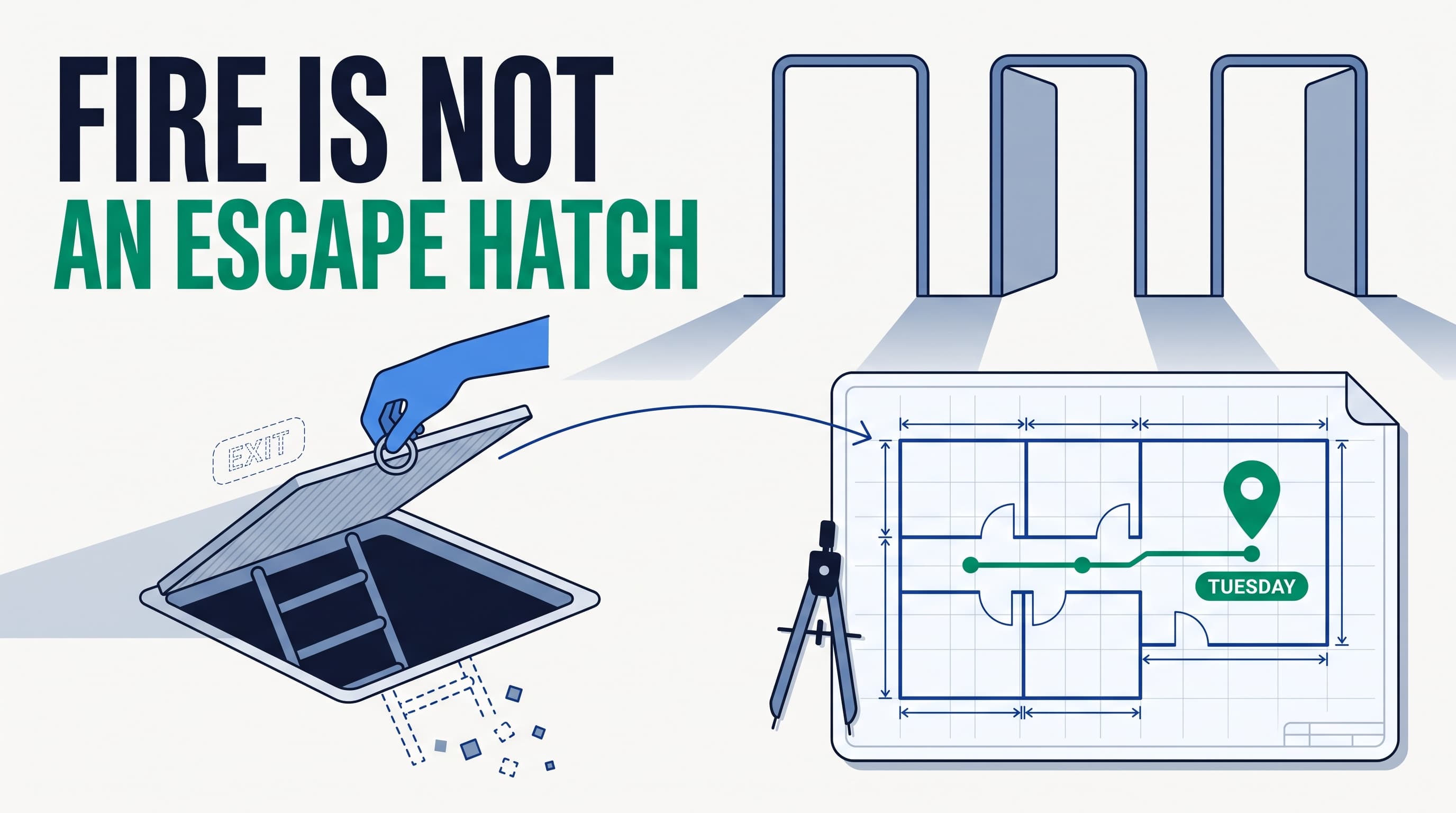
The test I use: can you describe a Tuesday?
Not the first week. Not the trip. A normal Tuesday in March, after the number.
Write one paragraph, present tense. If the only verbs in it are negative ones, not commuting, not in meetings, not answering to anyone, then what you have is an exit and not a destination. That's the finding. Don't fix it by saving more.
The retirement-adjustment literature backs this up more bluntly than I expected: researchers describe two tasks for a retirement that works, psychologically letting go of the job, and building a life worth having afterwards. Skip the second and you get the unretirement statistics. Around 7% of retirees go back to work in a six-month window, and while roughly half cite money, about 15% cite boredom.
Mine took a year to say out loud, and it isn't a beach. It's a classroom and a maths timetable for a fraction of what I earn now, plus free Wednesdays. I've written that one out properly elsewhere, so I won't relitigate it here.
Naming it changed the plan more than any spreadsheet did. It also made the date revisable, which matters more than people think. Ours has moved. A baby moved it. A plan that recalculates when the inputs change is a plan you can be honest with. A fixed date you're serving out is a sentence.
Where I think I'm wrong
There's a version of this argument that beats mine, and I'd rather put it here than bury it in a closing hedge.
Sometimes escape is the correct answer, and it's urgent. Jeffrey Pfeffer and colleagues at Stanford and Harvard went through 228 studies on workplace stressors and concluded that working conditions contribute to at least 120,000 excess deaths a year in the US and up to $190bn in health costs, which would put the workplace around the fifth leading cause of death. Job insecurity raises the odds of reporting poor health by about 50%. Long hours raise mortality by nearly 20%. If your job is measurably damaging you, "but what's your destination?" is a luxury question and arguably an insulting one. I don't push back on this one at all. It isn't an inferior motive, it's triage, and the right response to triage is speed. Go. Sort the destination out in your first year on the other side, the way most people who leave under pressure end up doing anyway.
Fear is an unusually effective savings engine. The precautionary-saving literature is not ambiguous: income uncertainty makes people save more, and the effect is strongest among the young. And look at what's actually happening in the most anxious labour market in a decade. American workplace savers hit an all-time-high average savings rate of 12.1%, 45% of them increased their rate, and only 5% traded during the volatility. Fear is producing textbook behaviour. A portfolio does not know why it was funded, and €300,000 saved out of dread spends exactly like €300,000 saved out of joy.
That one is half right, and I'll only argue with the half. The portfolio genuinely doesn't care about your motive. But the Allianz split says the escape you're funding is not the exit that arrives, which means you're optimising for an event with a 21 to 30% hit rate. Good behaviour aimed at the wrong event is still good behaviour. It just isn't the plan you think you're holding.
The third objection is the one I have no clean answer to, so I'll put it as plainly as I can. "Fix the job instead" is advice that scales with the options you already had. I'm a product manager in a field with high autonomy and portable skills, writing this from the comfortable side of the argument. Gallup locates the cause of detachment in management quality, not employee attitude: manager engagement collapsed while individual contributors barely moved, and no region of the world improved. Telling someone whose engagement was demolished by their organisation to go and design a destination is asking them to individually solve a structural problem. And the career lever I just recommended is stiff right now. US and Canadian job-market optimism fell 10 points in 2025 and is down 23 points since 2019.
The most I can honestly put against that is one number, and it's a narrow one. Switchers have out-earned stayers in every year since 2015, including this one. The door is heavier. It isn't locked. Whether that holds for a warehouse shift or a public-sector post the way it holds for me, I don't know, and anyone who tells you they do is selling something.
What this looks like when nothing dramatic is happening
Nothing about my version is interesting, which is sort of the point.
Income grows through skills rather than through a second job. A large share of it gets saved. One boring world ETF gets bought every month whether or not I have an opinion that week. Once a month my wife and I sit down for twenty minutes and categorise where the money went, which is the least romantic hour of our marriage and probably one of the most useful. The date at the end of it is 40, and it doesn't mean stopping. It means free Wednesdays and a classroom.
I still like my job. I fully expect to be asked again how long I'm staying.
The difference between a financial independence escape plan and the same numbers pointed at something is not visible in the spreadsheet. It shows up in what you do on a Monday: whether you take the risky internal move, whether you spend money on a skill, whether you can look at a 20% drawdown as weather rather than as a punishment. Escape plans optimise the exit date. Everything else is a cost.
Freedom is options, not exit. If the only thing on the far side of your number is not this, you haven't built a plan yet. You've built a countdown.
Go write the Tuesday.
Stay Updated
Get notified about new articles and MFFT build-in-public updates.
Ready to Apply This?
Start tracking your finances today and put these tips into practice.
- Import bank statements in seconds
- AI-powered categorization
- Beautiful visualizations
- Set and track financial goals
Related posts
 Start Here
Healthspan vs Lifespan: My FIRE Plan Funds Me to 90 and Assumes a Body It Never Modeled
My projection argues about returns to a tenth of a percent and has no field for the body spending the money. At 65 in the EU you get 20 years, 9.4 of them healthy. Here's what healthspan vs lifespan does to a FIRE plan, and what a protected health line actually costs.
 Start Here
How Much Money Do I Need to Retire? The 25x Answer
You need about 25x your annual spending: $60,000 a year means $1.5M. The full table, where 25x comes from, and the age and pension adjustments.
 Start Here
What Is Barista FIRE? Meaning, Math, and Your Number
Barista FIRE: part-time work covers the gap while your portfolio compounds. The formula, a worked example, the healthcare catch, and your number.
 Start Here
Safe Withdrawal Rate 2026: Is the 4% Rule Still Right?
Morningstar says the safe withdrawal rate in 2026 is 3.9%; the 4% rule's inventor now says 4.7-5.5%. Here's why both are right, and how to find your number.
 Start Here
Micro-Retirement Without Wrecking Your FIRE Plan (2026)
A mid-career break can buy back a year of your life without wrecking your FIRE plan — if you fund it right. How to size a break fund and protect your net worth.