I Bonds vs TIPS in 2026: The Hedge I Almost Bought Twice

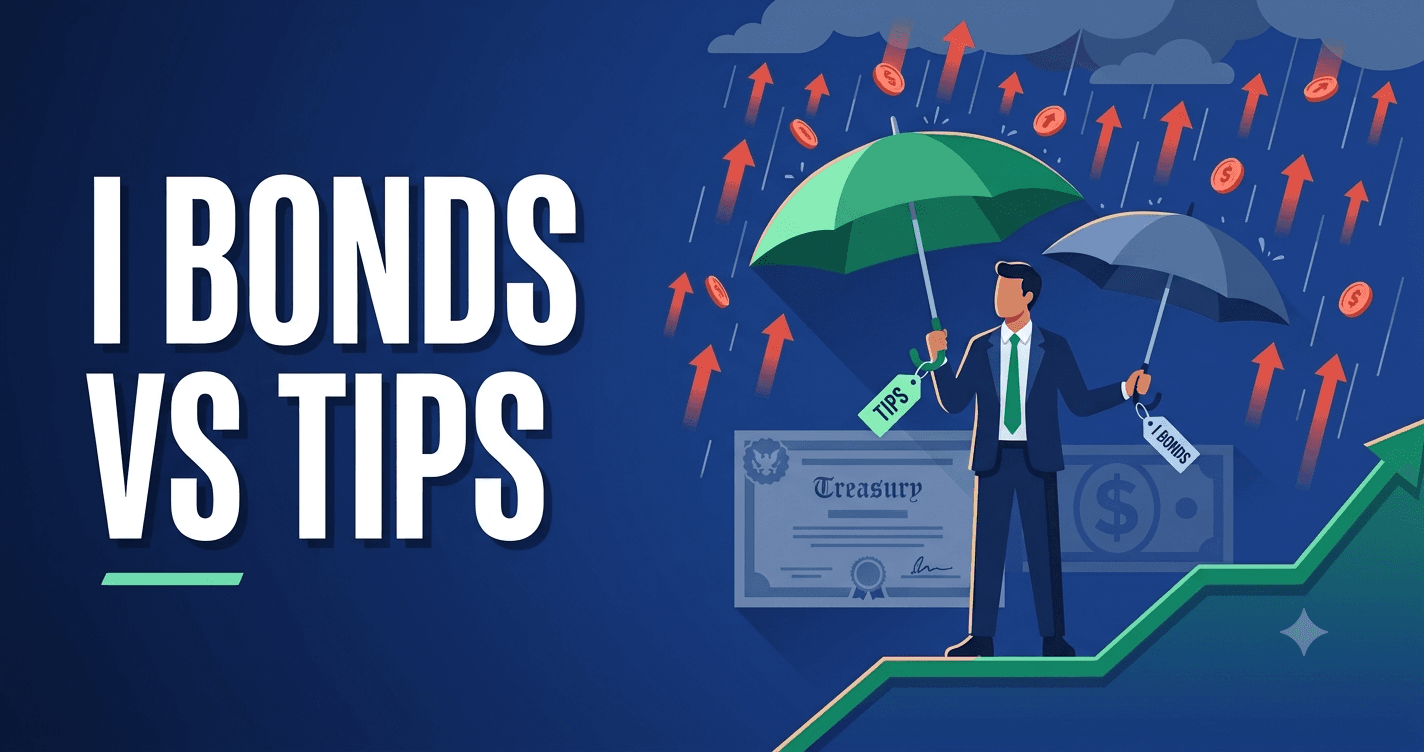
In late October 2022 I had two browser tabs open and a genuinely dumb plan.
One was TreasuryDirect, mid-meltdown, refusing to load because half the country was trying to do the exact thing I was. The other was my brokerage, where my boring monthly ETF autoinvest had been running untouched for years. The plan was to pause the boring thing, pull some cash, and dump $10,000 into an I Bond paying a headline 9.62%, because every finance article that week said I was a fool if I didn't. That reflex is the whole I Bonds vs TIPS 2026 question in one move: chase the headline, or do the math.
I didn't do it. Not out of discipline. The site kept timing out, I got annoyed, and I went to make dinner. That is the entire story of how I dodged a bad move: a slow government server and my own laziness.
Now the sirens are singing again. CPI clawed back to 4.2% year over year in May 2026, the hottest reading since 2023, and my feed filled up with "inflation's back, buy inflation-protected bonds." So I finally did the homework I skipped in 2022 and ran both instruments through real numbers instead of headlines. Here's what I found, and why I nearly bought the hype a second time before catching myself.
 Data: BLS; Macrotrends.
The 9.62% bonds were the worst deal in the room
Here's the part that still makes me laugh.
Those glorious 9.62% I Bonds that crashed the Treasury website in 2022? Their fixed rate was 0.00%.
Quick decoder, because this is the one thing you have to understand. An I Bond's rate is two parts bolted together: a fixed rate that stays with the bond for its entire 30-year life, and an inflation rate that resets every six months to track CPI. The 9.62% was almost pure inflation pass-through. The moment inflation cooled, that yield collapsed toward zero, exactly as designed. The people who lined up to buy it locked in a 0.00% real edge forever and got a headline number that evaporated inside a year.
The boring person who waited? A new I Bond today carries a 0.90% fixed rate. That 0.90% compounds above inflation for three decades. It is a structurally better bond than the one 82,000 people opened accounts in a single day to buy.
 Data: usinflationcalculator.com / TreasuryDirect.
That's the whole trap with these things. The number in the headline is the inflation part, and the inflation part is identical no matter when you buy. The number that actually decides whether you got a good deal is the fixed rate, and nobody puts the fixed rate in a thumbnail.
I Bonds and TIPS, without the jargon
Two government products, both pegged to CPI, built completely differently.
An I Bond is a savings bond you buy directly from Uncle Sam at TreasuryDirect.gov. The composite rate right now is 4.26% through October, which is that 0.90% fixed rate plus the current inflation piece. You can't lose principal, the rate never drops below 0% even in deflation, and the interest compounds tax-deferred for up to 30 years. In exchange for all that safety you wear handcuffs: $10,000 per person per year, no touching it for 12 months, and if you cash out before year five you forfeit the last three months of interest. One quick myth to kill, because I see it repeated everywhere: the old $5,000 paper I Bond you could buy with your tax refund is gone. That route ended January 1, 2025. It's electronic-only now, so don't build a plan around a door that's already closed.
A TIPS, which stands for Treasury Inflation-Protected Security, is a marketable bond. Its principal gets marked up with CPI, it pays a fixed coupon on that adjusted principal, and it trades on the open market like any other Treasury. No purchase cap, fully liquid, and you can pick a 5-, 10-, or 30-year maturity. The catch is that because it trades, its price moves, and a TIPS you sell early can be worth less than you paid.
One is a piggy bank with a lock on it. The other is a bond you can sell any day of the week, but whose price will bounce around while you hold it. Keep that image, because it quietly explains every trade-off that follows.
What the I Bonds vs TIPS 2026 math actually says
Now the part that changed my mind, because in 2026 the answer is not the one I walked in expecting.
For new money today, it's advantage TIPS, and it isn't close.
A new I Bond hands you a 0.90% fixed real rate. A 10-year TIPS in mid-2026 yields about 2.31% real. That is roughly 1.4 percentage points more guaranteed return above inflation, every single year, locked in, just for buying the marketable bond instead of the savings bond. Stretch the maturity and the gap widens: the 30-year TIPS sits around 2.87% real. Even David Enna over at Tipswatch, who is about as pro-I-Bond as a human being can get, titled his June piece "advantage TIPS." When the resident superfan tells you to buy the other thing, you listen.
 Data: TheStreet; tipswatch.com.
A "real yield" is just the return you keep after inflation. A 2.31% real yield means the bond beats CPI by 2.31% a year no matter what inflation does. That's genuinely a good deal. Real yields north of 2% barely existed for most of the last fifteen years. If you're a retiree building an income floor, this is the most interesting fixed income has looked in a very long time, and I'll come back to that, because it's where my whole argument picks up a dent.
But before anyone opens a brokerage tab, the catches.
The catches nobody puts in the headline
The purchase limit alone reframes the entire conversation. Ten grand per person, per calendar year. A couple maxing out both accounts moves $20,000 into I Bonds a year. Set that next to a six-figure index portfolio and it's a rounding error. I Bonds are structurally incapable of being the main event. They're a side dish. That one fact quietly answers half the "should I go all-in on inflation protection" questions people torture themselves over.
Then there's the tax gremlin living inside TIPS. When a TIPS marks its principal up for inflation, the IRS treats that adjustment as taxable income in the year it happens, even though you don't receive a cent of it until the bond matures. It's called phantom income, and it's exactly as fun as it sounds. A retiree holding $850,000 in TIPS through a 3% inflation year owes tax on roughly $25,500 of "income" that never touched their checking account. That's the reason every sane person tells you to hold TIPS inside an IRA or 401(k), where the phantom can't reach you. I Bonds sidestep this entirely, since they're already tax-deferred, which is why they're perfectly fine held directly at TreasuryDirect.
And now the big one. The mistake that makes people swear off TIPS for life: buying a TIPS fund and expecting it to behave like a TIPS.
In 2022, inflation ran near 9% and a broad TIPS fund fell about 11.8%. People lost money on their inflation hedge during the worst inflation in forty years and understandably concluded the whole thing was a con. It wasn't. A fund never matures. It holds a rolling basket of bonds, so when real rates spiked in 2022 the fund's price got clobbered by duration, and there was no maturity date to pull that price back to par. An individual TIPS held to maturity delivers its promised real return, full stop. A fund makes no such promise. If you take one practical thing from this whole article, make it this: for a guaranteed real return you hold the actual bond to maturity, and a fund is a different animal wearing the same name.
Should you wait for the November reset?
Short version: there's no fire to put out.
The 0.90% fixed rate and 4.26% composite are locked for any I Bond bought through the end of October. On November 1 the Treasury resets the fixed rate, and with real yields where they are, it could tick up to something like 1.0% to 1.2%. Nobody knows the exact figure until the day it drops.
So if you've already decided you want I Bonds, waiting a few weeks to see the new fixed rate costs you almost nothing and might get you a better bond for the next 30 years. What I'd gently warn against is turning this into a hobby. I have watched people burn more mental energy timing an I Bond fixed rate than they spend on the 90% of their net worth sitting in stocks. The fixed rate is a rounding error on your life. Check it once in November, act or don't, and go do something else.
Where I Bonds vs TIPS actually fit for a boring index investor
Here's my real position, the one most "I Bonds vs TIPS" articles skip because they've already assumed you're buying one of them.
For a long-horizon index investor, the inflation hedge you already own is your stock fund.
Over long stretches, the real return on equities is remarkably indifferent to inflation. Companies raise prices, grow earnings, and drag their share prices along with the cost of living over time. My world ETF isn't labeled "inflation protection" anywhere, but across 20 or 30 years that's precisely what it's been. It's the same reason I keep landing on the argument in Do You Need Bonds in Your Portfolio?: for a young accumulator, a big fixed-income sleeve is often solving a problem you don't have yet.
So what are I Bonds and TIPS actually for? Money you'll spend soon and can't afford to watch shrink.
That's the clean line. The real question was never "which inflation bond do I buy." It's "how far away is the money?"
- Cash you need in the next year or two, like an emergency reserve: I Bonds and TIPS both have a role, but respect the I Bond's 12-month lockup. It is not an instant-access account. I get into why the standard emergency-fund advice needs a rethink in The Emergency Fund Reality Check.
- Idle cash quietly bleeding to inflation: this is the actual enemy for most people, and a far bigger leak than picking the "wrong" bond. I ranted about it in The Cash Sweep Trap.
- A specific goal two to five years out, like a house down payment: a short TIPS or an I Bond fits nicely, or honestly a plain CD ladder if you don't need the inflation link and just want the yield. I compared that route in The CD Ladder Strategy.
- Retirement money you're 20-plus years from touching: the stock fund is doing the job. A tiny TIPS position is fine if it helps you sleep, but be honest that it's a comfort blanket, not a load-bearing wall.
Where I'll admit I might be wrong
I don't trust an argument that can't steelman its opponent, so here's the strongest case against everything I just said.
If you're at or near retirement, "stocks are the long-run inflation hedge" is technically true and practically useless. You don't have the long run anymore. You have the next few years, and if the market drops 35% the same month you start drawing the portfolio down, you can do permanent damage that no long-run average will rescue you from. That's sequence-of-returns risk, and it's the one thing stocks genuinely cannot hedge for you. I wrote the whole playbook on it in Sequence of Returns Risk, and it's the biggest hole in the lazy "just hold equities forever" story.
For that reader, a TIPS ladder isn't a side dish. It's the main course. You hold each rung to maturity, so the scary price swings become irrelevant, and Morningstar's 2026 research found a 30-year TIPS ladder can support a roughly 4.8% inflation-adjusted withdrawal rate versus about 3.9% for the best traditional approach. That's a higher safe spending rate, not a lower one, funded by today's unusually generous real yields. The closer you are to spending the money, the bigger the correct TIPS role gets, not smaller. If that's you, throw out my "side dish" framing and read the retiree-specific stuff instead.
What I actually did, and a 10-minute checklist
After all of it, here's my unhyped conclusion on the I Bonds vs TIPS 2026 call.
I didn't break the autoinvest. Again. The core stays a boring world ETF, because at my horizon that fund is my inflation hedge and bolting on a bond sleeve would be solving a problem I don't have. I did earmark a slice of near-term cash, the money with a job in the next few years, for a short TIPS position held to maturity inside my tax-advantaged space, precisely because 2.3% real is too good to leave on the table for money I can't afford to watch shrink. I put exactly zero of my long-term retirement money into either one. And I'll glance at the November fixed rate, once, then close the tab.
Before you buy anything, run these three questions:
- When do I spend this money? Under five years, an inflation bond can earn its place. Over twenty, your stock fund already is the hedge, and this is mostly a comfort purchase.
- Individual bond or fund? If you want a guaranteed real return, you hold the actual bond to maturity. If you buy a fund, accept that it can lose money when real rates rise, 2022 style, and size it accordingly.
- Right account? TIPS go in an IRA or 401(k) to dodge the phantom-income tax. I Bonds live at TreasuryDirect and are fine exactly where they are.
The honest truth is that the I Bonds vs TIPS question is a smaller decision than the internet makes it feel. It's a question about a slice of your short-term cash, not the engine of your wealth. The engine is your savings rate and the boring fund you already own. Everything in this article is about tuning the trunk, not the road.
I nearly forgot that twice. A slow server saved me the first time. This time I just did the math.
Stay Updated
Get notified about new articles and MFFT build-in-public updates.
Ready to Apply This?
Start tracking your finances today and put these tips into practice.
- Import bank statements in seconds
- AI-powered categorization
- Beautiful visualizations
- Set and track financial goals
Related posts
 Invest Smart
Is Your House Part of Your Asset Allocation? I Call Myself a 100% Stock Investor and Own Two Houses
I hold 100% stocks, have never owned a bond, and own two houses I had never once put on the same page as the portfolio. The euro-area main residence is 47% of household assets. Here is what the real mix says, why it argues for more equities and not fewer, and the paper that says I am wrong.
 Invest Smart
Holding Leveraged ETFs Long Term Isn't a Maths Problem. It's a You Problem.
At twenty I put everything into one stock and it worked, which is the worst possible outcome. If a 2x version had been one tap away, I'd have tapped it. The maths of leveraged ETFs is arguable. The behaviour isn't. They don't double your returns, they double you.
 Invest Smart
Investing as a Couple With Different Risk Tolerance: My Wife Never Chose 100% Stocks, and Half of It Is Hers
I hold 100% stocks, I decided that years ago, and half that account is my wife's money. She never picked it. A 2026 paper says household portfolios weight the husband's risk preference 0.6 to the wife's 0.4, and being the one who runs the money buys extra weight on top of that.
 Invest Smart
Currency Risk in a World ETF: The Bet I Never Placed and Still Own
I have bought the same world ETF on the same day every month for years and never had an opinion about the three currencies passing through that transfer. It is 72.85% dollars. Here is what I found when I checked, and why I am still not hedging it.
 Invest Smart
US vs International Stocks: The Home-Bias Bet I Refused
Owning anything outside America felt like a diversification tax. Then 2025 flipped, and here's why I still won't bet either way on us vs international stocks.