When to Sell Your Investments: I've Never Pressed the Button, and That Isn't Discipline

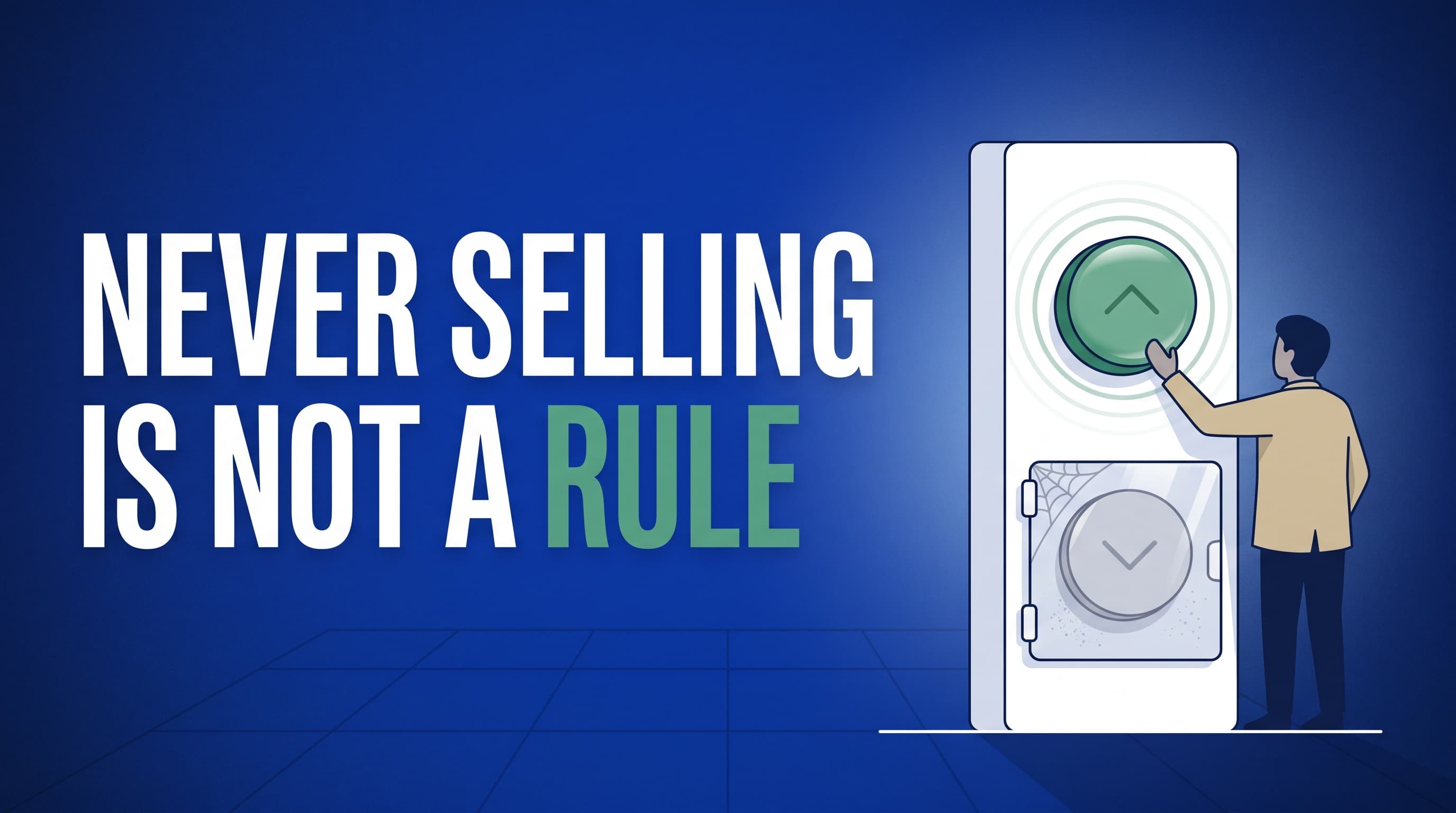
The only button I have ever pressed in that account is Buy.
One accumulating world ETF, roughly the same day every month, for years. I have never sold a share of it. Not in a drawdown, not for the house, not once. For a long time I filed that under discipline.
It isn't discipline. It's that I have never written down a single line about when to sell your investments, or mine. No condition, no threshold, no exception, nothing. There is no rule in that account. There is an assumption I have been mistaking for one.
The proof showed up with the second house. We bought it, we're still paying it off, and it is comfortably the largest capital decision we have ever made. At no point in any of those conversations did either of us say "or we could sell some of the fund." The money came from elsewhere because it always comes from elsewhere. Nobody decided that. It simply never got onto the table, and a door you have never opened isn't locked. It's a door you have never opened. I've written about how that second house turned into a part-time job rather than passive income; this is the quieter thing it taught me, and it took me a while to notice.
Buying, in our house, is a habit. Selling is an open question. And open questions don't stay open. They wait until you're under pressure, and then they answer themselves.
Every answer to "when to sell your investments" is the same single word
Go and read the threads. People have been asking some version of "should I sell index funds for a down payment?" on Bogleheads continuously since at least 2015, and again in 2022, 2023, 2025. The replies are thoughtful, detailed, and almost entirely about two things: what the sale costs on the way out, and what it costs in forgone growth. Serious people doing careful arithmetic on the how much.
Nobody asks what the money was for.
In the FIRE corner it compresses further, down to one word. Don't. Never touch it. The portfolio isn't for spending, it's for becoming free, and until you're free, hands off.
I understand the instinct, because I've been running on it for years. Richard Thaler's mental-accounting work explains why it works at all: households sort money into labelled pots ranked by how tempting they are to spend, and the labels aren't decoration. They're a self-control technology. "Never touch the portfolio" is a very good label.
But a prohibition with no exceptions written down isn't a rule. It's a refusal to decide. A rule is written, bounded, and made in a calm week. A refusal is unwritten, absolute, and made never. The two look identical right up until the first real test, and then one of them is a decision and the other is an improvisation.
Meanwhile the machinery on the buy side keeps getting better. Continental Europe executed 15.1 million ETF savings plans a month in 2025, up 39% in a year, moving €22.7bn over the year at an average of €125.30 a go. Every one of those is a standing yes that runs whether or not you have an opinion that week. There is no standing anything for the other direction. Millions of us hold an automated buy instruction and zero written sell instruction, and we call the asymmetry a strategy.
The four things that actually come for the money
Not a crash. Four ordinary things, and the FIRE internet pretends three of them don't exist.
A house, or a bigger one. In 2025, 26% of American first-time buyers funded their deposit out of financial assets, the first year in the survey's history that financial assets beat help from family and friends. The median first-time buyer is now 40 years old. Read those two facts together and the mechanism is structural rather than moral: by the time people can afford to buy, they have a portfolio, and the portfolio is the only place a deposit can come from. Nobody planned that. It happened to a generation.
A career break, chosen or handed to you. HSBC asked 10,000 people and 37% said they planned a six-to-twelve-month pause before their actual retirement. Take-up runs far behind intention, but the forced version needs no intention at all: EU unemployment sat at 6.1% this July. Planning a micro-retirement properly is the cleanest example of something the portfolio could legitimately fund, because it's named and sized years ahead.
Family. There are 63 million family caregivers in the US, spending roughly $7,200 a year out of pocket, and nearly half of them have taken on debt, stopped saving, or couldn't afford food. Note the middle one. Stopping contributions is a portfolio decision nobody files as one, because it doesn't require pressing sell.
Capital for a business or a qualification. Kauffman Foundation research puts the share of entrepreneurs funding themselves from personal and family savings at around 65%.
None of these is an emergency in the emergency-fund sense, and that's exactly the problem. They're too big for the buffer, too slow to count as a shock, too legitimate to refuse. So no pot gets assigned to them, and the biggest pot in the house sits there undefended.
We passed the crash test. It was the wrong exam.
Here's the number that reorganised this whole article for me.
Between late January and the end of March 2026, the S&P 500 fell about 9% on geopolitical news. Of Vanguard's retail investors, 14% traded at all. Eighty-six percent did nothing. And among the 14% who did move, buyers outnumbered sellers by close to four to one. The median age of the net sellers was 56; for net buyers it was 40. Vanguard's own behavioural research lead, Andy Reed, read the episode as discipline rather than emotion, and I think he's right.
So the panic-selling story I've half-believed for a decade is mostly not true of the people reading this.
Now the other column. Hardship withdrawals from Vanguard's workplace plans hit 6% of participants in 2025, the highest share ever recorded, against a pre-pandemic norm of about 2%, and they've risen six years in a row. The median one is $1,900. Nearly half the people who take one take more than one in the same year. Across the US system, EBRI's estimate of cash-out leakage from long-term accounts is $60–105bn a year, and roughly two-thirds of it isn't driven by a financial emergency.
Put the two columns next to each other. In a 9% drawdown, almost nobody sold. In an ordinary year, with markets fine, money left long-term accounts at record rates for reasons that mostly weren't emergencies.
The portfolio isn't being drained by fear. It's being drained by life, turning up with a date on it.
Which is why I want to be straight about the behaviour-gap argument I'd normally reach for here. Morningstar's Mind the Gap puts the investor return gap at 1.2 percentage points a year over the decade to 2024, about 15% of the total return. I have quoted that number before. But a Financial Analysts Journal paper published this May by Fulkerson, Jordan, Riley and Yan re-ran Morningstar's own sample and put the true cost of bad timing at 0.10% a year. A tenth of a percent. I'd rather say that myself than have it turn up in the comments.
 Data: Morningstar, Mind the Gap 2025 — US funds only, ten years to 31 December 2024. Carry the dissent with the number: a May 2026 Financial Analysts Journal paper (Fulkerson, Jordan, Riley and Yan) re-runs the same sample and puts the timing cost at 0.10% a year, not 1.2 points.
So I'll drop the claim I can't defend. My argument isn't that you'll mistime the market by 1.2% a year. It's narrower and better evidenced: a withdrawal with no rule behind it gets sized wrong, timed to somebody else's deadline, and repeated. The repeat withdrawer is the finding that carries the weight, and it's Vanguard's, not mine. Their researchers also noticed that as plans removed friction — self-certification instead of paperwork, no loan required first, only 10% of plans still asking for documentation at all — withdrawals went up. Less friction, more use.
Your broker app has less friction than any of that. Two taps.
And I'd rather not stake anything on my own composure, because I have watched it fail. Years ago I picked Tesla early, it went up a great deal, and I decided the sensible explanation was that I had a talent for this. Crypto sent me the invoice for that conclusion shortly afterwards. Neither decision was analysis. Both were made in a moment, by a man who felt clever, and every boring monthly purchase since exists so that man never gets a vote again. He doesn't get one on the buy side. On the sell side he has the whole field to himself, because nobody ever wrote anything down.
A written rule is friction you install yourself.
When to sell your investments: four tests, not a wish list
Almost everything published on this question is either an arithmetic exercise or a single word, and both answer something you didn't ask. Everybody writes the after-FIRE ruleset: the 4% rule, bucket strategies, sequence-of-returns risk. Almost nobody writes the before. So here's mine, and the format is the point. These are tests a request has to pass, not a list of approved purchases.
Named. The purpose was on a written list before the money was needed. New categories go on next January's list, not today's.
Sized. A number written down before anybody quoted you a price, because "whatever it takes" is not a size.
Dated. A deadline longer than your buffer's runway. Anything due sooner than the buffer can cover is a buffer problem in a portfolio costume.
Cooled. A fixed gap between deciding and executing. Thirty days turns most urgent things back into ordinary things, and the ones that survive it are usually real.
All four, every time. Three out of four is a no.
The never list
Shorter, and it does more work:
- Anything that permanently raises fixed costs. A bigger mortgage payment, a second lease, any commitment shaped like a subscription.
- Anything bought to avoid a conversation, with a partner, a parent, an employer or a lender.
- Anything on a deadline shorter than the buffer.
- Anything already declined in a previous January.
- Any amount you'd "replace" by pausing contributions, because that's the same withdrawal wearing a costume.
The portfolio is the fifth pot, not the first
None of that works if the portfolio is the only liquid thing you own. Then every surprise becomes a sell decision, and you don't have rules, you have a single point of failure.
So, the sequence. The next pot only opens when the one above it is empty: this month's cash flow, then the sinking funds, then the emergency buffer, then pausing new contributions, and only then the portfolio.
Sinking funds do most of the quiet work here, because the known-and-dated items — the car, the roof, the insurance renewal that steps rather than drifts — never have to arrive as a withdrawal question at all. And our emergency fund is deliberately too big, twelve months of essentials, sized as though both of us stopped earning. I've published what that costs us every year. I keep paying it.
There's better evidence for this than my preference. Vanguard found that US workplace plans offering an intermediate savings pot alongside the retirement account saw hardship withdrawals fall 16%, and plans with an integrated health-savings pot saw them 69% lower. Same people, same salaries, same stresses. Give them a layer to hit before the long-term one and they stop hitting the long-term one. That isn't an opinion, it's a measured 69%.
 Data: Eurostat, inability to face unexpected financial expenses (ilc_mdes04), 2025, and the Federal Reserve's SHED 2025. The two bars above and below the dashed line are not the same measurement: Eurostat sets the threshold country by country against the national poverty line, while the US figure is the residual of adults who said they could cover a flat $400 expense with cash. Read it as two separate pictures, not as a ranking.
Christine Benz's rule of thumb is that three to six months is a floor rather than an answer, and that specialised, long-tenured, well-paid people should hold a year or more because their next job takes longer to find. The reality check in the other direction is brutal: 45% of Vanguard participants hold under $2,000 in emergency savings, 37% of US adults couldn't cover a $400 expense entirely with cash, and 29.2% of people in the EU couldn't face an unexpected expense at all in 2025. For a lot of them this isn't an allocation debate, it's an income problem, and none of this is aimed at them.
Now the part where you argue with me
The strongest objection is one I can't fully beat, so let's give it room.
By writing down three legitimate reasons to sell, I've converted an unbreakable norm into a negotiable one. And every negotiation is won by the person under pressure, who is by definition the version of me standing in front of a house with a deadline on it. The research on bright-line rules genuinely cuts both ways: absolute rules work precisely because they remove the negotiation, and the University of Chicago Law Review's treatment of precommitment concedes in the same breath that bounded exceptions are valuable and difficult. Abstainers do better abstaining. Moderators do better moderating. None of us knows which one we are until it's expensive to find out.
My answer has two parts. First, the norm was never unbreakable. Six consecutive years of rising hardship withdrawals, and tens of billions a year of leakage that mostly isn't emergency-driven, is what an "unbreakable" norm looks like at population scale. We're not protecting a rule, we're protecting the absence of one. Second, a test is not an exception. A list of approved purchases can be argued into; named, sized, dated and cooled is a gate, and the cooling-off clause is the one a person under pressure structurally cannot satisfy.
The second objection lands harder, and it's aimed at me. Rules written in your late twenties are written by someone who won't exist at forty. Psychologists call it the end-of-history illusion: at every age we happily admit how much we changed in the last decade and flatly deny we'll change in the next one. My list will look arbitrary to the man reading it ten years from now, and he'll be right.
Which is why tests age better than lists, and why the whole thing gets reopened every January rather than carved into something. The review exists because the author changes. I'd rather build that in than argue with it.
Price it in months, not in euros
The last piece is the unit you decide in.
A €20,000 withdrawal doesn't cost €20,000. At the 7.48% a year the MSCI ACWI has returned since the end of 2000, that money would have been about €41,000 in ten years and €85,000 in twenty. In purchasing power, using the 6.6% real return on US equities that Dimson, Marsh and Staunton measure across 1900 to 2025, call it €38,000 and €72,000. Past returns aren't a forecast and the path looks nothing like the average — the same index fell 58% between 2007 and 2009 — but the direction isn't in dispute.
 Data: a computed projection, not observed returns. Return assumptions: 7.48% a year is the MSCI ACWI (net, USD) annualised return since 29 December 2000, from the August 2026 factsheet; 6.6% is the real return on US equities 1900–2025 from the UBS Global Investment Returns Yearbook 2026, which is the optimistic end — the world figure is lower, and a euro investor's outcome also moves with the dollar. No contributions and no fees. The same index fell 58.38% between October 2007 and March 2009, so the line is an average, not a path anyone actually rides.
Even those numbers are the wrong unit, because nobody can feel €85,000 in 2046. What's decidable is time. Take the amount, add the contributions you'll divert to rebuild it, and convert the lot into a delay against your own FIRE number.
"This costs us eleven months" is a sentence two adults can have a real conversation about. "This costs €40,000" is a sentence that ends in a shrug. Being able to model that before committing is a decent chunk of why I built the tracker in the first place, and yes, that's my product, weigh it accordingly.
One thing I'm deliberately not covering: what any of this triggers where you live. Your local rules decide the how, not the whether.
Decide it while it's boring
Write the list now, while the number is small enough that deciding costs you nothing. These rules are cheap to write in a calm January and impossible to write in the week a deadline shows up, and the only reason mine never got tested by the second house is that we happened to have the money somewhere else. That was luck wearing the costume of a principle.
I'm not about to start selling. I'll buy the same fund on the same day next month, and I'd be mildly surprised if I press sell this decade. But "never" was never a plan. Freedom is supposed to mean options, and an account you've promised never to touch isn't an option. It's a different kind of lock, one you fitted yourself and then threw the key away on purpose.
So the real answer to when to sell your investments isn't a threshold or a date. It's a gate you built years before anyone knocked on it, and the measure of it isn't that you never sell. It's that if you ever do, you'll be executing a decision instead of making one.
Our January meeting is the first one with three of us in the room. I know what I'm putting on the agenda.
Stay Updated
Get notified about new articles and MFFT build-in-public updates.
Ready to Apply This?
Start tracking your finances today and put these tips into practice.
- Import bank statements in seconds
- AI-powered categorization
- Beautiful visualizations
- Set and track financial goals
Related posts
 Learn To Invest
AI Investing Advice Sells Conviction, Not an Edge. I Build a Money Tool and I Still Buy One Boring Fund.
Four in five young UK investors use AI for investing. Nearly three in four know it can be wrong. They do it anyway. AI didn't make anyone a better analyst, it made conviction free — and conviction was always the expensive part. Here's the test I use instead.
 Learn To Invest
Investing at All-Time Highs: I Bought Again This Month. The Number I Changed Was in My Plan, Not My Standing Order.
I bought my usual world ETF at a Shiller CAPE of 41, a level the market has only ever hit in 1999 and 2000. I still didn't touch the standing order. Valuation explains 25.8% of the next decade and 3.9% of the next year, so it belongs in your plan, not your bank instruction.
 Learn To Invest
How Does Compound Interest Work? (Formula + Examples)
Compound interest means growth earns growth. The formula in words, a year-by-year table, the rule of 72, and how the same math runs against you on debt.
 Learn To Invest
The Investor Return Gap: Your Fund Made 9.9%, You Made 8.7%
Morningstar: the average dollar earned 8.7% a year while its funds earned 9.9%. I was that investor return gap once. The fix is fewer decisions, not discipline.
 Learn To Invest
Robo-Advisor vs DIY Investing 2026: I Almost Paid 0.25%
I almost paid a robo-advisor 0.25% of everything I own, forever. The honest robo advisor vs DIY investing math for 2026, and when a robo is worth it.