AI Scams Stole $21 Billion: How to Protect Yourself in 2026


Sarah's phone rang at 2 a.m. It was her son Jake's voice — shaky, congested, terrified. He'd been in a car accident, his nose was broken, and he needed $4,000 wired for bail before morning. "Please don't tell Dad." It was unmistakably Jake's voice, every inflection right. Except Jake was asleep in his dorm forty miles away. The voice on the phone was a clone, built from three seconds of one of his TikToks.
Sarah didn't lose a cent. Not because she's a tech genius, but because her family had agreed on a single word months earlier. She asked the caller for it. He stalled. She hung up and called Jake directly. Cost of that defense: zero dollars and two minutes of planning.
This is the article I wish every family had read before that phone rang. Because in 2026, learning how to protect yourself from AI scams is no longer an IT footnote — it's a core part of personal finance. You can do everything right with your savings rate and still watch a single AI phone call drain the account in minutes. Building wealth and defending it are now the same job.
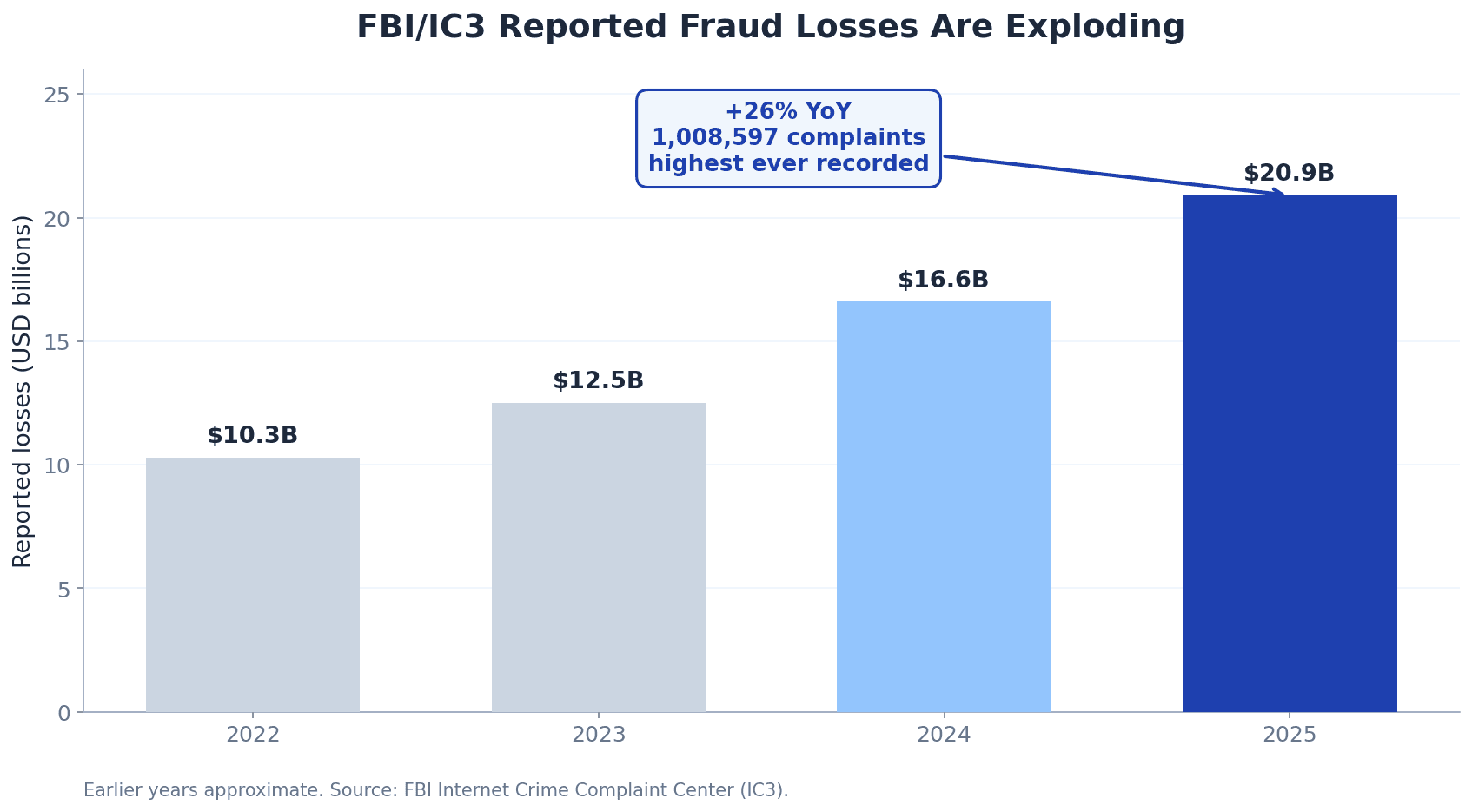
The numbers are staggering. The FBI's Internet Crime Complaint Center (IC3) logged a record $20.9 billion in reported losses in its latest annual report — up 26% in a single year — across more than one million complaints. And those are only the losses people reported. The real figure is higher, because most victims never even realize artificial intelligence was the weapon.
Let me walk you through exactly how these attacks work, why your brain is the real target, and the calm, concrete defense system you can set up in a single afternoon — for free.
The $21 Billion Wake-Up Call: Why 2026 Is the Year Fraud Got Smart
For the first time in roughly 25 years, the FBI broke out AI as its own crime category in the 2025 IC3 report. That slice alone — 22,364 complaints, about $893 million in losses — sounds modest next to the $20.9 billion total. But the bureau said something important alongside it: that AI number is "almost certainly higher," because victims rarely know AI was used.
Here's the part that should reframe how you think about money. Roughly 85% of all 2025 losses came from cyber-enabled fraud — schemes that exploit human behavior, not technical hacking. Nobody picked your lock. Someone talked you into opening the door.
And the trend line is the real alarm. Deloitte's Center for Financial Services projects that generative-AI-enabled fraud losses in the U.S. could hit $40 billion by 2027, up from $12.3 billion in 2023 — a 32% compound annual growth rate. Even their conservative scenario lands around $22 billion. As Deloitte puts it, "the economics of deception now favor attackers." The tools that clone a voice or fake a video have gotten cheap, and that means the defenders are structurally behind.
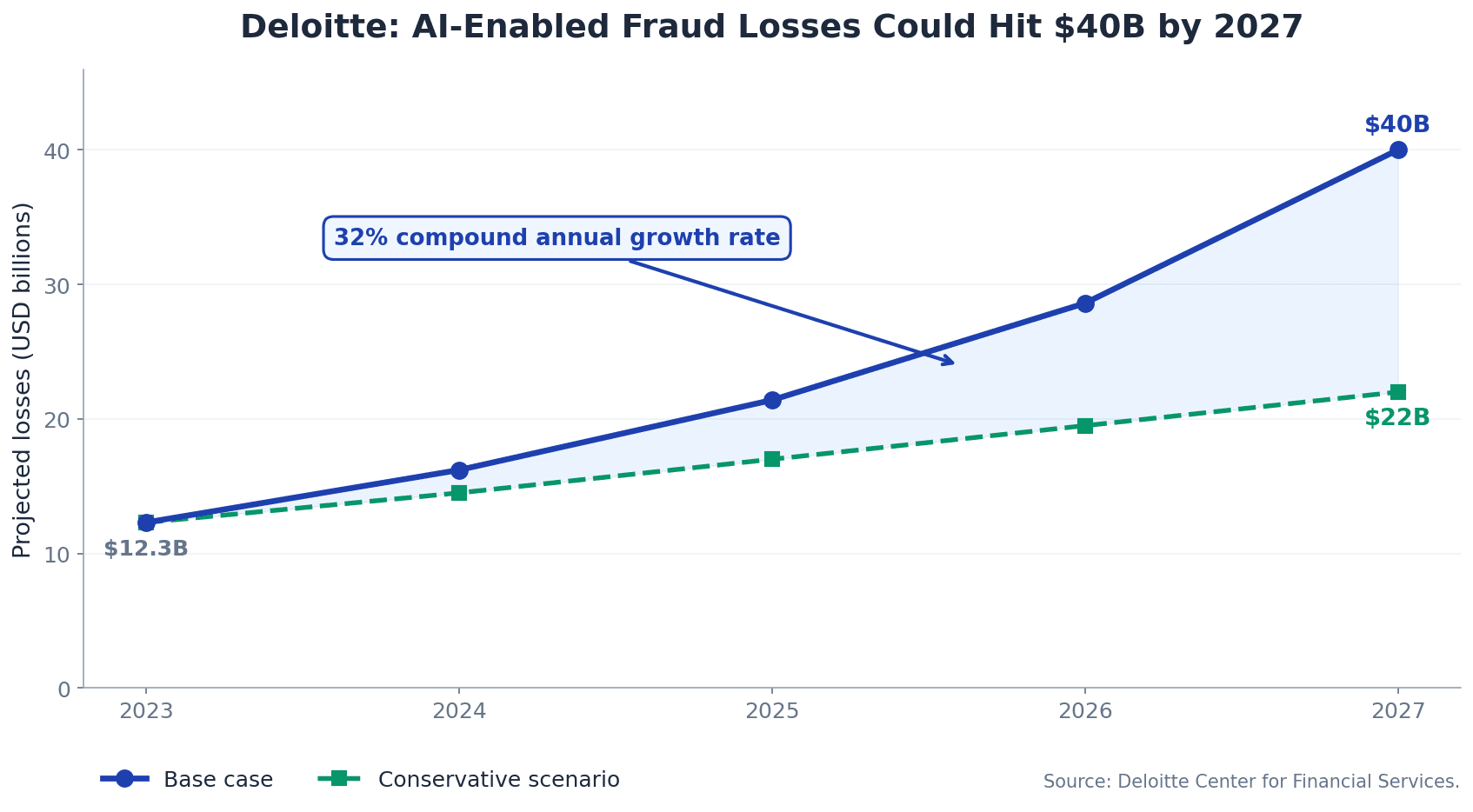
I want to be honest, because this blog is built on not overhyping: the precise AI dollar figure is fuzzy. The verified backbone is the $20.9 billion total, the +26% trend, and the Deloitte projection. That's plenty. A lifetime of disciplined saving can be erased in one well-built phone call. For anyone chasing financial independence, every dollar lost to fraud is a setback measured in years of progress. Fraud defense is net-worth defense.
How AI Supercharged the Old Scams: The 5 Attacks Hitting Wallets Now
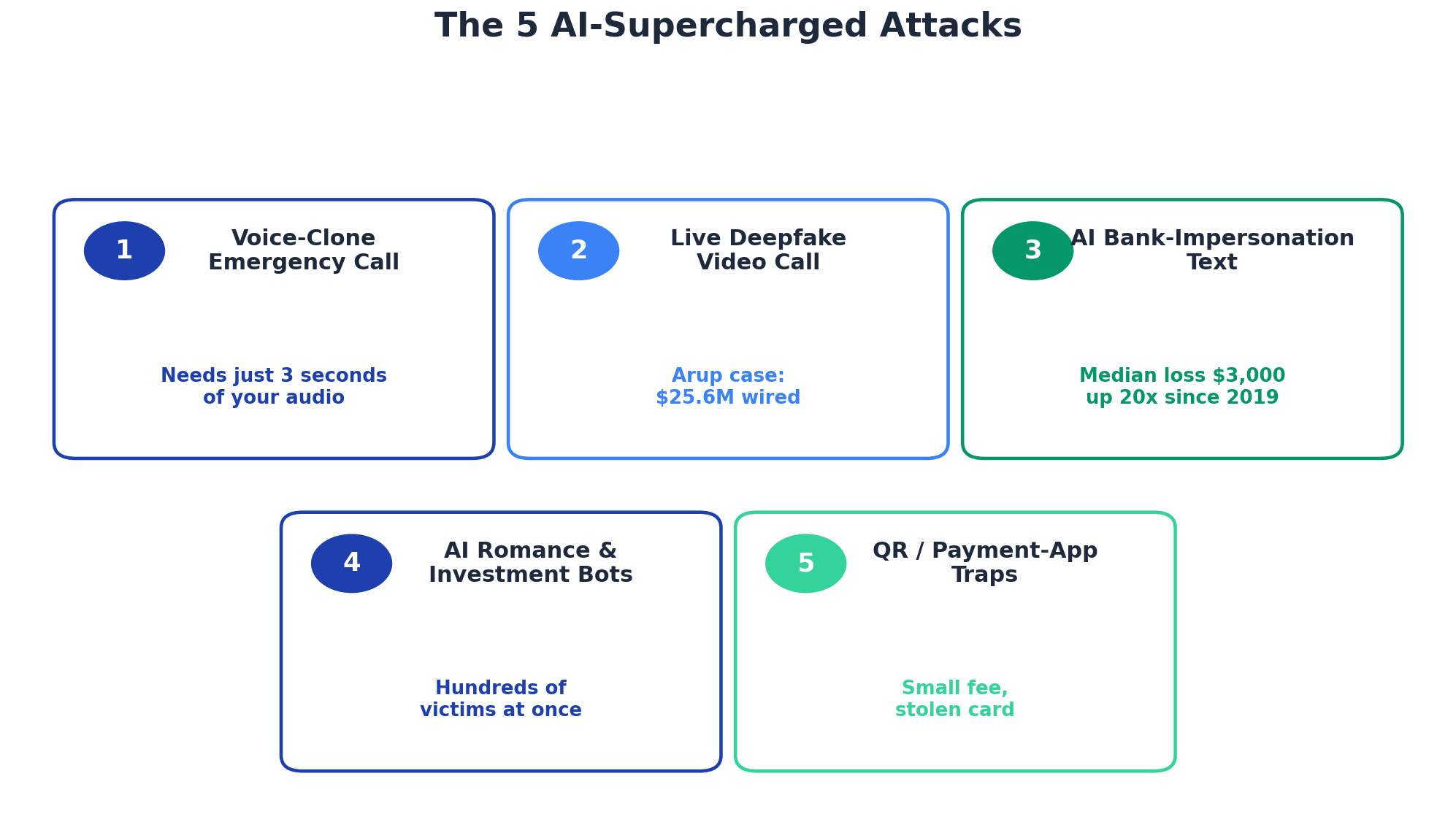
None of these cons are new. What's new is that AI made them flawless and infinitely scalable. Here's the modern threat menu.
1. The voice-clone emergency call. This is Sarah's story. AI can now produce a usable voice clone from under three seconds of sample audio — a TikTok, a voicemail greeting, a podcast clip. The scammer types the words; the AI speaks them in your loved one's voice. Voice phishing ("vishing," a phone-based phishing call) reportedly surged 442% in the second half of 2024 and is still accelerating.
2. The live deepfake video call. The marquee case is real and chilling: a finance employee at engineering giant Arup wired $25.6 million across 15 transactions after a video call with a deepfaked "CFO" and deepfaked colleagues. The worker had suspected the initial email was phishing — but the live video, built from real footage of staff from past online meetings, erased every doubt. The money was never recovered.
3. The AI bank-impersonation text. Bank impersonation is now the most-reported text-message scam, up nearly 20x since 2019, with a typical victim losing around $3,000. You get a text that looks exactly like your bank: "Did you authorize a $899 Zelle to M. Rivera? Reply NO." You reply NO. A calm "fraud agent" calls within seconds — caller ID even shows the bank's real name — and walks you through "moving your money to a safe account." That safe account is the scammer's.
4. AI romance and investment bots. Generative AI lets one scammer run hundreds of convincing, around-the-clock conversations at once, building trust over weeks before the "opportunity" appears. Imposter scams overall accounted for $3.5 billion in FTC-reported losses in 2025.
5. QR-code and payment-app traps. A fake "your package is held — pay a $1.99 redelivery fee" text harvests your card. Small bait, big resale value.
Why Your Brain Is the Real Target: The Psychology Scammers Exploit
Here's the uncomfortable truth, and it matters: intelligence is not a shield. The research is unanimous. Scams don't beat your logic — they bypass it, by hijacking emotion.
The four levers are urgency, authority, fear, and isolation. The 2 a.m. call is urgent (bail by morning), authoritative (it's "your son"), terrifying (he's hurt), and isolating ("don't tell Dad"). When those fire at once, the rational part of your brain goes offline. Palo Alto's Unit 42 found the median time for someone to fall for a phishing attempt is under 60 seconds. That's by design — speed is the whole strategy.
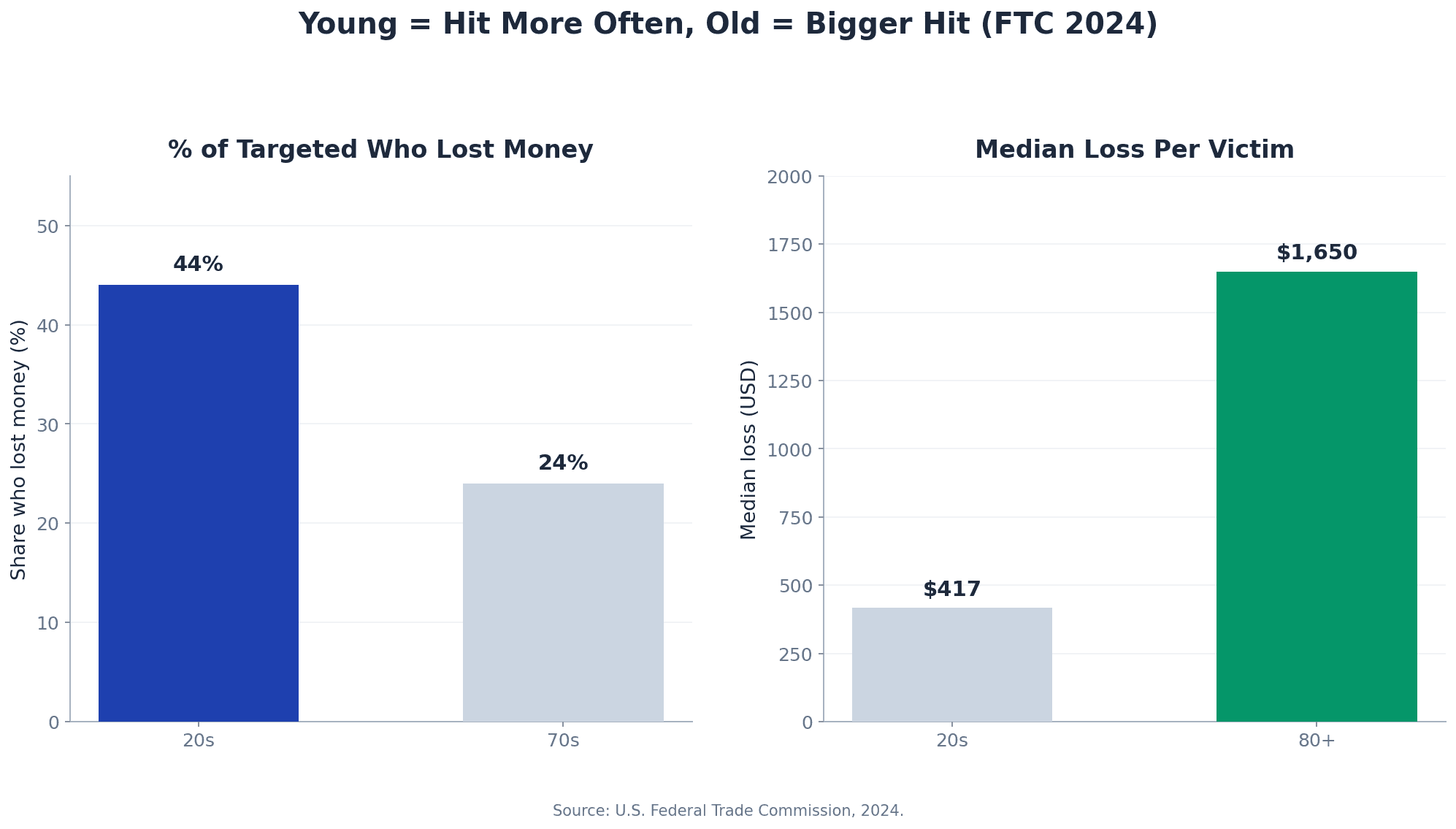
And please don't assume this is a "seniors only" problem. FTC data shows 44% of people in their 20s who were targeted in 2024 lost money, versus 24% of people in their 70s. Younger, phone-native users get hit more often. Seniors simply lose more per incident — a median of $1,650 for those 80+ versus $417 for people in their 20s. Different vulnerability, same enemy.
One more myth to kill: don't count on a "deepfake detector" app to save you. Detectors that score 94–96% accuracy in the lab collapse to below 50% against tools they weren't trained on. The durable defense isn't spotting the fake. It's having a process the fake can't survive.
The Family Safe Word: Your 60-Second Defense Against Voice Cloning
This is the single highest-leverage move in the entire article, and it costs nothing. The FBI itself points to it as the top defense, for one simple reason: an AI can only say what the scammer types. It cannot know a secret that was never posted online.
Here's how to set it up today:
- Pick a word or phrase that's boring and un-Googleable. Not a pet's name, not a street you've lived on, not anything on social media. "Blue otter." "Rusty teapot." Something a stranger could never guess and an AI could never scrape.
- Send it in a group text to your immediate family in two minutes. Tell everyone to memorize it, not screenshot it.
- Set the rule: money is never sent on a single call. No matter the story, no matter the voice. The safe word is the gate; "we always hang up and call back" is the lock.
- Add a callback rule. If a "relative" calls in crisis, hang up and call them back on the number already saved in your phone. Never trust caller ID — it's trivially spoofed. If they don't answer, call a second family member.
That's it. Two minutes of planning that would have cost Sarah $4,000.
Lock Down the Money: Account-Level Defenses Most People Never Turn On
Beyond the safe word, your bank and brokerage have powerful settings that almost nobody activates. These are the locks on the money rails themselves.
Turn on alerts for every transaction. Not just large ones — every one. A push notification on a $1 charge is how you catch a test transaction before the big one lands.
Ask your bank about an ACH block or filter. An ACH (Automated Clearing House) transfer is the electronic pull most scams use to drain an account. A block or filter stops unauthorized pulls cold. Pair it with a "post no checks" / check block if you don't write checks.
Request transaction holds or disbursement delays on large transfers. A built-in 24-hour cooling-off window on big outgoing wires is often enough time to come to your senses.
Separate spending from savings. Keep day-to-day money in one account and your real savings in another that has no debit card and no link to payment apps. If a scammer compromises the spending account, your nest egg isn't sitting next to it.
Freeze your credit at all three bureaus. It's free, it's done online, and it takes effect within one business day — but you must do it separately at Experian, Equifax, and TransUnion. A freeze stops a thief from opening new accounts in your name.
Turn on two-factor authentication (2FA) everywhere — banking, email, and social media especially. Email is the master key to every reset link you own.
Build a Real-Time Tripwire: Monitoring Without Paranoia
Monitoring everything sounds like a recipe for anxiety. It isn't, if you build a lightweight cadence instead of a constant watch. Automated alerts do the moment-to-moment work; you just need a calm weekly review.
Once a week, spend 15 minutes scanning your accounts for anything you don't recognize. This is the same muscle as a regular subscription audit — you're training your eye to notice what doesn't belong before it compounds. A surprise charge and a forgotten subscription get caught by the exact same habit.
Here's where I'll be blunt about a popular shortcut. A lot of new "AI finance assistants" ask you to link every bank account through a third-party aggregator so a chatbot can read your transactions. I've made the case before that handing your raw bank data to an AI tool creates exactly the kind of centralized honeypot scammers dream about. The privacy-first alternative is to track your net worth and spot anomalies manually — eyeballing the real number going up or down — without surrendering live access to your accounts. That's the philosophy MFFT is built on: you see the whole picture, no third party gets the keys.
Protecting the People You Love: A Plan for Parents and Kids
Fraud defense is a team sport, and the two groups that need you most are aging parents and young adults.
For aging parents, who lose the most per incident: older adults losing more than $100,000 to impersonation scams jumped eight-fold between 2020 and 2024. Sit down and set up a shared family safe word with them. Ask their bank about view-only or trusted-contact access so you can spot trouble without taking over their independence. And gently help them shrink their social-media footprint — every public voicemail greeting and video is voice-cloning fuel. If you're already supporting parents while raising kids, my sandwich generation survival guide covers how to carry both loads without burning out.
For teens and young adults, who get hit most often: remind them that scams are not a grandparent problem, that no real package company texts a redelivery link, and that their TikToks and reels are the raw material for the next clone. The same safe word protects them too.
The throughline: lock down voice and face exposure on social media for the whole family. You can't clone what isn't public.
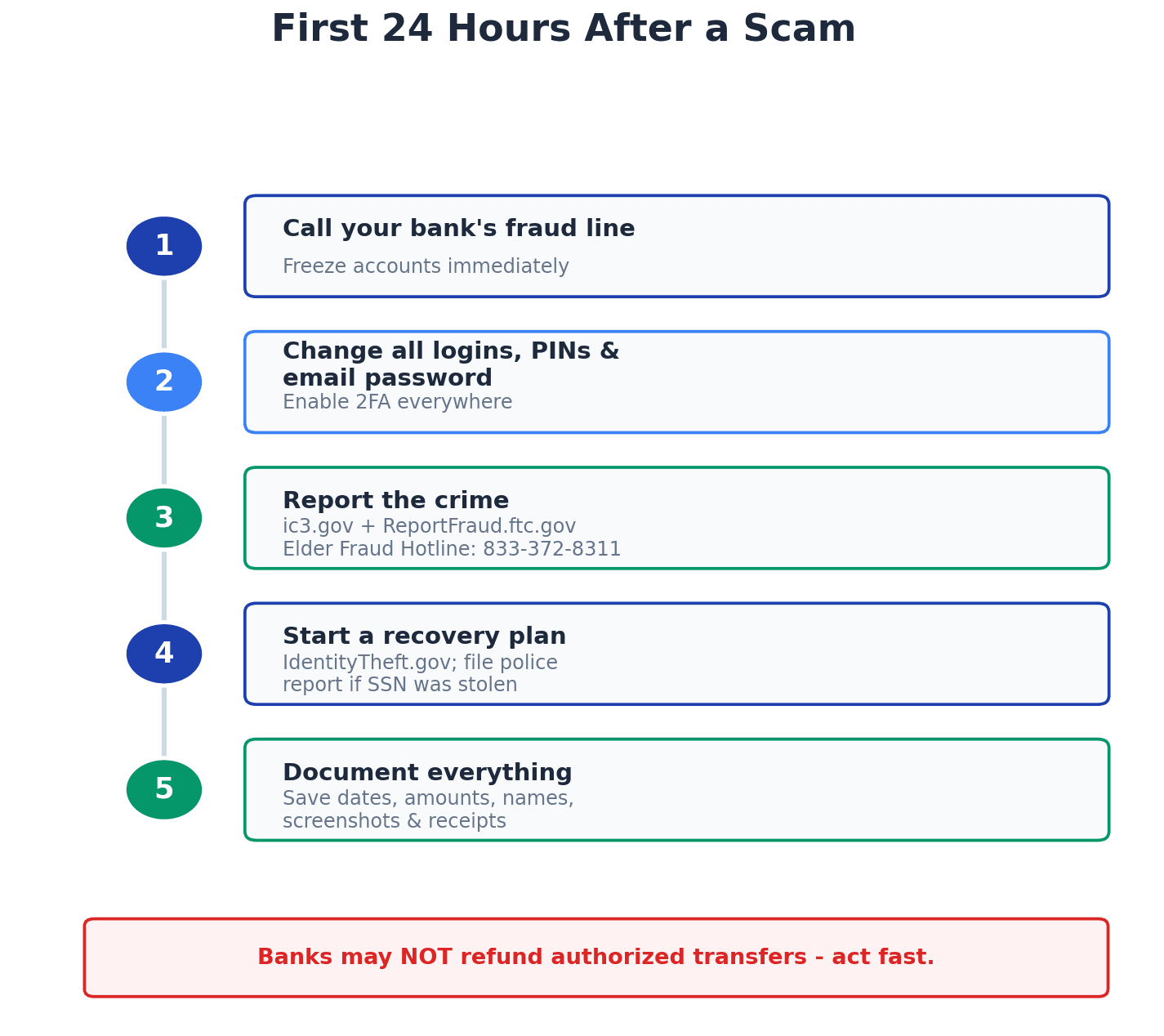
If It Already Happened: The First-24-Hours Recovery Checklist
If you've been hit, breathe. Speed matters more than shame, and shame is exactly what keeps people from acting. Here's the first-24-hours playbook.
- Call your bank's fraud line immediately and freeze the affected accounts. The faster you move, the better the (slim) odds of clawing back a transfer.
- Change every credential — banking logins, PINs, and especially your email password — and turn on 2FA if it wasn't already.
- Report it. File with the FBI at ic3.gov and the FTC at ReportFraud.ftc.gov. For an older victim, call the DOJ National Elder Fraud Hotline at 833-372-8311 (Mon–Fri, 10 a.m.–6 p.m. ET).
- Use IdentityTheft.gov for a personalized, step-by-step recovery plan, and file a local police report if your Social Security number was stolen.
- Document everything — screenshots, times, amounts, phone numbers. It's what investigators and your bank will need.
One hard truth so you're not blindsided: your bank may not refund you. Institutions often argue that authorized transfers — where you were tricked into sending the money yourself — aren't covered the way hacked transactions are, and wires are especially hard to reverse. Don't assume a safety net exists.
This is exactly why an emergency fund is the unsung hero of fraud defense. A cash buffer is what absorbs the blow and keeps your life running while you fight — possibly in vain — to recover the money. Rebuild from it, calmly, instead of spiraling into high-interest debt.
Your 2026 Fraud-Proofing Checklist
Here's the whole defense on one screen. Knowing how to protect yourself from AI scams comes down to these six moves — and you can finish every one of them in an afternoon, for free.
| Defense | Where | Cost | Time |
|---|---|---|---|
| Family safe word + callback rule | Group text | Free | 2 min |
| 2FA on bank, email, social | App settings | Free | 10 min |
| Transaction alerts on every charge | Bank app | Free | 5 min |
| Credit freeze at all 3 bureaus | Bureau websites | Free | 15 min |
| ACH block / "post no checks" | Call your bank | Free–low | 1 call |
| Saved-number callback habit | Your routine | Free | 0 |
Pin it. Do it this weekend. Then check on the people you love and walk them through the same list.
The thesis I opened with stands: in 2026, AI scams have made fraud defense inseparable from personal finance. Your savings rate, your index funds, your years of discipline — all of it is only as secure as the weakest phone call you'll answer this year. The good news is that the most effective defenses are also the cheapest. A free safe word beats a $40-billion fraud economy, one call at a time.
If you set up your family safe word after reading this, or if you're recovering from a scam and want a sounding board, email me at dennis.vymer@myfinancialfreedomtracker.com. I read every reply.
Build the wealth. Then build the wall around it.
Frequently asked questions
- What is a family safe word?
- A family safe word is a pre-agreed, un-Googleable word or phrase your family uses to verify identity on any call that asks for money. An AI voice clone can only say what a scammer types — it cannot know a secret that was never posted online. Pair it with a callback rule: hang up and call the person back on the number already saved in your phone before any money moves.
- Can banks refund money lost to a scam transfer?
- Often not. Banks frequently argue that authorized transfers — where you were tricked into sending the money yourself — aren't covered the way hacked, unauthorized transactions are, and wire transfers are especially hard to reverse. Call your bank's fraud line immediately anyway: speed improves the slim odds of clawing money back, and an emergency fund is what absorbs the blow if recovery fails.
- What should I do in the first 24 hours after an AI scam?
- Call your bank's fraud line and freeze the affected accounts, change every credential and turn on two-factor authentication, report the scam to the FBI at ic3.gov and the FTC at ReportFraud.ftc.gov, start a personalized recovery plan at IdentityTheft.gov, and document everything — screenshots, times, amounts, and phone numbers.
- How do I protect aging parents from AI voice-cloning scams?
- Set up a shared family safe word with them, ask their bank about view-only or trusted-contact access so you can spot trouble without taking over their independence, and help them shrink their social-media footprint — public voicemail greetings and videos are voice-cloning fuel. The number of older adults losing more than $100,000 to impersonation scams jumped eight-fold between 2020 and 2024.
Stay Updated
Get notified about new articles and MFFT build-in-public updates.
Ready to Apply This?
Start tracking your finances today and put these tips into practice.
- Import bank statements in seconds
- AI-powered categorization
- Beautiful visualizations
- Set and track financial goals
Related posts
 Master Your Money
How to Stop Arguing About Money With Your Partner: Our Money Date Is Twenty Boring Minutes Because Nothing Is Left to Decide
Our monthly money date takes twenty minutes and it's deeply boring, and for years I thought that was because we're good at talking about money. It isn't. Half of couples avoid the conversation on purpose to keep the peace, and every article tells them to talk more. Here's the opposite case.
 Master Your Money
One Spouse Manages All the Finances in Our House. It's Me, and That's a Design Flaw.
In our house, one spouse manages all the finances, and it's me. I built the tool, I buy the ETF, I read the numbers out loud while my wife listens. That's a bus factor of one. Here's the 30-minute quarterly drill we run instead of a password folder, and why documents rot.
 Master Your Money
How to Calculate Net Worth (Formula + Worked Example)
Net worth is assets minus liabilities. What counts on each side, how to handle the house, pension and car, a worked example, and why monthly beats once.
 Master Your Money
How to Calculate Your FIRE Number (Formula + Examples)
Your FIRE number is annual retirement spending × 25, from the 4% rule. Three steps, a spending-to-target table, a worked example, and when 25× is wrong.
 Master Your Money
Job Hopping vs Staying in 2026: Both Camps Time the Market
Job hopping vs staying is market timing with a résumé: the switching premium hit a record low in January, then widened by July. I've made that mistake before.