Car Loan Interest Tax Deduction 2026: Worth ~$2,000

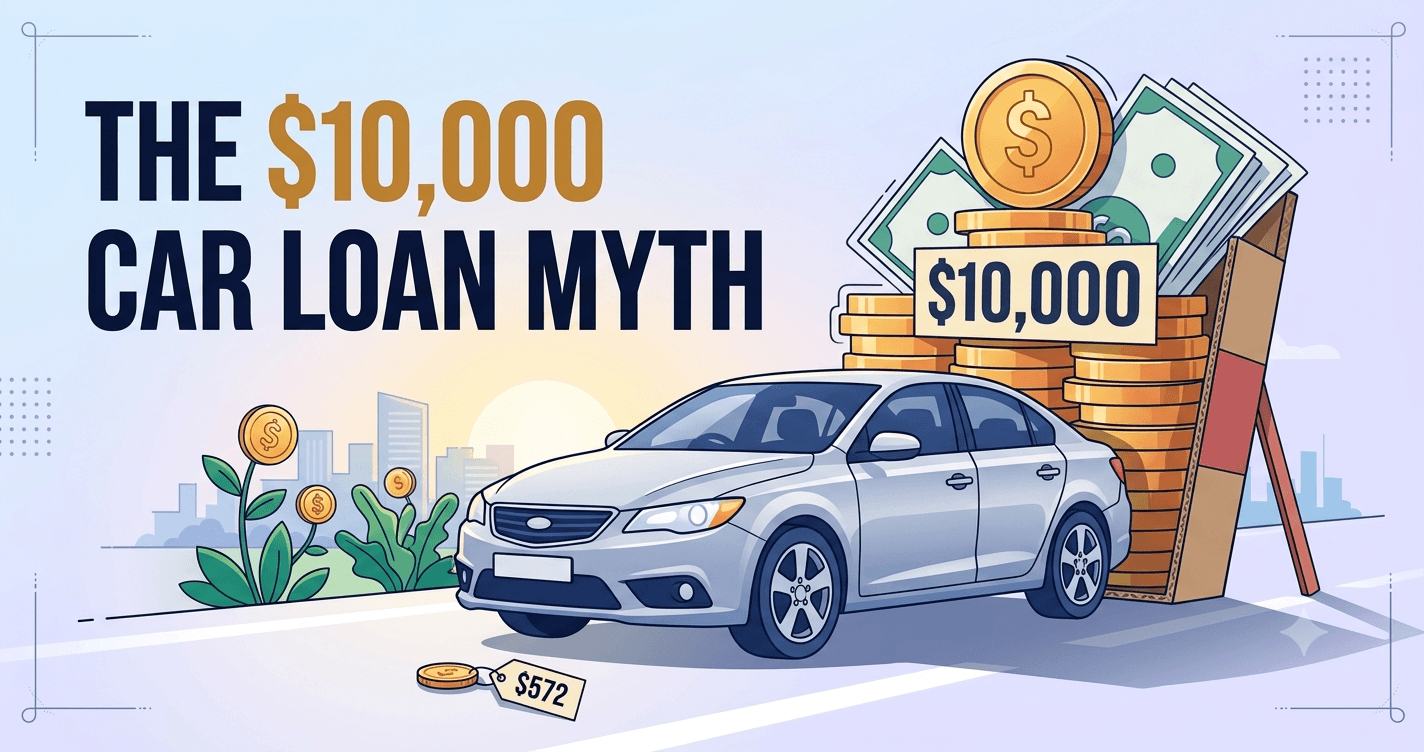
"The government basically pays your car interest now."
I heard some version of that three times in June. Once from a guy at a barbecue, once from a radio ad, and once from a salesman who was very sure I needed to be looking at an F-150.
So I did what I always do when a number sounds too generous. I opened a spreadsheet.
The car loan interest tax deduction 2026 everyone keeps texting me about is real. It's the "No Tax on Car Loan Interest" line out of the One Big Beautiful Bill, and yes, you really can knock some auto-loan interest off your taxable income now. But the way people talk about it, you'd think the Treasury mails you a $10,000 check for financing a truck.
It does not. Not remotely.
Here's what the spreadsheet actually said, and what I'd do with it.
The car loan interest tax deduction 2026, minus the marketing
The law is IRC §163(h)(4). Ugly name, simple idea: for tax years 2025 through 2028, you can deduct up to $10,000 of interest on a qualifying new-car loan each year.
That "$10,000" is where everyone's brain breaks.
It is not $10,000 back. It is not $10,000 a year of savings. It's the cap on how much interest you're allowed to deduct, and almost nobody pays anywhere near that much car interest in a year anyway. Hold that thought, because it's the whole ballgame.
Two things the headlines get wrong, and I want to be precise here because most articles are sloppy about it.
It's a deduction, not a credit. A credit comes straight off your tax bill. A deduction just lowers the income you get taxed on. So a dollar of deductible interest doesn't save you a dollar. It saves you a dollar times your tax bracket. At 22%, a dollar of interest is worth 22 cents to you. One dollar of headline, 22 cents of reality. That gap is the whole story.
It does not lower your AGI. This one trips up even the tax blogs. You can take this deduction on top of the standard deduction, so you do not have to itemize, which is genuinely nice. But it reduces your taxable income, not your adjusted gross income. It won't quietly slide you under some other income cutoff or change which other tax breaks you qualify for. It's a smaller, narrower lever than the loose "above-the-line" label makes it sound.
If you read my take on the no tax on overtime deduction, this is its sibling. Another OBBBA car loan interest deduction that lives on the new Schedule 1-A and sounds bigger than it actually spends.
So, is car loan interest tax deductible in 2026? Yes. Is it the windfall the name promises? Keep reading.
Do you even qualify? The gates
Before any of the math matters, your car and your loan have to clear a fence. Miss one rail and your deduction is exactly zero.
- New only. The original use has to start with you. Used cars are out. Leases are out too, because there's no loan and no ownership.
- Final assembly in the United States. Not "American brand." Final assembly, actual plant, on US soil. A Toyota built in Kentucky can qualify; a Chevy built in Mexico might not.
- Loan originated after December 31, 2024, and secured by a first lien on the car itself. Bought it with a HELOC or a personal loan? That's not a first lien on the vehicle, so it doesn't count.
- Mostly personal use. You have to expect more than half personal use. Your commute counts as personal. Business entities can't claim it.
- The VIN goes on your return every single year you claim it. No VIN, no deduction.
The vehicle itself can be a car, SUV, van, pickup, even a motorcycle, as long as it comes in under 14,000 pounds. Most of what's in a normal driveway clears that easily.
That US-assembly gate is the one that catches the most people. Roughly half of new vehicles sold here are imports, and about 80% of cars priced under $30,000 are built abroad. So the affordable end of the lot, where plenty of us shop, mostly fails the test. The cheaper the car, the likelier it doesn't qualify, which, stacked on top of what tariffs are already doing to household budgets and sticker prices, is its own kind of dark joke.
One myth I want to kill: the first digit of your VIN is not proof of anything. People will tell you "1, 4 or 5 means American, so you're fine." It's a hint, not an answer. Go to the free NHTSA VIN decoder and read the plant-of-manufacture field, or check the "Final Assembly Point" printed on the window sticker (the Monroney label). That's the number that holds up if the IRS ever asks.
The car loan interest deduction income limit
There's also a ceiling on who gets it, and it's steeper than most people expect.
The deduction starts phasing out once your modified AGI crosses $100,000 single or $200,000 married filing jointly. For every $1,000 you go over, your $10,000 cap drops by $200. Run the arithmetic and it's fully gone at $150,000 single / $250,000 joint.
Quick example. Single filer at $130,000 MAGI: you're $30,000 over the line, so your cap falls by $200 × 30 = $6,000, leaving $4,000 of deductible interest. Married at $230,000? Same $30,000 over, same $6,000 haircut, same $4,000 left. Hit $150,000 single or $250,000 joint and you're at zero.
The other end of the income scale gets nothing for a different reason. Anyone whose income already sits under the standard deduction ($15,750 single, $31,500 for a couple in 2025) owes little or no federal income tax, so an extra deduction saves them roughly nothing. You can't deduct your way below zero.
Put those two ends together and the sweet spot Congress actually aimed at is middle-income buyers. High earners get phased out. Low earners get no benefit. This was never the "everyone with a car payment" break it's been sold as.
What the car loan interest tax deduction 2026 actually saves you
Okay. The spreadsheet.
I ran the current average new-car loan through it. Per Experian, that's $42,332 financed at 6.56% APR. The real average term is about 69 months; I used a clean 72 months so the years line up neatly. That gives a $712.81 monthly payment and $8,990 of total interest over the life of the loan.
Now the part nobody prints on a billboard: car interest is front-loaded. You pay most of it early, when the balance is fat, and almost none at the end. So the deduction is biggest in year one and shrinks every year after that.
 Data: Experian (average new-car loan $42,332 at 6.56% APR, modeled over 72 months).
Year one is about $2,600 of interest. That's the single biggest year of the entire loan, and it still isn't even close to the $10,000 cap. Deduct that $2,600 at a 22% bracket and you save about $572.
Then it slides. Year two, around $483. By year six, sixty-five bucks. Add up all six years and the deduction is worth roughly $1,978 across the whole loan. At 22%. Total. Not per year.
Your bracket nudges the number, but not as much as you'd hope:
 Data: IRS 2025 tax brackets; ITEP.
This isn't just my spreadsheet talking. CNBC ran a pricier scenario, a $48,000 car at 9.5% over 72 months, and got about $3,800 of first-year interest, worth under $750 in tax savings at a 15 to 20% rate. Bigger loan, higher rate, and it still can't sniff the headline. The Anderson Economic Group did the realistic lifetime version for most eligible buyers and landed between $300 and about $1,000 over the loan. My $1,978 sits at the optimistic edge of that, and I'll happily take it. But it's a nice-dinners-out budget, not a down payment.
Why chasing it is a trap
Here's where I get a little worked up.
A tax break on a thing is never a good reason to buy the thing. And a new car is the single most reliable way I know to light money on fire.
Look at what the car costs you next to what the deduction gives back:
 Data: Cox/KBB average new-car price $50,326; iSeeCars first-year depreciation; Experian.
The average new car now sells for $50,326. It sheds around 20% of that in the first year alone. Call it $10,065 gone before the first oil change. (Estimates vary. Carfax says closer to 12.5%, or $6,291; Edmunds says 23.5%, or $11,827. Pick your poison.) That first-year depreciation is roughly five times the entire six-year deduction. The total interest you'll hand the bank is about four and a half times it.
So when the salesman leaned on "and the interest is a write-off now," what he was really dangling was that $572 of year-one tax relief on a machine that would quietly drop $10,000 in value while I drove it off the lot. The write-off covers about three weeks of that depreciation.
That's the trap, and dealers know it. The deduction is bait that gets you comfortable with a bigger payment and a longer term, and a longer term is exactly how people end up underwater, owing more than the car is worth. I wrote a whole piece on the seven-year car loan debt trap, because stretching the loan is the real danger here, far more than a small deduction is a gift.
How I'd play it
My rule fits on a sticky note. Claim it, don't chase it, invest the difference.
If you were already buying a new, US-assembled car inside the income window, you needed it and the payment genuinely fits your budget, then take every dollar. It sits on Schedule 1-A whether you itemize or not. Leaving $572 on the table would be silly. This part really is free money.
But if the tax break is doing any of the convincing, walk away.
I'll be honest about my own bias here. I drive a used VW Golf with no payment, and it's not because I'm allergic to nice cars. It's that I'd rather that $712 go somewhere it actually grows. I ran the barbecue guy's F-150 through my sheet later that night, half out of stubbornness, and the answer was the same as always: the same $712.81 a month, dropped into a boring index fund on autoinvest instead of a lender's pocket, is the thing that moves the needle when I update my net worth by hand at the end of the month. Not the deduction. The redirected payment. If you want the least glamorous, most effective version of that, it's all in investing made simple.
And in a year where everyday costs are already squeezing budgets, talking yourself into a $50,000 depreciating asset to capture a $572 tax break is the kind of math that feels clever and ends up expensive.
A tax break on a depreciating asset is still a terrible reason to buy the asset. Read that one twice.
How to claim it without screwing it up
Say you qualify and you're buying anyway. Good. Don't fumble the easy part:
- Check assembly the right way. Run the VIN through the NHTSA decoder, or read the Final Assembly Point on the window sticker. Do this before you sign, not at tax time when it's too late to matter.
- Get your interest number from the lender. They have to give you a statement of interest paid once it hits $600 or more. Heads-up for this filing season: the formal Form 1098-VLI is still only a draft, and the IRS is letting lenders report through an online account or a plain year-end statement instead. So don't sit around waiting for one specific form. An interest statement is an interest statement.
- Claim it on Schedule 1-A, Part IV ("No Tax on Car Loan Interest"), and put the VIN on the return. Forget the VIN and the whole deduction gets thrown out.
- Keep the paperwork. The loan agreement proves your origination date and the first lien; the interest statements prove the number.
A few quick ones I keep getting asked:
- Leased the car? No deduction. You don't own it.
- Bought used? No deduction, even if the loan itself is brand new.
- Refinanced? It can still qualify, but only if the new loan is a first lien on the same car, and only up to the balance you refinanced. Cash-out on top of that doesn't count.
- Borrowed from a parent? Related-party loans are excluded.
- US-built EV? Same rules as everything else. Assembly and income are what matter, not the drivetrain.
One more thing before you sign
The uptake numbers tell the honest story. The government expected around 4 million people to use this, and the whole thing is projected to cost about $31 billion. As of April, roughly 1.2 million returns had actually claimed it. Some of that gap is just newness. A lot of it is people finding out their car was built in the wrong country, or their loan was a month too old, or the payoff simply wasn't worth the paperwork they thought it would be.
Don't let a nickname write a $50,000 check on your behalf.
If you were buying the qualifying car anyway, the car loan interest tax deduction 2026 is a small, real rebate. Grab it, file it, move on with your day. If you weren't, no headline should talk you into a payment. Run your own numbers first. Mine live in a spreadsheet and a net-worth tracker, and yours can too.
Then go buy the sensible used car and invest the difference.
Questions, or want to poke holes in my math? I read everything at dennis.vymer@myfinancialfreedomtracker.com.
Stay Updated
Get notified about new articles and MFFT build-in-public updates.
Ready to Apply This?
Start tracking your finances today and put these tips into practice.
- Import bank statements in seconds
- AI-powered categorization
- Beautiful visualizations
- Set and track financial goals
Related posts
 Master Your Money
Your Job Is the Biggest Position in Your Portfolio. I Diversified Everything Except the Thing That Pays for It.
My world ETF is spread across an entire developed-market index, and every euro that buys it comes from one employer, one country, one currency. Your job is the biggest undiversified position you own. Here is what actually reduces the risk, and why seven income streams does not.
 Master Your Money
How to Stop Arguing About Money With Your Partner: Our Money Date Is Twenty Boring Minutes Because Nothing Is Left to Decide
Our monthly money date takes twenty minutes and it's deeply boring, and for years I thought that was because we're good at talking about money. It isn't. Half of couples avoid the conversation on purpose to keep the peace, and every article tells them to talk more. Here's the opposite case.
 Master Your Money
One Spouse Manages All the Finances in Our House. It's Me, and That's a Design Flaw.
In our house, one spouse manages all the finances, and it's me. I built the tool, I buy the ETF, I read the numbers out loud while my wife listens. That's a bus factor of one. Here's the 30-minute quarterly drill we run instead of a password folder, and why documents rot.
 Master Your Money
How to Calculate Net Worth (Formula + Worked Example)
Net worth is assets minus liabilities. What counts on each side, how to handle the house, pension and car, a worked example, and why monthly beats once.
 Master Your Money
How to Calculate Your FIRE Number (Formula + Examples)
Your FIRE number is annual retirement spending × 25, from the 4% rule. Three steps, a spending-to-target table, a worked example, and when 25× is wrong.